
The Mystery of Water and Light
If you fill a clear glass with water straight from your kitchen tap, it appears completely transparent and colorless. Yet, when you look at a photograph of the Caribbean Sea or stand on a beach looking out at the open ocean, the water is a breathtaking shade of deep sapphire blue, cyan, or turquoise.
Why does water seem to change color depending on how much of it you are looking at? The answer lies in the fascinating physics of electromagnetic radiation, molecular absorption, and light scattering.
The True Nature of Sunlight
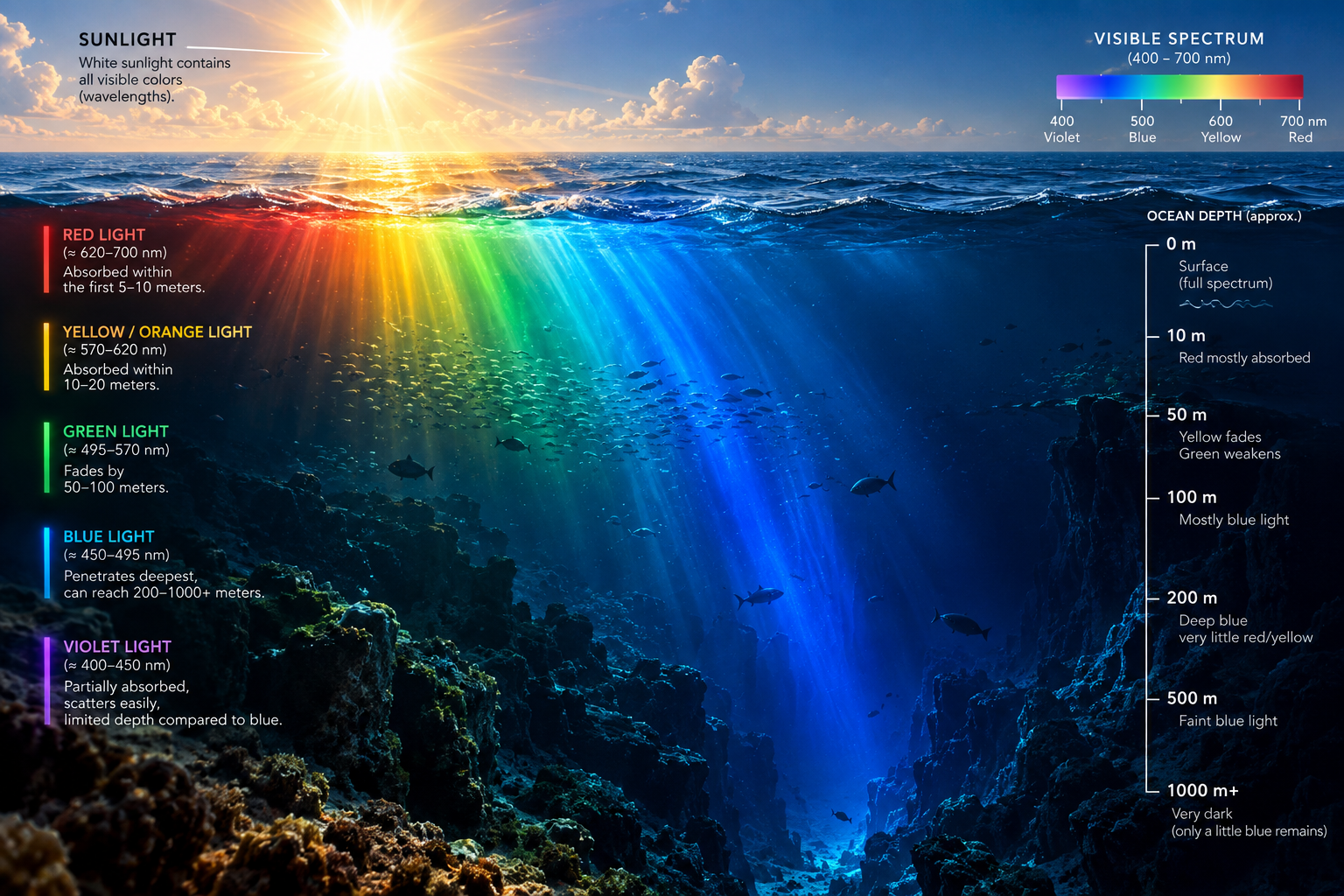
To understand the color of the ocean, we first need to look at sunlight. Sunlight looks white or golden to our eyes, but it is actually made up of all the colors of the visible spectrum combined. Each color corresponds to a specific wavelength of light:
- Red and Orange Light: Longest visible wavelengths (approx. 620 to 750 nanometers) with the lowest energy per photon.
- Yellow and Green Light: Medium wavelengths (approx. 500 to 590 nanometers).
- Blue and Violet Light: Shortest visible wavelengths (approx. 380 to 495 nanometers) with the highest energy per photon.
How Water Molecules Absorb Color
Water is not completely inert to light. Liquid water molecules (H_2O) contain chemical bonds that naturally vibrate. When sunlight strikes the surface of the ocean and penetrates into the depths, water molecules act as selective absorption filters:
- Red Light Absorption: Water molecules absorb red, orange, and infrared light extremely efficiently within the first 10 to 15 meters (30 to 50 feet). The energy from these longer wavelengths is converted into subtle molecular kinetic heat.
- Yellow and Green Absorption: Yellow and green wavelengths penetrate deeper, reaching depths between 30 and 50 meters before they too are fully absorbed.
- Blue Light Survival: Blue wavelengths possess higher energy and are absorbed much less readily by water molecules. Blue light can penetrate up to 100 to 200 meters (330 to 650 feet) into crystal-clear ocean water.
Scattering: How Blue Light Reaches Our Eyes
Absorption alone is not enough to make the ocean look blue. If water only absorbed light, the ocean would simply look black. We see blue because of scattering.
As blue light travels through deep water, it collides with water molecules and tiny suspended particles. These collisions bounce the blue light rays in all directions-a phenomenon known as Rayleigh scattering. A significant portion of this scattered blue light travels back up toward the surface and exits the water, entering our eyes.
Why Does Deep Water Turn Completely Black?
Oceanographers divide the ocean into distinct vertical zones based on the penetration of sunlight:
- The Epipelagic Zone (Sunlight Zone: 0 to 200m): Sunlight is abundant enough to support photosynthesis by phytoplankton and marine plants. This is where rich shades of cyan and blue exist.
- The Mesopelagic Zone (Twilight Zone: 200 to 1,000m): Only the faintest trace of blue-violet light survives. Photosynthesis is impossible here, and colors vanish into an eerie twilight.
- The Bathypelagic Zone (Midnight Zone: 1,000m and deeper): Total, absolute darkness. Zero solar photons can penetrate past 1,000 meters. The only light generated at these crushing depths comes from bioluminescent creatures such as anglerfish and lanternfish.
Why Are Coastal Waters Sometimes Green or Brown?
Not all oceans look bright blue. In coastal areas, rivers wash soil and organic matter (tannins) into the sea, while shallow waters foster huge blooms of microscopic algae called phytoplankton.
Phytoplankton contain green chlorophyll to capture sunlight for photosynthesis. Chlorophyll strongly absorbs blue and red light while reflecting green light. When high concentrations of phytoplankton are present, coastal waters shift from royal blue to rich emerald green.
Summary Comparison Table
| Color Wavelength | Wavelength Range (nm) | Penetration Depth | Primary Fate in Pure Seawater |
|---|---|---|---|
| Red / Infrared | 650 - 750 nm | 0 - 15 meters | Rapidly absorbed; converted to thermal energy |
| Yellow / Orange | 580 - 620 nm | 15 - 35 meters | Moderately absorbed within shallow layers |
| Green | 500 - 560 nm | 35 - 75 meters | Reflected by chlorophyll in marine plants |
| Blue / Violet | 400 - 480 nm | Up to 200 meters | Scattered backward to create the ocean's blue color |
Key Takeaways for Students
- A single glass of water looks clear because there are not enough water molecules to absorb noticeable amounts of red light.
- In large bodies of water, red light is absorbed first, leaving blue light to penetrate deep and scatter back to our eyes.
- Below 1,000 meters (the Midnight Zone), sunlight is 100% extinguished, plunging the deep abyss into permanent darkness.
- Green ocean water indicates abundant microscopic life (phytoplankton) using chlorophyll to produce oxygen.
Frequently Asked Questions (FAQ)
Q1: Is the ocean blue because it reflects the blue sky?
A: No! While the surface of still water can reflect the sky like a mirror, the ocean's deep blue color is primarily caused by water molecules absorbing red light and scattering blue light.
Q2: What color do red fish look like in deep water?
A: Below 20 meters, where all red light has been absorbed, a bright red fish appears completely black or charcoal gray, providing natural camouflage against predators.
Q3: Why is swimming pool water blue even indoors?
A: Even under indoor white lights, a large volume of clean pool water absorbs red light and scatters blue light, proving the effect is independent of the sky.
Classroom Experiment: How to Prove Water Absorbs Red Light at Home
You do not need a submarine to observe the absorption of light in water. You can demonstrate this right in your school laboratory or kitchen with a simple, safe experiment:
- Take a clear, long transparent tube (such as a 1-meter clear acrylic pipe or several tall clear vases placed in a row) filled with clean tap water.
- In a dark room, shine a red laser pointer or a red LED flashlight through the length of the tube, and then shine a blue or green laser pointer through the exact same column of water.
- You will immediately notice that the red beam fades and dims significantly faster over distance compared to the bright, piercing green and blue beams.
This hands-on demonstration proves that water molecules selectively extract energy from longer, reddish wavelengths while allowing short, high-energy blue photons to travel through unimpeded.
Vocabulary Bank for Science Students
- Electromagnetic Spectrum: The full range of all types of light radiation, from radio waves to gamma rays.
- Rayleigh Scattering: The dispersion of light by particles or molecules much smaller than the wavelength of the light.
- Photons: Elementary particles representing a quantum of light energy.
- Phytoplankton: Microscopic marine organisms that use chlorophyll to perform photosynthesis and produce over 50% of the world's oxygen.