
The Solid That Is 99.8% Air
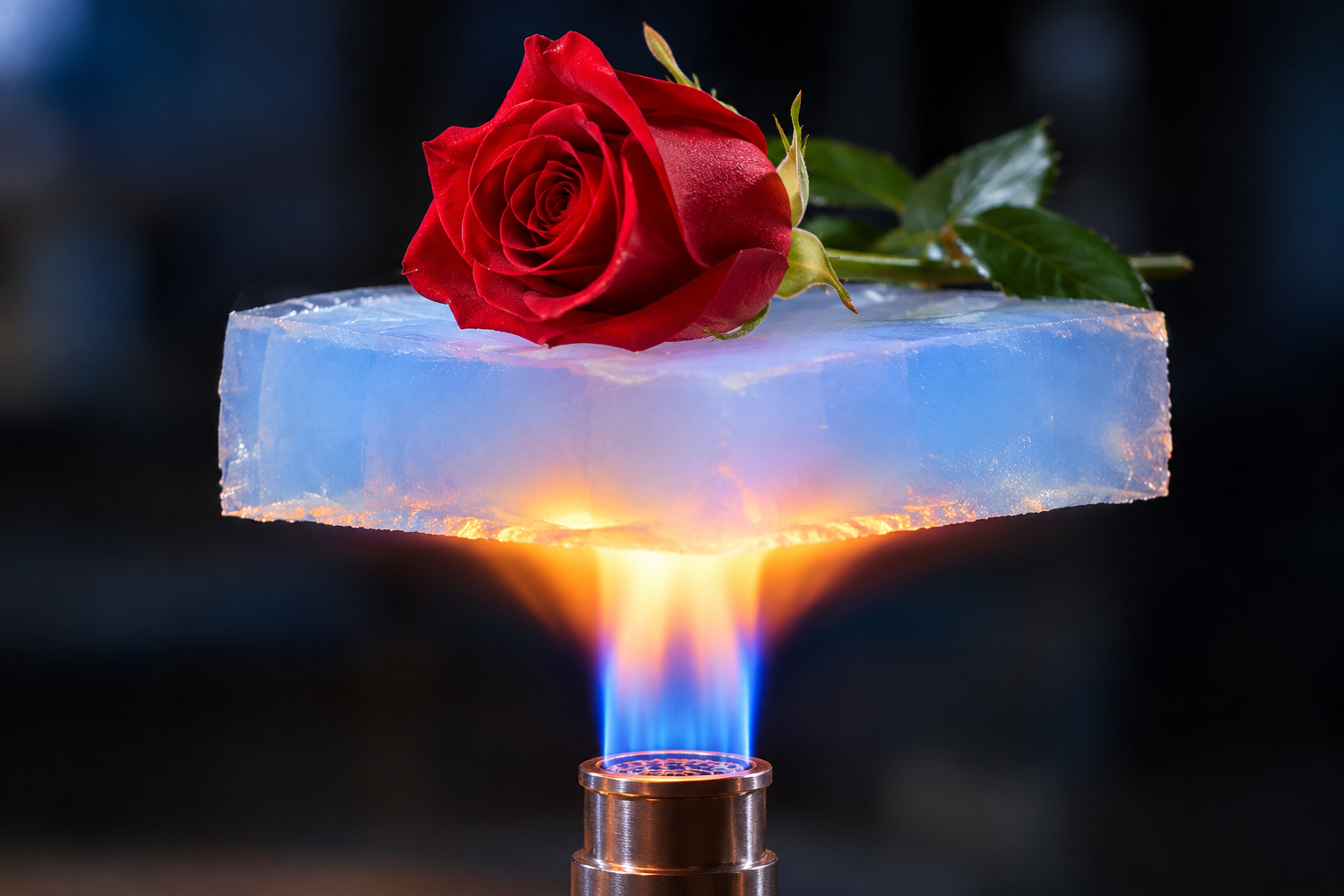
Hold a block of this substance in your hand, and you can barely feel its presence. It looks like a captured cloud, a semi-transparent ghostly phantom hovering between your fingers, casting a pale sky-blue shadow. When you drop it onto a hard table, it rings with the hollow, metallic clatter of ceramic glass. If you hold a 1,200°C blowtorch flame against one side of a one-inch slab and rest an unburned red rose or a block of chocolate directly on the other side, the flower petals will not singe and the chocolate will not melt.
This remarkable material is Aerogel, nicknamed "Frozen Smoke" or "Solid Air." Holding over 15 entries in the Guinness Book of World Records—including the world's lowest-density solid and the best thermal insulator known to science—aerogel is one of humanity's greatest material science triumphs. It is composed of up to 99.8% empty air, yet a small brick weighing a few grams can support the weight of a 2.5-kilogram bowling ball!
The 1931 Bet: Removing Liquid Without Shrinking
Aerogel was born not in a billion-dollar aerospace lab, but out of a friendly scientific bet between two American chemists, Samuel Stephens Kistler and Charles Learned, in 1931. Kistler bet that he could take a jar of ordinary household jelly and remove all the liquid water inside without causing the jelly structure to shrink or collapse.
When you let wet gelatin or silica gel air-dry on a counter, the liquid evaporates. As the water level drops, the surface tension of the receding liquid acts like a powerful hydraulic vice, pulling microscopic pores together and collapsing the internal solid framework into a shriveled, brittle crystal.
The Feynman Analogy: The Scaffolding in the Pool
To understand how Kistler won the bet, picture a massive stadium scaffolding structure erected inside an Olympic swimming pool. If you drain the water rapidly with a roaring drain pump, the violent suction and surface waves will knock the fragile scaffolding down.
To avoid surface tension entirely, Kistler used a process called Supercritical Drying. He placed the wet silica gel inside a high-pressure heating chamber (an autoclave) and raised the temperature and pressure above the fluid's critical point. Above the critical point, the boundary between liquid and gas ceases to exist; the liquid turns into a supercritical fluid that can flow out of the gel pores as freely as air, with zero surface tension! When the pressure was released, the liquid was completely gone, leaving behind an intact, porous 3D skeleton of silicon dioxide containing 99.8% empty space.
Why Is Aerogel the Ultimate Thermal Insulator?
Heat normally travels through materials via three classical thermodynamic mechanisms: conduction, convection, and radiation. Aerogel is scientifically engineered to practically eliminate all three simultaneously:
- Eliminating Solid Conduction: Silicon dioxide (silica) is naturally a poor heat conductor. In aerogel, silica makes up less than 0.2% to 1% of total volume, meaning heat has almost zero physical solid bridges to travel through.
- Eliminating Gas Convection (The Knudsen Effect): The average distance an air molecule travels before bouncing into another air molecule is about 70 nanometers (known as the Mean Free Path). The microscopic pores inside silica aerogel are smaller than that—averaging only 20 to 40 nanometers across! Air molecules trapped inside the pores literally cannot bump into one another; they can only bounce off the pore walls, freezing thermal convective airflow dead in its tracks.
- Eliminating Infrared Radiation: Carbon-doped or metal-oxide aerogels scatter and absorb infrared heat radiation, preventing thermal photons from penetrating the barrier.
Comparison: Aerogel vs Common Thermal Insulating Materials
| Material | Density (kg/m³) | Thermal Conductivity (W/m·K) | Primary Advantages & Disadvantages |
|---|---|---|---|
| Silica Aerogel | 1 to 100 kg/m³ | 0.013 to 0.017 W/m·K | World's best thermal insulation, fireproof, ultralight; brittle and expensive |
| Polyurethane Foam | 30 to 40 kg/m³ | 0.022 to 0.028 W/m·K | Inexpensive, easy to apply; flammable and degrades under UV exposure |
| Fiberglass Batt Insulation | 10 to 30 kg/m³ | 0.038 to 0.045 W/m·K | Low cost, common in housing; irritates skin/lungs and vulnerable to moisture |
| Mineral Rockwool | 40 to 100 kg/m³ | 0.035 to 0.040 W/m·K | Fire resistant, sound absorbing; heavy and prone to settling over time |
| Still Air (Ideal Gas) | 1.2 kg/m³ | 0.026 W/m·K | Theoretical baseline; impossible to isolate in bulk without natural convection currents |
Why Is Aerogel Sky-Blue? (Rayleigh Scattering)
When you look at a silica aerogel block against a dark background, it radiates a stunning, translucent sky-blue color. Yet silica glass is completely colorless, and air is completely invisible. Why does aerogel turn blue?
The answer is the exact same optical physics that makes Earth's daytime sky blue: Rayleigh Scattering! The microscopic silica nanoparticles forming the aerogel lattice have dimensions between 2 to 5 nanometers—much smaller than the wavelength of visible light (400 to 700 nm). When white light passes through the aerogel, the shorter blue wavelengths scatter violently off the nanoparticles in all directions, illuminating the block in pale azure blue, while longer red wavelengths pass straight through!
NASA's Stardust Mission: Catching Comet Dust at 20,000 km/h
In 1999, NASA launched the Stardust Spacecraft to intercept Comet Wild 2 in deep space and return physical samples of pristine cometary dust to Earth. The challenge seemed impossible: comet dust grains were hurtling past the spacecraft at speeds exceeding 6 kilometers per second (over 21,000 km/h)—six times faster than a military rifle bullet!
If the dust particles hit a metal plate, they would vaporize instantly on impact. Instead, NASA engineers equipped Stardust with an aerogel collector grid resembling a tennis racket filled with blocks of transparent aerogel. When the microscopic comet grains smashed into the aerogel, the porous silica sponge gently absorbed their kinetic energy over a deceleration track hundreds of times their diameter, bringing the grains to a smooth halt completely intact. Stardust safely returned millions of pristine organic cometary molecules to Earth in 2006!
Vocabulary Bank for Materials Science Students
- Aerogel: A synthetic porous ultralight material derived from a gel, in which the liquid component for the gel has been replaced with a gas without significant collapse of the gel network.
- Supercritical Drying: A process to remove liquid from a porous material without damaging the solid structure, performed above the thermodynamic critical point of the solvent.
- Knudsen Effect: The reduction in thermal conductivity that occurs in gases when the size of the containing pores is comparable to or smaller than the mean free path of the gas molecules.
- Mean Free Path: The average distance traveled by a moving particle (such as an atom or molecule) between successive impacts with other particles.
- Rayleigh Scattering: The scattering of electromagnetic radiation by particles much smaller than the wavelength of the radiation, inversely proportional to the fourth power of the wavelength.
- Thermal Conductivity: A measure of a material's intrinsic ability to conduct heat, expressed in Watts per meter-Kelvin (W/m·K).
Frequently Asked Questions (FAQ)
Q1: Why is aerogel so brittle if it can support bowling balls?
A: Aerogel exhibits phenomenal compressive strength: its uniform nanoscale silica archways can distribute downward compressive pressure evenly across millions of tiny pillars. However, it has very poor tensile and shear strength: if you bend, twist, or strike it with a hammer, the brittle silica bonds snap easily like glass.
Q2: Is aerogel used on Mars rovers?
A: Yes! NASA's Mars Exploration Rovers (Sojourner, Spirit, Opportunity, Curiosity, and Perseverance) all feature silica aerogel thermal blankets surrounding their electronics bays. Nighttime temperatures on Mars plummet to -100°C (-148°F); aerogel keeps sensitive lithium batteries and computing chips at room temperature using minimal electric heaters.
Q3: Can you make aerogel out of materials other than silica?
A: Absolutely! Scientists have synthesized carbon aerogels (used in supercapacitors and batteries), graphene aerogels (the lightest material ever created, 7 times lighter than air, resting atop delicate flower petals), and cellulose/chitosan bio-aerogels made from recycled cardboard or shrimp shells for oil-spill cleanup.
Q4: Why don't we insulate all houses with aerogel?
A: Cost and manufacturing scale. High-pressure autoclaves and supercritical carbon dioxide drying cycles make aerogel production expensive compared to fiberglass batts or rockwool. However, flexible aerogel composite blankets (aerogel infused into polyester or fiberglass mats) are increasingly used in subsea pipelines, skyscrapers, and extreme Arctic apparel.