
The Greatest Navigators on Earth
Every autumn, a tiny songbird called the Northern Wheatear, weighing no more than an empty soda can (about 25 grams), takes flight from the rocky tundra of Alaska. It embarks on an epic, non-stop migratory journey spanning over 14,000 kilometers (nearly 9,000 miles), crossing open oceans, vast deserts, and rugged mountain ranges, finally landing on the exact same acacia tree in sub-Saharan Africa. Months later, it flies all the way back to the exact same breeding territory in Alaska.
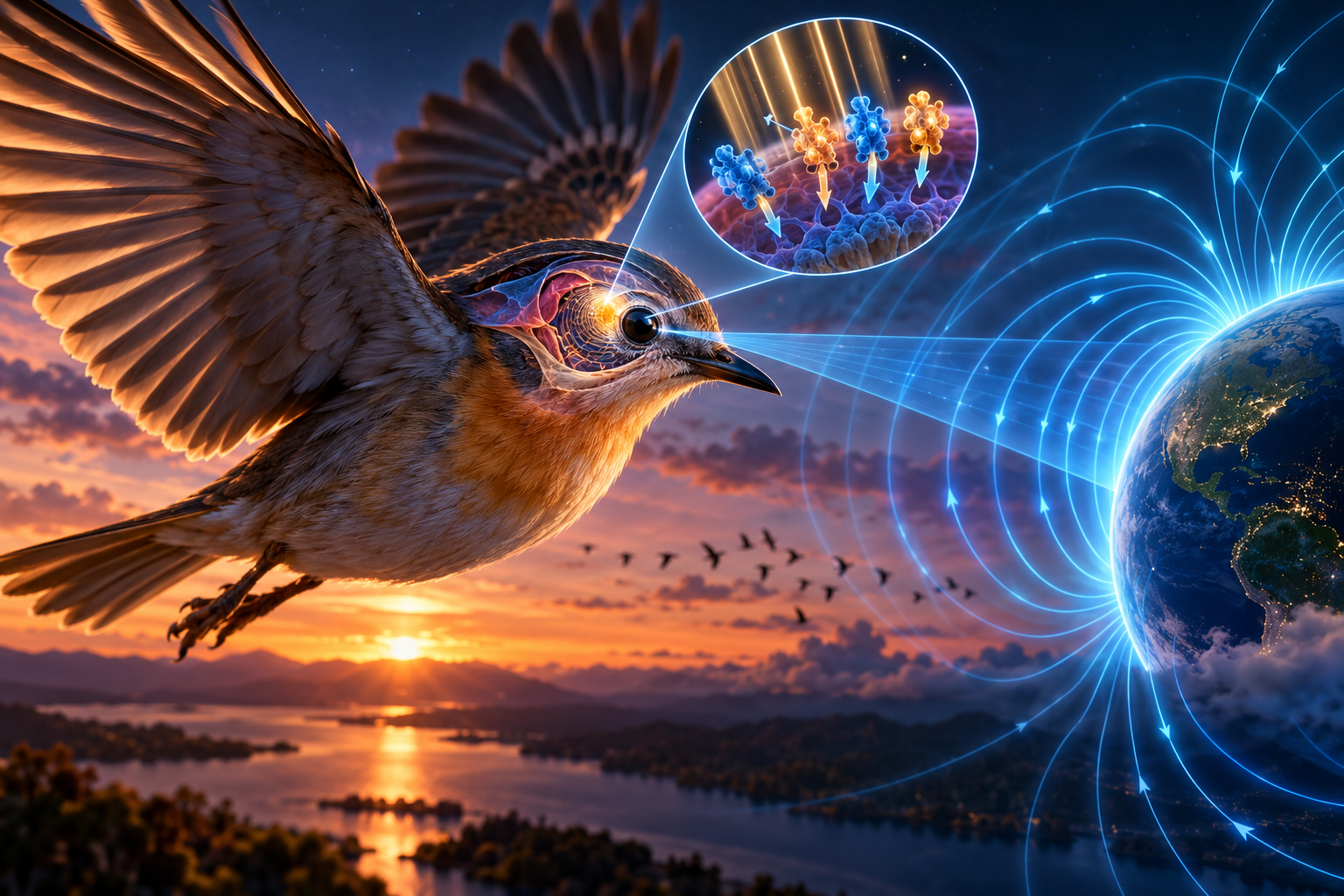
How do migratory birds navigate across continents with pinpoint millimeter accuracy? For decades, biologists thought birds relied strictly on visual landmarks, olfactory scents, the position of the Sun, or the rotation of the night stars. While these cues help, blindfolded birds flying under heavy overcast clouds at night can still navigate flawlessly across oceans. The shocking answer comes from the cutting-edge frontier where quantum mechanics meets evolutionary biology: migratory birds can literally see Earth's invisible magnetic field lines using quantum entanglement inside their eyes!
The Feynman Analogy: The Quantum Compass in Your Eye
To understand how an animal senses a magnetic field that is thousands of times weaker than a common refrigerator magnet, consider Richard Feynman's way of explaining delicate quantum spin.
Imagine balancing two delicate spinning coins on a glass tabletop. Normally, the two coins spin independently. But suppose you connect their spin states through quantum mechanics so that their magnetic moments are intimately linked. If someone waves a faint magnetic wand near the room, the two spinning coins don't tip over from brute force—instead, the magnetic field subtly alters how fast they synchronize their spins before they settle on heads or tails.
Inside a bird's eye, evolution built this exact quantum device using a light-activated protein called Cryptochrome-4 (Cry4). Blue photons striking the bird's retina create an entangled pair of radical electrons whose chemical reaction rates are influenced by Earth's magnetic inclination, painting a transparent augmented-reality compass directly onto the bird's visual field!
The Radical Pair Mechanism: Step-by-Step Quantum Chemistry
How does quantum biology actually happen at room temperature inside living tissue? Biophysicists have mapped out the precise four-step Radical Pair Mechanism:
- Blue Light Activation: A photon of ambient blue light (around 450 nm wavelength) enters the bird's eye and strikes a light-absorbing molecule called Flavin Adenine Dinucleotide (FAD) nestled inside the Cryptochrome-4 protein.
- Electron Hopping Chain: The photon excites an electron inside FAD, pulling an electron from a nearby chain of four amino acids (tryptophans). This electron transfer creates two molecules with unpaired valence electrons: a Radical Pair [FAD•⁻ ... TrpH•⁺].
- Singlet vs Triplet Quantum States: Because the two unpaired electrons were born from the same bond, their quantum spins are initially entangled. The radical pair oscillates back and forth between two quantum states:
- Singlet State: Electron spins point in opposite directions (antiparallel, net spin 0).
- Triplet State: Electron spins point in the same direction (parallel, net spin 1).
- Earth's Magnetic Steering: Even though Earth's magnetic field is incredibly weak (only ~30 to 60 microteslas), it tilts the probability balance between the singlet and triplet states. Singlet and triplet states produce different downstream chemical signaling molecules, transmitting neural signals through the optic nerve to Cluster N, the specialized visual brain center for nocturnal migration!
Comparison: Human Navigational Tools vs Avian Magnetoreception
| Navigation Method | Operating Principle | Strengths & Weaknesses |
|---|---|---|
| Mechanical Needle Compass | Magnetic iron needle aligns with horizontal magnetic polarity (North vs South) | Simple and reliable, but susceptible to local metal interference and fails near magnetic poles |
| Satellite GPS Navigation | Triangulates microsecond radio time-delay signals from 24+ orbiting satellites | High millimeter accuracy, but requires complex satellite infrastructure and electrical battery power |
| Celestial Navigation (Stars / Sun) | Measures angle between horizon and Polaris or daytime solar azimuth | Immune to magnetic distortion, but completely useless under cloud cover, fog, or daytime overcast |
| Avian Quantum Magnetoreception | Quantum radical-pair spin states detect geomagnetic field inclination and intensity | Functions 24/7 across clouds and open oceans; light-dependent and requires blue photons to activate |
Inclination Compass: Seeing Angles Instead of Polarity
One of the most fascinating aspects of bird navigation is that birds do not use a "polarity compass" like humans do. A human handheld compass tells you which direction is magnetic North versus South.
Birds use an Inclination Compass. Earth's magnetic field lines do not simply run flat along the ground; they curve in three-dimensional space:
- At the Equator, magnetic field lines run parallel to the ground (0° inclination).
- At the Magnetic Poles, field lines plunge vertically straight down into the ground (90° inclination).
By detecting the precise angle at which the magnetic lines pierce the Earth's crust, a migratory bird instantly knows how far north or south it is relative to the equator! To the bird, this manifests not as a conscious mathematical angle, but as bright or dark patches overlaid onto its vision—a literal heads-up display built into nature.
The Tragic Threat of Urban Radiofrequency Smog
Because quantum radical pair navigation relies on ultra-fragile spin state oscillations, it has an unexpected Achilles' heel: electromagnetic radiofrequency (RF) background noise.
In 2014, a landmark study published in Nature by Henrik Mouritsen showed that low-level electromagnetic radiation emitted by ordinary household electronics, AM radio transmitters, and urban power lines completely disrupts birds' magnetic compasses. In laboratory testing, migratory European robins kept inside city centers lost their ability to orient toward migration routes. Only when cages were shielded in aluminum Faraday screens (blocking urban RF noise) did the birds immediately orient in the correct migratory direction!
Vocabulary Bank for Quantum Biology Students
- Magnetoreception: The sensory ability of an organism to detect a magnetic field, perceive its direction, intensity, or inclination.
- Cryptochrome (Cry4): A class of blue-light photoreceptor proteins found in plants and animals involved in circadian rhythms and avian quantum magnetoreception.
- Radical Pair: A short-lived pair of chemical radicals with unpaired electrons whose spins are entangled and oscillate between singlet and triplet configurations.
- Quantum Spin: An intrinsic form of angular momentum carried by elementary particles, composite particles, and atomic nuclei.
- Inclination Compass: A magnetic compass that determines latitude by measuring the vertical angle at which magnetic field lines intersect Earth's surface.
- Cluster N: A specialized forebrain region in nocturnal migratory songbirds that processes visual and magnetic navigational signals.
Frequently Asked Questions (FAQ)
Q1: Why do birds need blue light to navigate magnetically?
A: The chemical activation of the Cryptochrome-4 protein requires an incoming photon with enough energy to trigger electron transfer between tryptophan amino acids and the FAD cofactor. Only blue-wavelength photons (around 450 nm) carry sufficient energy; birds placed under pure red light lose their magnetic sense completely.
Q2: Do any other animals possess magnetoreception?
A: Yes! Sea turtles use geomagnetic inclination to navigate the entire Atlantic gyre; honeybees use magnetic fields to orient waggle dances; salmon use magnetic imprinting to return to their birth rivers; and monarch butterflies use magnetic sensors during their multi-generational migrations.
Q3: Do humans have Cryptochrome proteins?
A: Yes, humans have Cryptochrome-1 and Cryptochrome-2 in our eyes and tissues, but they function primarily to regulate our 24-hour circadian sleep-wake cycles. However, in laboratory experiments where human Cryptochrome was inserted into fruit flies, it successfully restored magnetic sensing in the flies, suggesting evolutionary remnants remain in human DNA!
Q4: What happens to birds during geomagnetic solar storms?
A: Intense solar geomagnetic storms compress and distort Earth's magnetic lines, creating temporary navigational confusion for migrating flocks. Radar tracking studies show that during heavy solar flare days, migratory birds exhibit erratic flight paths and often pause flights until magnetic turbulence subsides.