
The Sky on Fire: The Magic of the Auroras
On crisp, sub-zero nights near the Arctic and Antarctic circles, one of the most mesmerizing natural spectacles on Earth unfolds across the heavens. Without warning, ribbons of pale green light begin to stir across the stars. They ripple, twist, and dance like radiant silk curtains billowed by an invisible cosmic breeze. Over several hours, the display intensifies into violent storms of emerald, magenta, ruby red, and violet light illuminating snow-covered tundra landscapes.
These are the Northern Lights (Aurora Borealis) in the north and the Southern Lights (Aurora Australis) in the south. For thousands of years, ancient civilizations watched in terror and awe. Norse Vikings believed auroras were the shimmering armor of the Valkyrie warrior maidens; indigenous Arctic cultures saw the spirits of their ancestors dancing in the sky. Today, modern astrophysics has unraveled the true story—and it is even more breathtaking than ancient myth. Auroras are the visual signature of a titanic, million-mile-per-hour collision between violent solar eruptions and Earth's invisible planetary magnetic armor.
The Sun: A Restless Nuclear Volcano
The story of every aurora does not begin on Earth; it begins 150 million kilometers (93 million miles) away in the turbulent plasma surface of the Sun. The Sun is not a tranquil glowing ball of fire; it is an churning thermonuclear furnace where tangled magnetic field lines store immense amounts of magnetic tension.
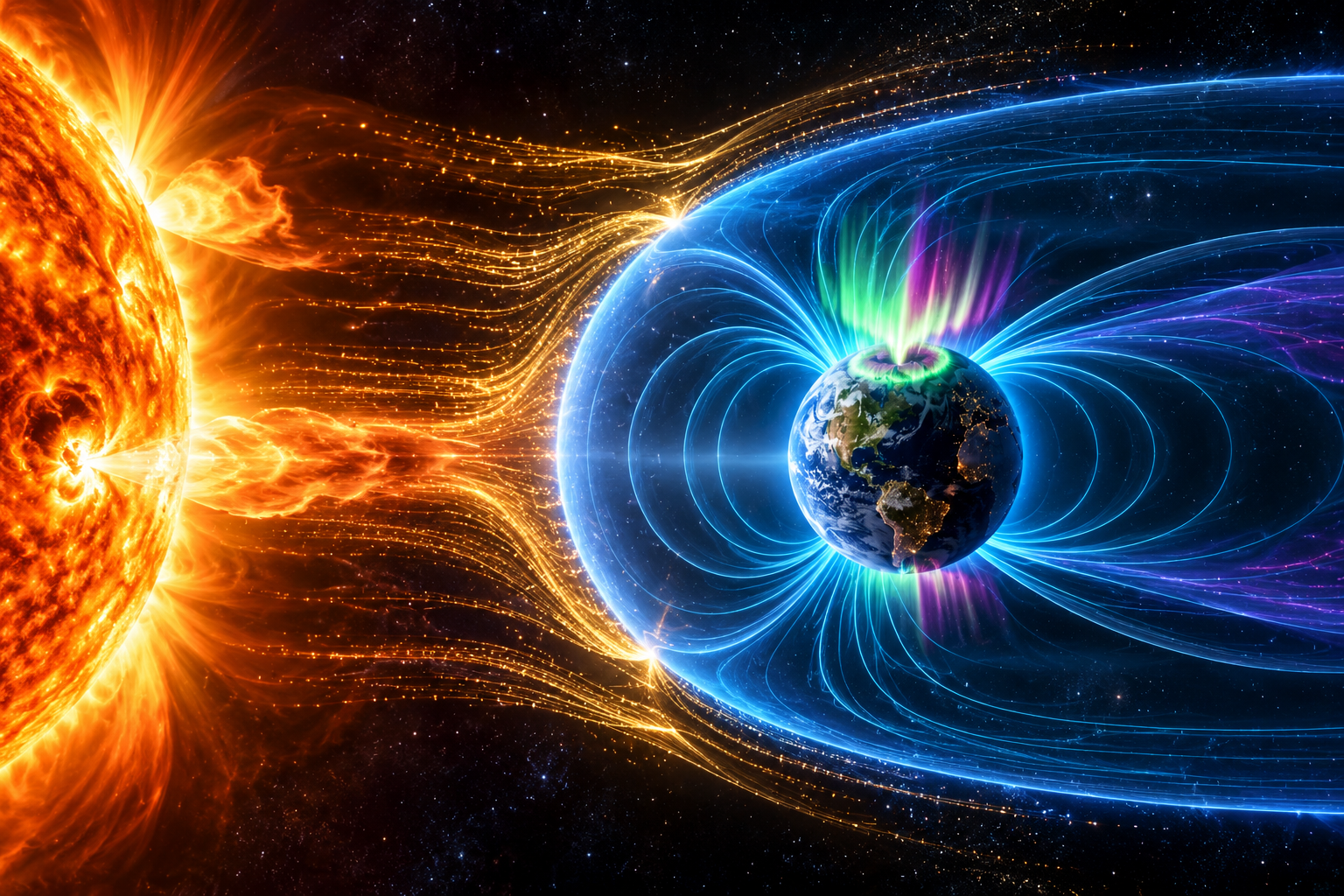
Occasionally, these magnetic field lines snap and violently reconnect, triggering a Coronal Mass Ejection (CME) or a massive solar flare. When a CME erupts, the Sun blasts a colossal cloud containing billions of tons of superheated plasma—consisting of high-energy protons and free electrons—directly into interplanetary space. This Solar Wind hurtles outward across the solar system at speeds ranging from 400 to over 1,000 kilometers per second (nearly 2.2 million miles per hour)!
The Feynman Analogy: The Cosmic Neon Sign
How does a stream of invisible solar particles traveling through empty space create bright neon light in our atmosphere? Richard Feynman loved explaining light emission through the simple physics of neon signs hanging in shop windows.
Inside a glass neon sign, electrical voltage accelerates electrons through gas. When a fast-moving electron slams into a stationary neon atom, it kicks an orbital electron into a higher, unstable energy state (an excited state). But nature hates instability! Within a fraction of a microsecond, the excited electron falls back down to its original ground state. To shed that extra energy, the atom spits out a discrete packet of light: a photon!
The northern lights are literally Earth's version of a giant planetary neon sign. Fast-moving solar wind particles act as the electric current, and Earth's upper atmosphere acts as the gas tube. As millions of solar electrons collide with atmospheric gases, trillions of photons are emitted simultaneously, painting glowing curtains across the sky!
The Shield: Earth's Magnetosphere and Magnetic Reconnection
If solar wind particles hit Earth's surface directly, they would strip away our atmosphere, boil our oceans, and irradiate all biological life. Thankfully, our planet is protected by a vast, invisible magnetic bubble called the Magnetosphere, generated by the churning molten iron core thousands of miles below our feet.
When the solar wind collides with Earth's magnetosphere:
- The magnetic field deflects the vast majority of solar particles around the planet, like river water parting around the bow of a ship.
- However, on the night side of Earth, the magnetosphere is stretched into a long cosmic tail called the Magnetotail.
- As solar magnetic energy accumulates in the magnetotail, the field lines snap and reconnect in an explosive process called Magnetic Reconnection.
- This slingshots trapped electrons down Earth's magnetic funnel lines directly into the upper atmosphere above the North and South magnetic poles!
Why Are Auroras Different Colors? (The Chemistry of the Sky)
The dazzling colors of an aurora depend entirely on which atmospheric gas molecule is struck, and at what altitude the collision occurs:
| Aurora Color | Atmospheric Gas | Altitude of Collision | Underlying Physics & Quantum State |
|---|---|---|---|
| Emerald Green (Most Common) | Atomic Oxygen (O) | 100 to 240 km | Excited oxygen atoms transition from ¹S to ¹D states, emitting 557.7 nm wavelength light |
| Crimson / Blood Red (Rare) | Atomic Oxygen (O) | 240 to 400+ km | High-altitude low-density oxygen transitions from ¹D to ³P states (630.0 nm); requires low collision rates |
| Blue and Violet | Ionized Molecular Nitrogen (N₂⁺) | Below 100 km | Fast, high-energy electrons penetrate deep, ionizing nitrogen molecules (391.4 nm and 427.8 nm) |
| Magenta / Pink Edges | Molecular Nitrogen (N₂) | 80 to 100 km | Neutral nitrogen molecules emit pinkish-purple hues along the lower rippling fringes of curtains |
Solar Cycles: Why 2024 to 2026 Are Peak Aurora Years
Auroral activity is not constant; it follows the Sun's natural 11-year Solar Cycle. Approximately every 11 years, the Sun's magnetic poles flip—north becomes south, and south becomes north. During this magnetic transition, sunspot counts surge, solar flares become frequent and violent, and the Sun reaches Solar Maximum.
During the historic May 2024 geomagnetic superstorm (the strongest in over 20 years), coronal mass ejections compressed Earth's magnetosphere so severely that the Northern Lights were photographed as far south as Florida, Mexico, India, and the Mediterranean!
Vocabulary Bank for Space Weather Students
- Magnetosphere: The region of space surrounding an astronomical body in which its magnetic field dominates the motion of charged particles.
- Coronal Mass Ejection (CME): A massive burst of solar wind and magnetic fields rising above the solar corona or being released into space.
- Magnetic Reconnection: A physical process in plasma where magnetic field lines suddenly rearrange and convert magnetic energy into kinetic and thermal energy.
- Photon: A quantum unit of light and all other forms of electromagnetic radiation.
- Solar Maximum: The regular period of greatest solar activity during the Sun's 11-year solar cycle, characterized by numerous sunspots and intense solar flares.
- Excited State: Any quantum state of an atom or molecule that has a higher energy than its ground state.
Frequently Asked Questions (FAQ)
Q1: Do other planets in the Solar System have auroras?
A: Yes! Any planet with an atmosphere and a magnetic field experiences auroras. NASA's Hubble and James Webb Space Telescopes have captured colossal ultraviolet auroras on Jupiter and Saturn thousands of times more energetic than Earth's, powered by volcanic sulfur particles from Jupiter's moon Io.
Q2: Can you hear sound during an aurora?
A: For centuries, Arctic travelers reported hearing faint crackling, rustling, or popping noises during intense auroral storms. In 2012, Finnish acoustic researchers proved that this sound is real: during calm, cold nights, temperature inversions create an electrical charge pocket at about 70 meters altitude that discharges static electricity during intense geomagnetic storms.
Q3: What was the Carrington Event of 1859?
A: The Carrington Event was the most powerful geomagnetic storm in recorded human history. The solar storm was so intense that auroras illuminated skies worldwide so brightly that gold miners in the Rocky Mountains woke up and started cooking breakfast at 2:00 AM thinking it was morning. Telegraph systems worldwide sparked violently, shocking operators and setting telegraph papers on fire.
Q4: Why don't auroras occur at the equator?
A: Earth's magnetic field lines curve horizontally across the equator, acting as an impenetrable ceiling that deflects incoming charged particles. The field lines only dip vertically downward into the atmosphere at the Arctic and Antarctic magnetic poles, funneling the solar electrons into the polar skies.