
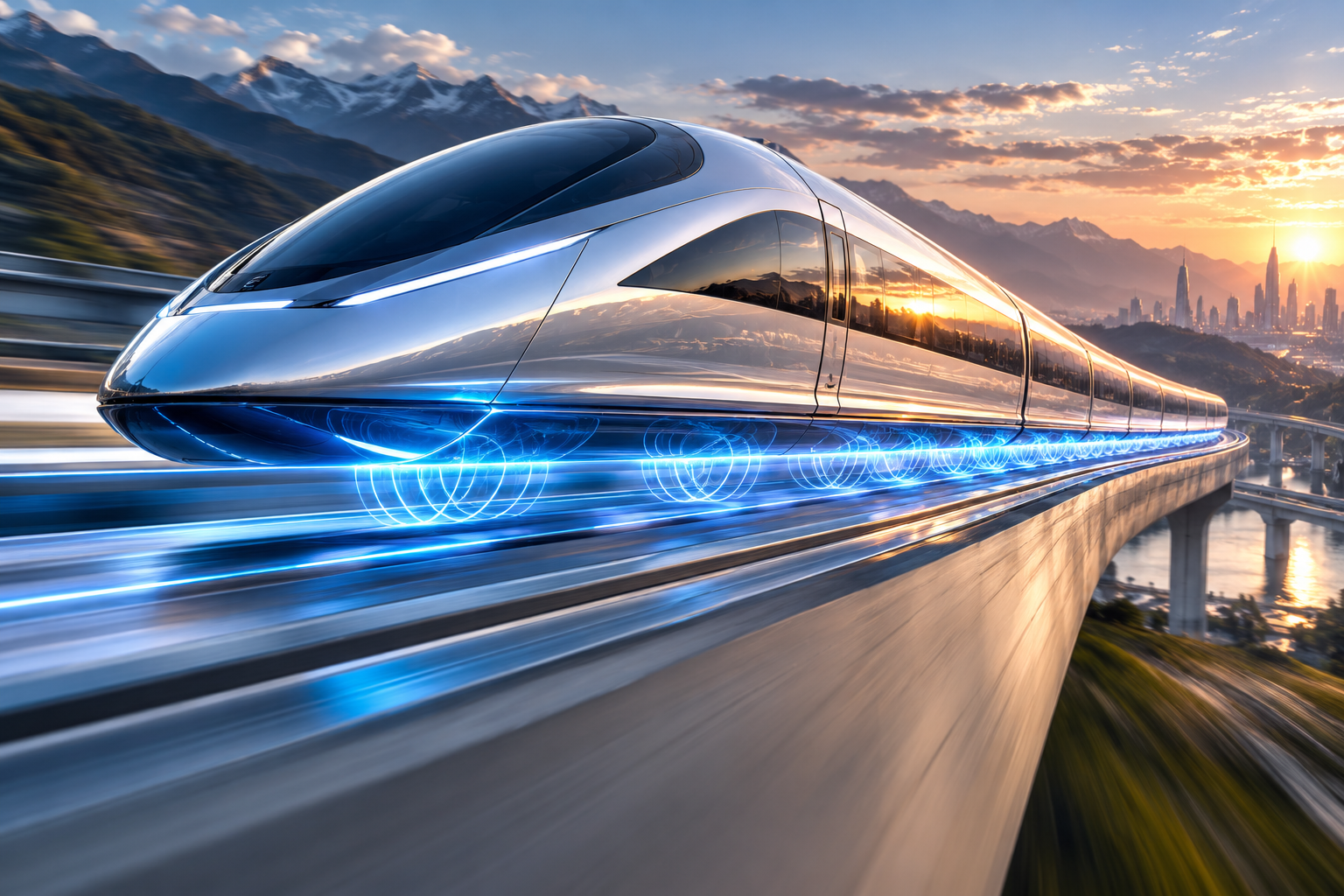
Flying on Ground: The Zero-Friction Revolution
Since the dawn of the Industrial Revolution in the early 19th century, trains have rolled across metal tracks on solid steel wheels. From George Stephenson's steam locomotive Rocket to modern bullet trains like the French TGV and Japanese Shinkansen, the fundamental principle remained unchanged: heavy steel wheels spinning against steel rails. But steel-on-steel contact has a hard physical ceiling. At velocities above 350 km/h (220 mph), friction generates ferocious heat, mechanical vibrations tear wheel bearings apart, and steel wheels can actually lose traction and slip.
To break through this physical barrier, transportation engineers dared to ask a radical question: What if we build a high-speed train that never touches the track at all?
Welcome to the world of Maglev (Magnetic Levitation) Trains. By harnessing the fundamental electromagnetic forces of attraction and repulsion, maglev vehicles float silently 10 to 100 millimeters above a concrete guideway. With zero mechanical friction and zero moving engine parts, maglev trains effortlessly break the 600 km/h (373 mph) speed barrier—matching the cruising speed of commercial passenger airplanes while gliding completely silent and smooth as silk.
The Feynman Analogy: Fighting Invisible Springs
Everyone has played with two bar magnets as a child. When you try to push two North poles together, you feel a spongy, invisible cushion pushing back. No matter how hard you squeeze, the magnets slip sideways and refuse to touch. Richard Feynman described magnetic fields as invisible spatial tensions: energy stored directly in empty space.
A maglev train is essentially a 400-ton passenger vehicle resting atop that invisible magnetic cushion. Instead of engine axles spinning wheels, the entire train is held aloft and pulled forward by traveling electromagnetic waves. You aren't riding on wheels; you are riding on a continuous wave of magnetic energy, like a surfer riding an ocean swell!
The Two Main Types of Maglev Technology
Not all maglev trains float the same way. The transportation industry has developed two primary, competing engineering architectures:
1. Electromagnetic Suspension (EMS) - Attractive Levitation
- Pioneered By: Germany (Transrapid system, deployed on the Shanghai Maglev in China).
- How It Works: The bottom of the train wraps around the underside of a T-shaped steel guideway. Conventional electromagnets mounted under the train point upward toward the steel rail. When energized, the magnets are magnetically attracted upward toward the track, lifting the train exactly 15 millimeters off the ground!
- Key Advantage: Can hover while standing completely still; operates well at both low and high speeds.
- Engineering Challenge: Highly unstable. Micro-sensors must adjust electrical current 100,000 times per second to prevent the magnets from snapping violently onto the track or dropping.
2. Electrodynamic Suspension (EDS) - Repulsive Levitation
- Pioneered By: Japan (SCMaglev L0 Series, setting the world speed record of 603 km/h).
- How It Works: Uses Superconducting Electromagnets (SCMs) chilled by liquid helium to -269°C (-452°F). When the train travels along the concrete U-shaped track, the moving magnetic fields induce electrical eddy currents in track coils. By Lenz's Law, these currents create opposing magnetic poles that repel the train, levitating it 100 millimeters (4 inches) into the air!
- Key Advantage: Inherently fail-safe and self-stabilizing. If the train drifts lower, repulsive forces automatically increase, pushing it back to center.
- Engineering Challenge: Requires auxiliary rubber wheels during takeoff and landing (below 100 km/h) until sufficient speed builds up to induce levitation.
Comparison: Traditional High-Speed Rail vs Maglev vs Commercial Aircraft
| Feature / Parameter | Traditional Bullet Train (TGV / Shinkansen) | Superconducting Maglev (SCMaglev) | Commercial Jetliner (Boeing 737 / A320) |
|---|---|---|---|
| Operating Top Speed | 300 to 350 km/h | 500 to 600+ km/h | 850 to 900 km/h |
| Track / Surface Friction | High (Steel wheel on steel rail contact wear) | Zero (Magnetic levitation in air) | Zero in flight (Aerodynamic air drag only) |
| Mechanical Wear & Maintenance | Frequent grinding of rails and wheel replacement | Extremely low; no friction parts or transmission gearboxes | High jet turbine maintenance cycles and safety overhauls |
| Acceleration & Grade Climbing | Moderate; limited by wheel traction on steep grades | Rapid linear motor acceleration; climbs 10% gradients effortlessly | High runway acceleration; vertical climb capability |
| Weather Sensitivity | Snow and ice clog switches; leaves cause wheel slip | All-weather operational; elevated guideway immune to snowdrifts | Vulnerable to runway icing, crosswinds, and airport fog delays |
How Linear Synchronous Motors Propel the Train Forward
If there are no rotating wheels or onboard jet turbines, how does a maglev train accelerate from 0 to 600 km/h?
The answer is a Linear Synchronous Motor (LSM). Imagine taking a standard electric motor, slicing it open down the middle, and unrolling it flat along miles of track. The stator coils are embedded directly into the concrete guideway walls, and the rotor magnets are on the sides of the train.
By shifting alternating electrical current (AC) along the guideway coils, the track creates traveling magnetic poles: North poles in front of the train pull the train forward, while South poles behind the train push it forward. The speed of the train is regulated simply by controlling the frequency of the alternating current supplied by power substations along the route!
The Future: Vactrain and Hyperloop Speeds
Because maglev eliminates all mechanical rolling resistance, the only remaining barrier to infinite speed is aerodynamic air drag. At 600 km/h, pushing through dense surface air consumes over 80% of total electrical power.
The next frontier of maglev engineering is the Vactrain (Vacuum Tube Train), being developed in China and Europe. By placing maglev tracks inside low-pressure, sealed vacuum tubes where air is pumped out to match conditions at 100,000 feet altitude, trains can exceed 1,000 to 1,200 km/h (Mach 1), connecting Beijing to Shanghai or London to Paris in less than one hour!
Vocabulary Bank for Engineering Students
- Maglev: Short for magnetic levitation; a system of train transportation that uses two sets of magnets to lift and propel the train forward.
- Electromagnetic Suspension (EMS): An attractive levitation system using conventional electromagnets attracted upward toward ferromagnetic steel guideways.
- Electrodynamic Suspension (EDS): A repulsive levitation system using superconducting magnets that repel magnetic coils in the track.
- Linear Synchronous Motor (LSM): An unrolled electric motor where traveling magnetic fields in the track propel magnets on the vehicle synchronously.
- Meissner Effect: The expulsion of a magnetic field from a superconductor during its transition to the superconducting state.
- Eddy Currents: Loops of electrical current induced within conductors by a changing magnetic field in the conductor according to Faraday's law of induction.
Frequently Asked Questions (FAQ)
Q1: What happens if a maglev train loses electrical power at 600 km/h?
A: Maglev trains cannot derail or plunge to the ground! In EDS systems (Japan), the levitation coils require zero external track power because the train's own forward motion generates the repulsive field, and emergency deployable rubber wheels gently roll the train to a halt. In EMS systems (China/Germany), onboard backup batteries maintain levitation until the vehicle glides safely to a stop.
Q2: Where is the fastest commercial maglev operating today?
A: The fastest commercial passenger maglev in daily operation is the Shanghai Maglev Train in China, which connects Pudong International Airport to the city outskirts at 431 km/h (268 mph), covering 30 kilometers in just 7 minutes and 20 seconds.
Q3: Why aren't maglev trains everywhere in the world yet?
A: The primary obstacle is capital infrastructure cost. Unlike standard bullet trains that can share existing rail tracks entering historic city centers, maglev requires dedicated, custom-built concrete guideways with cryogenic substations, costing between 40 million to 100+ million per kilometer.
Q4: Is magnetic radiation inside the passenger cabin dangerous for humans?
A: Not at all. Maglev passenger cabins are shielded with high-permeability metallic alloys (Mu-metal) that block magnetic fields. The magnetic field strength inside a maglev cabin is roughly 50 microteslas—comparable to Earth's natural background magnetic field and far lower than sitting in front of a hair dryer.