
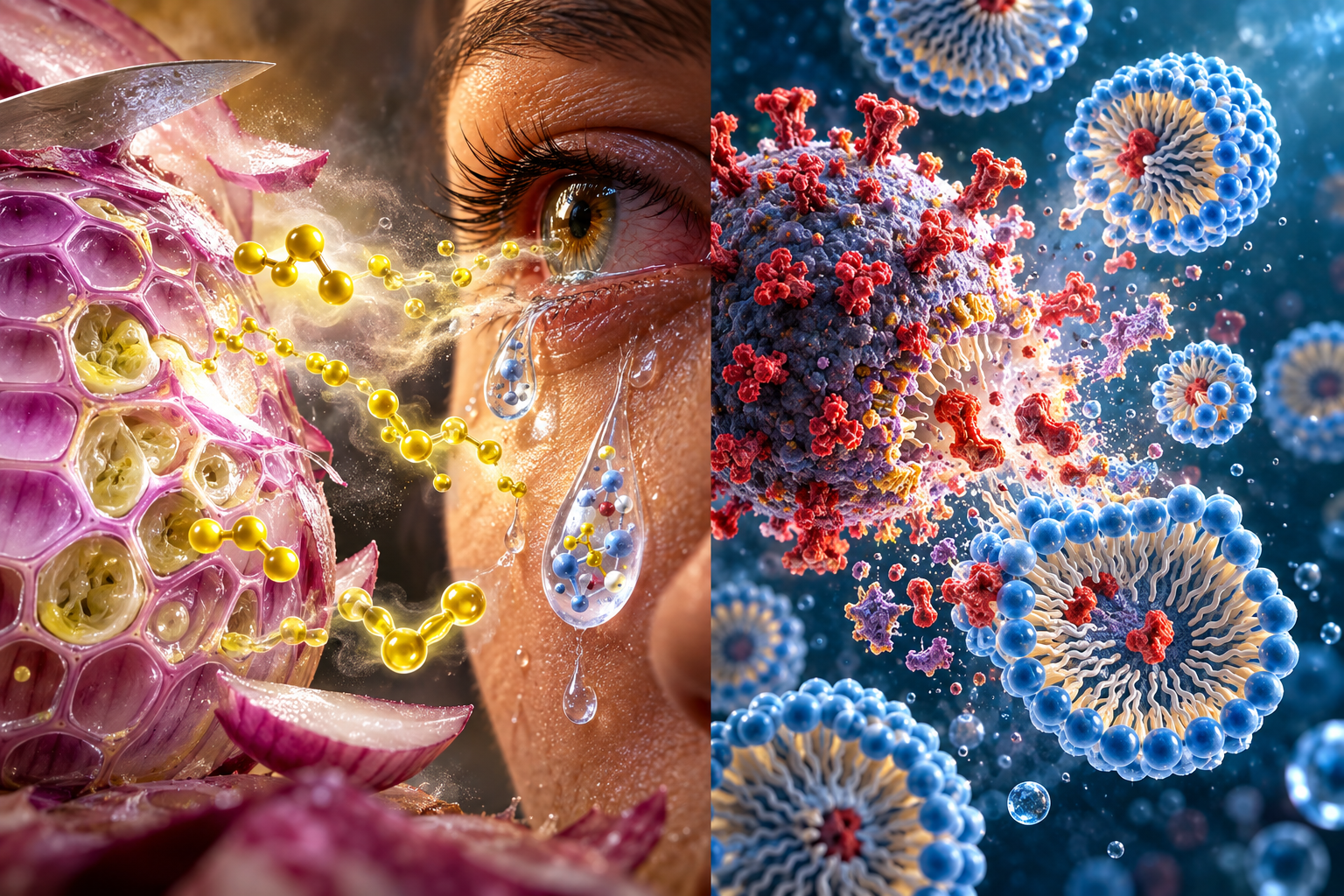
Chemistry Is Happening in Your Kitchen Every Day
When most students think of chemistry, they picture test tubes bubbling with neon liquids in a high-tech laboratory. But the truth is, your home kitchen and bathroom are active chemical laboratories!
Every single day, you witness remarkable molecular reactions without even realizing it. Two of the most fascinating everyday chemical puzzles are: Why do onions make you cry the moment a knife touches them? and How does basic bath soap destroy deadly viruses in seconds?
Part 1: The Chemical Warfare of Slicing an Onion
Have you ever noticed that a whole, unpeeled onion sitting on your kitchen counter has zero smell and does not make your eyes sting at all? Yet, within 10 seconds of taking a knife and chopping it, your eyes fill with tears.
This is actually an evolutionary defense mechanism developed by the onion plant to prevent underground rodents and pests from eating its bulbs!
The Two-Part Chemical Weapon
Inside the cells of a whole onion, two chemical compounds are stored in completely separate compartments:
- In the Vacuoles: Amino acid sulfoxides (sulfur-rich molecules).
- In the Cytoplasm: A special enzyme called Alliinase (or Lachrymatory Factor Synthase).
As long as the onion remains intact, these chemicals never touch. But the moment you slice through the onion with a knife, cell walls are ruptured. The alliinase enzyme mixes with the sulfur compounds, triggering a lightning-fast two-stage chemical reaction that produces a volatile sulfur gas called Syn-propanethial-S-oxide (C_3H_6OS).
How the Gas Reaches Your Eyes
Because Syn-propanethial-S-oxide is a light gas, it quickly floats up from the cutting board and contacts the moist surface of your eyes. When the sulfur gas touches the water in your eye's tear film, it reacts to form tiny trace amounts of sulfuric acid (H_2SO_4)!
Your eye's sensory nerve endings immediately sound the biological alarm. The brain's lachrymal glands flood your eyes with reflex tears to dilute and wash away the stinging acid.
3 Scientific Hacks to Stop Onion Tears
- Chill the Onion in the Fridge First: Lowering the onion's temperature slows down the chemical reaction rate of the alliinase enzyme, releasing far less gas.
- Use a Very Sharp Knife: A razor-sharp knife slices cleanly between plant cells, while a dull knife crushes and ruptures thousands of cell walls, releasing massive gas clouds.
- Turn On the Stove Exhaust Fan: A gentle breeze blows the volatile gas molecules away before they can reach your eyes.
Part 2: Why Soap Is the Ultimate Virus Destroyer
During the COVID-19 pandemic and seasonal flu outbreaks, doctors and scientists universally gave one piece of advice: Wash your hands with plain soap and warm water for at least 20 seconds.
Why is basic soap so much more effective than complex hand sanitizers? The answer lies in the unique molecular architecture of a single soap molecule.
The Amphiphilic Structure of Soap
A soap molecule looks like a tiny tadpole with two distinct chemical ends:
- The Hydrophilic Head: The "water-loving" polar head is attracted to water molecules.
- The Hydrophobic Tail: The "water-fearing" hydrocarbon tail repels water, but is strongly attracted to oils, greases, and lipids (fats).
The Viral Weakness: The Lipid Bilayer
Many dangerous viruses-including Coronaviruses, Influenza (flu), HIV, and Ebola-are enveloped viruses. Their genetic material (RNA or DNA) and spike proteins are protected by an outer shell made entirely of a double layer of fat molecules called a Lipid Bilayer.
This lipid coat acts like a bubble of oil holding the virus together.
How Soap Physically Rips Viruses Apart
When you lather soap on your hands with water:
- The hydrophobic tails of millions of soap molecules seek out fatty substances to escape water. They jam their tails directly into the virus's lipid membrane, acting like microscopic crowbars.
- The mechanical rubbing of your hands tears the viral fatty membrane wide open, causing the virus's internal proteins and RNA to spill out and become completely inactive (dead).
- The soap molecules then assemble into spherical micro-cages called Micelles, trapping the destroyed viral fragments inside.
- When you rinse your hands under running water, the water-loving heads of the micelles cling to the water flow, washing all virus debris down the drain!
Key Takeaways for Students
- Onions cry-induce because slicing ruptures cell walls, creating a volatile sulfur gas that forms trace sulfuric acid in eye moisture.
- Chilling onions and using sharp knives minimizes the release of the tear-triggering gas.
- Soap molecules have a hydrophilic head (water-loving) and a hydrophobic tail (oil-loving).
- Soap destroys enveloped viruses by physically dissolving their protective fatty outer membrane in 20 seconds.
Frequently Asked Questions (FAQ)
Q1: Why doesn't hand sanitizer work as well as soap when hands are dirty?
A: Hand sanitizers with 70%+ alcohol kill germs, but they cannot remove physical dirt, grime, or oils from skin. Soap physically breaks down oils and washes all trapped debris and microbes completely down the drain.
Q2: Do sweet onions make you cry as much as yellow or red onions?
A: No! Sweet onions (like Vidalia or Walla Walla) absorb much less sulfur from the soil during growth, producing significantly lower levels of the crying gas.
Q3: How long should you wash your hands with soap?
A: At least 20 seconds (about the time it takes to sing "Happy Birthday" twice). This gives soap molecules enough time to penetrate and dismantle tough viral lipid shells.
Fun Kitchen Chemistry: Testing Acidity with Red Cabbage Indicator
You can turn your kitchen into a pH chemistry laboratory using a simple red cabbage:
- Boil chopped red cabbage in water for 10 minutes until the liquid turns a deep purple color. Filter and save the purple juice.
- Red cabbage contains a natural pigment called Anthocyanin, which changes molecular structure and color based on acidity:
- Add lemon juice or vinegar (acids, pH 2-3) \rightarrow Turns bright red / pink!
- Add baking soda solution or soap (bases, pH 8-10) \rightarrow Turns blue, green, or yellow!
This simple experiment visually proves how everyday household solutions possess dramatically different chemical properties that interact with biological pigments.
Vocabulary Bank for Chemistry Students
- Alliinase: An enzyme responsible for catalyzing chemical reactions that release organosulfur flavor and tear-producing compounds.
- Hydrophilic: Having an affinity for water; readily absorbing or dissolving in water.
- Hydrophobic: Lacking an affinity for water; tending to repel or fail to mix with water.
- Micelle: An aggregate of surfactant molecules dispersed in a liquid, with hydrophobic tails inward and hydrophilic heads outward.