
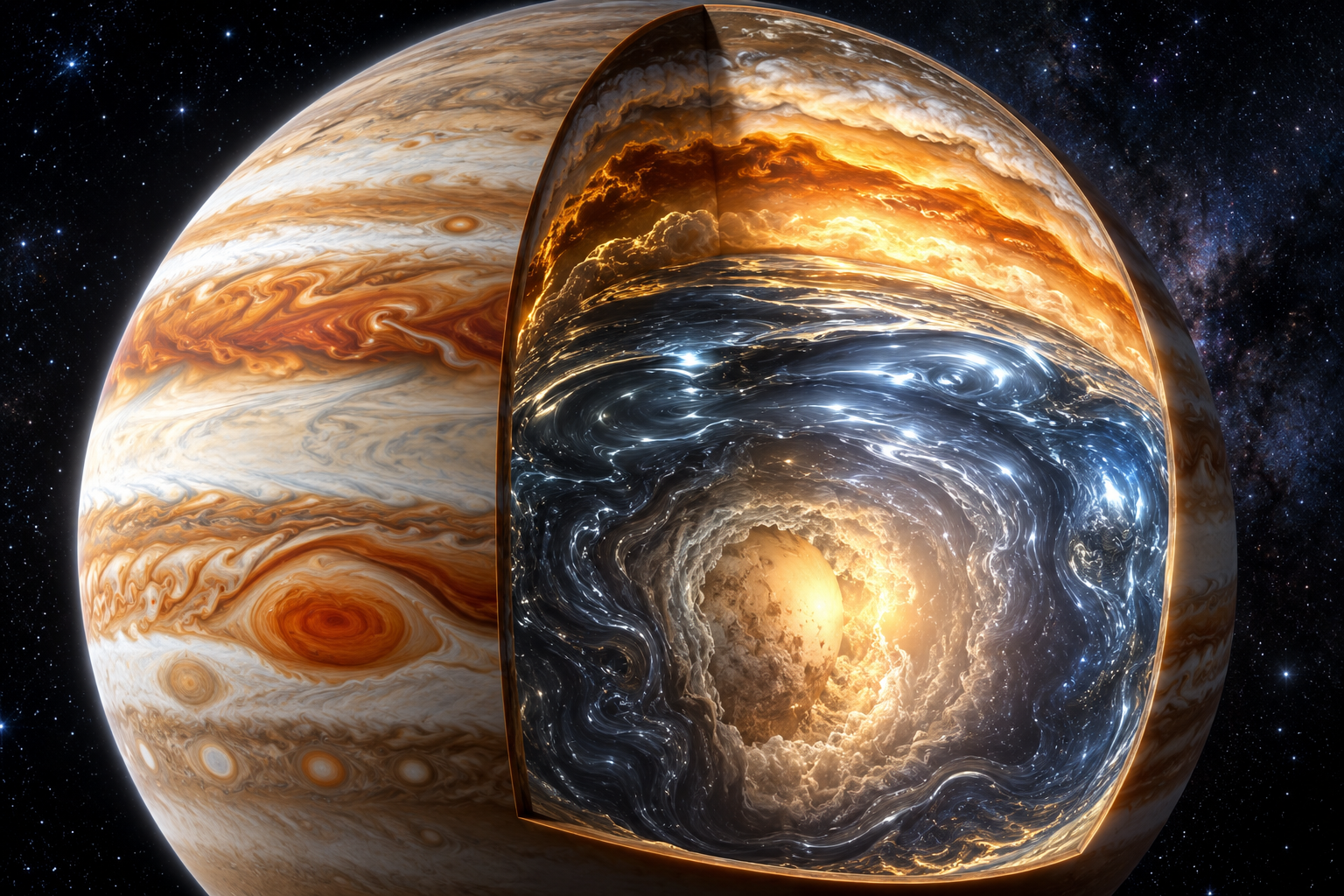
The Illusion of a Solid World
When you look at photographs of Jupiter with its swirling orange stripes and Great Red Spot, or Saturn with its spectacular golden rings, they look like enormous solid spheres floating in space-like giant, colorful bowling balls.
Naturally, one might ask: Could humans build a spacecraft and land on the surface of Jupiter?
The short answer is: You cannot land on Jupiter because there is literally no ground to land on! If you stepped out of a spacecraft over Jupiter, you would fall through thousands of kilometers of atmosphere, sink into oceans of liquid metal, and be crushed by pressures greater than at the bottom of the deepest sea.
What Is a Gas Giant Made Of?
Unlike terrestrial rocky planets like Earth, Mars, and Venus, Jupiter and Saturn are composed almost entirely of the lightest elements in the universe: Hydrogen (~90%) and Helium (~10%)-the exact same chemical recipe as the Sun!
Because they lack a solid crust, the transition from open space to the planetary interior is a smooth, continuous gradient of increasing density, temperature, and pressure.
The Hypothetical Dive: Sinking into Jupiter
Imagine designing an indestructible probe equipped with cameras and sensors, and dropping it directly into the upper clouds of Jupiter. Here is what that probe would encounter as it plummeted toward the core:
1. The Outer Cloud Decks (0 to 100 km depth)
At the very top of the atmosphere, the ambient pressure is about 1 atmosphere (the same as standing at sea level on Earth), but the temperature is freezing at -145°C (-230°F). The clouds are made of white ammonia ice crystals. Violent jet-stream winds whip past at over 500 km/h (310 mph).
2. The Storm Layers (100 to 300 km depth)
As you sink deeper, sunlight fades rapidly. You pass through dense rust-colored clouds of ammonium hydrosulfide and turbulent water-ice clouds. Here, monstrous thunderstorms rage, generating lightning bolts 1,000 times more powerful than Earth storms.
The pressure climbs to 10 to 20 atmospheres, and the temperature rises to a comfortable room temperature (20°C). But you cannot stop to enjoy it-gravity continues pulling you downward into pitch-black darkness.
3. The Supercritical Fluid Ocean (1,000 to 7,000 km depth)
Below 1,000 kilometers, the atmospheric pressure exceeds 20,000 times that of Earth. Under these crushing conditions, the boundary between gas and liquid disappears completely.
Hydrogen enters an exotic physical state called a supercritical fluid-it is neither a gas nor a liquid, but has properties of both. You are now sinking through a dense, hot fluid soup with temperatures climbing past 2,000°C.
4. The Ocean of Liquid Metallic Hydrogen (10,000 to 50,000 km depth)
At depths past 10,000 kilometers, pressures exceed 2 million atmospheres (200 GPa) and temperatures reach 10,000°C. The pressure is so immense that hydrogen atoms are squeezed together so tightly that electrons are stripped from their proton nuclei.
Hydrogen transforms into Liquid Metallic Hydrogen-a boiling, swirling ocean of liquid metal that conducts electricity like molten copper! The rapid convective swirling of this liquid metallic hydrogen ocean generates Jupiter's colossal magnetic field, the largest and most intense magnetosphere in the solar system.
5. The Mysterious Core (60,000+ km depth)
Data from NASA's Juno spacecraft (which has been orbiting Jupiter since 2016) revealed that Jupiter does not have a small, rock-hard dense sphere at its center. Instead, it has a "fuzzy" or diluted core made of dissolved rock, silica, and iron mixed with hydrogen, reaching temperatures of 20,000°C to 30,000°C under 40 million atmospheres of pressure.
Real-World Probe: NASA's Galileo Probe Mission
In December 1995, NASA sent the Galileo Probe on a suicide dive into Jupiter's clouds. Equipped with a heavy heat shield, the probe entered the atmosphere at 170,000 km/h.
The probe survived for exactly 58 minutes, descending 156 kilometers into the cloud deck while beaming valuable weather data back to Earth. Eventually, ambient temperatures reached 153°C and pressure climbed to 23 atmospheres, destroying the electronics and melting the aluminum probe entirely.
Key Takeaways for Students
- Gas giants like Jupiter and Saturn have no solid surface; they are massive balls of hydrogen and helium gas.
- As you descend into Jupiter, the gas gradually compresses into a supercritical fluid and eventually into an ocean of liquid metallic hydrogen.
- Jupiter's magnetic field is generated by convective currents of liquid metallic hydrogen.
- Any spacecraft attempting to land on Jupiter is destroyed by intense atmospheric pressure and soaring temperatures within minutes.
Frequently Asked Questions (FAQ)
Q1: If you can't land on Jupiter, can humans land on its moons?
A: Yes! Jupiter has 95 known moons, including large rocky and icy worlds like Europa, Ganymede, Callisto, and Io, which all have solid surfaces that robotic landers and future human astronauts can walk on.
Q2: Why didn't Jupiter become a star like the Sun?
A: Jupiter is sometimes called a "failed star" because it has the same chemical composition as the Sun. However, it lacks sufficient mass. Jupiter would need to be roughly 80 times more massive to trigger nuclear fusion in its core and ignite into a star.
Q3: Does Saturn have the exact same structure as Jupiter?
A: Yes, Saturn is structurally very similar, though its smaller mass means lower internal pressure and a thicker upper atmosphere layer before reaching metallic hydrogen.
What About the Moons? Ocean Worlds in the Outer Solar System
While you cannot set foot on Jupiter or Saturn, their vast gravitational fields keep active geothermal activity alive inside dozens of icy moons:
- Europa (Jupiter): Harbors a global saltwater ocean beneath its icy crust containing more liquid water than all Earth's oceans combined, making it a prime candidate in the search for extraterrestrial life.
- Titan (Saturn): The only moon in the solar system with a dense atmosphere (1.5x Earth's pressure) and liquid methane-ethane lakes on its surface. Humans walking on Titan would need warm thermal suits and oxygen masks, but no pressurized spacesuits!
- Enceladus (Saturn): Shoots massive geysers of liquid water, organic molecules, and salts directly into space from hydrothermal vents on its ocean floor.
Vocabulary Bank for Astronomy Students
- Gas Giant: A large planet of low density consisting mostly of hydrogen and helium, lacking a defined solid surface.
- Supercritical Fluid: Any substance at a temperature and pressure above its critical point, where distinct liquid and gas phases do not exist.
- Liquid Metallic Hydrogen: A phase of hydrogen in which it behaves like an electrical conductor under immense pressure.
- Magnetosphere: The region of space surrounding an astronomical body in which its magnetic field is the predominant magnetic field.