
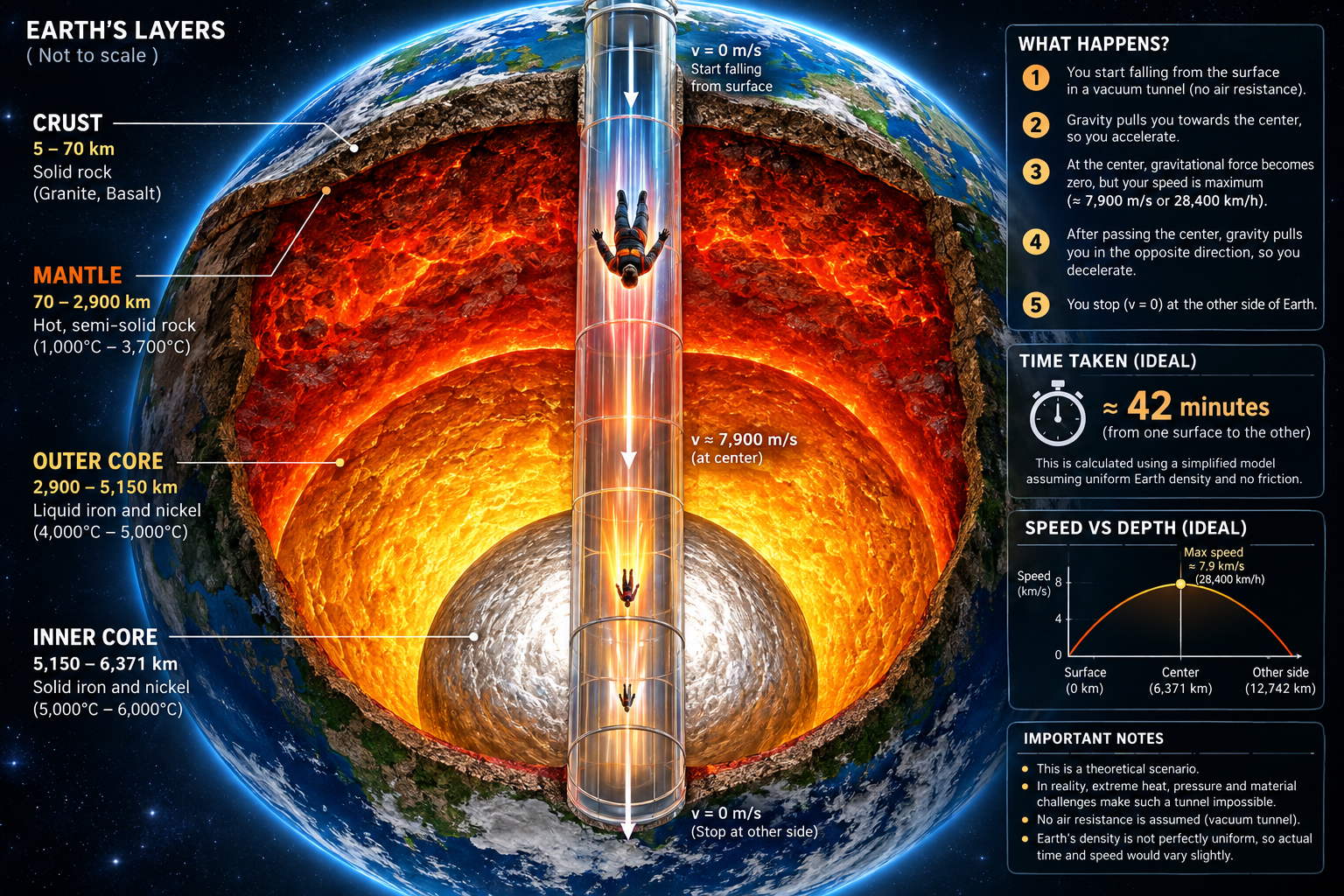
The Ultimate Thought Experiment
Have you ever looked down at the ground and wondered what would happen if you dug a hole so deep that it came out on the opposite side of the planet (the antipodes)?
While drilling through the Earth is practically impossible with current technology due to extreme heat and crushing tectonic pressure, physicists love using this theoretical puzzle-known as the Gravity Tunnel thought experiment-to teach the principles of gravitational acceleration, potential energy, and simple harmonic motion.
The Physics of the Fall: Stepping into the Abyss
Let us assume an idealized scenario: we have a straight, evacuated vacuum tunnel (no air resistance) bored directly through the center of a perfectly spherical, uniform Earth, and the tunnel walls are magically shielded from the 6,000°C temperature of Earth's iron core.
The moment you step into the opening, gravity begins pulling you downward toward the center of the planet. Here is what you would experience second by second:
1. Acceleration at the Surface
At the start, you accelerate downward at Earth's standard gravitational acceleration of 9.8 m/s^2. With every second that ticks by, your downward speed increases by nearly 10 meters per second (approx. 35 km/h).
2. The Diminishing Pull of Gravity
As you plunge thousands of kilometers beneath the crust, something remarkable happens. In everyday life on the surface, all of Earth's mass is below your feet, pulling you down. But once you are inside the planet, the rock and magma above you pull you upward, while only the mass beneath you continues to pull you toward the center.
According to Newton's Shell Theorem, the gravitational force inside a uniform sphere is directly proportional to your distance from the core. As you get closer to the center, the net gravitational pull actually decreases, approaching zero at the very midpoint.
3. Reaching Maximum Speed at the Center
Even though the force of gravity weakens as you approach the center, you are still continuously accelerating the entire way down. By the time you reach the exact center of the Earth (approx. 6,371 kilometers deep), your gravitational acceleration drops to zero, but your velocity reaches its staggering peak:
- Top Velocity: Approx. 7,900 meters per second (28,440 km/h or 17,670 mph)!
- At this breathtaking speed, you would cross the entire continent of North America in under 10 minutes.
4. The Journey to the Other Side
What happens after you zoom past the center? Now, the bulk of Earth's mass is behind you. Gravity begins pulling you backward toward the core, causing you to decelerate at an increasing rate.
Because energy is perfectly conserved in our frictionless vacuum tunnel, the deceleration exactly mirrors your previous acceleration. Precisely when you reach the exit on the opposite side of the planet, your speed reaches zero. If you grab onto the rim of the hole, you can simply step out into the other hemisphere!
How Long Does the Entire Trip Take?
Remarkably, the entire one-way journey from one side of the Earth to the other takes exactly 42 minutes and 12 seconds (or about 38 minutes when accounting for Earth's realistic non-uniform density profile, known as the Preliminary Reference Earth Model or PREM).
If you fail to grab the edge of the tunnel when you reach the other side, gravity will immediately pull you back down into the hole, and you will oscillate back and forth forever like a cosmic pendulum-a textbook example of Simple Harmonic Motion (SHM).
Real-World Obstacles: Why We Cannot Build It Today
In the real world, several extreme physical barriers prevent any such tunnel from existing:
- Crushing Pressure and Heat: Earth's outer core consists of liquid iron-nickel at temperatures exceeding 5,000°C to 6,000°C, and pressures reach over 3.6 million atmospheres (360 GPa). No known material could prevent the tunnel walls from instantly collapsing and vaporizing.
- Air Resistance and Terminal Velocity: If the tunnel were filled with air, atmospheric friction would cap your falling speed at a terminal velocity of roughly 200 to 300 km/h. Furthermore, the air at the center would be compressed into a supercritical fluid denser than water, stopping you long before you reached the other side.
- The Coriolis Effect: Because Earth is constantly rotating eastward on its axis, a falling person would retain their surface sideways momentum and slam violently into the eastern wall of the tunnel within a few kilometers.
Key Takeaways for Students
- Inside the Earth, gravitational force decreases linearly toward zero at the center due to Newton's Shell Theorem.
- Falling through an idealized vacuum tunnel is an example of simple harmonic oscillation taking approximately 42 minutes.
- Your speed at the exact center of Earth would reach nearly 28,400 km/h before gravity slows you down on the ascent.
- Real-world drilling is limited by extreme core heat (6,000°C), tectonic pressure, and Earth's rotational Coriolis deflection.
Frequently Asked Questions (FAQ)
Q1: What is the deepest hole humans have ever actually drilled?
A: The Kola Superdeep Borehole in Russia reached a depth of 12,262 meters (12.26 km or 7.6 miles) in 1989. This represents only about 0.2% of the distance to Earth's center!
Q2: Would you feel weightless at the center of the Earth?
A: Yes! At the exact center of the Earth, the gravitational pull from all surrounding directions cancels out to zero, meaning you would experience complete zero-gravity weightlessness.
Q3: Does the journey time change if the tunnel is drilled at an angle rather than through the center?
A: Amazingly, in a uniform density Earth, a straight vacuum gravity tunnel connecting any two cities on Earth (even across the same continent) takes the exact same 42 minutes, because a shorter path has a smaller component of gravitational force along the tunnel!
Relativistic Physics: What Happens to Time Inside the Earth?
According to Albert Einstein's Theory of General Relativity, time passes at different rates depending on the strength of the surrounding gravitational field. A clock sitting at sea level ticks slightly slower than a clock placed on top of Mount Everest because gravity is stronger closer to Earth's mass.
If you were to place an ultra-precise atomic clock at the exact center of the Earth inside our hypothetical gravity tunnel, the total gravitational potential well is at its deepest. Over the 4.5-billion-year lifespan of planet Earth, scientists estimate that Earth's core is actually about 2.5 years younger than the surface crust due to gravitational time dilation!
Vocabulary Bank for Physics Students
- Newton's Shell Theorem: A mathematical theorem proving that inside a uniform spherical shell, the net gravitational force on an object is zero everywhere.
- Simple Harmonic Motion (SHM): Periodic oscillatory motion where the restoring force is directly proportional to displacement from the equilibrium point.
- Terminal Velocity: The constant maximum speed that a freely falling object reaches when the upward drag force of the fluid equals the downward force of gravity.
- Coriolis Effect: An apparent deflection of moving objects caused by the rotation of the frame of reference (Earth's rotation).