
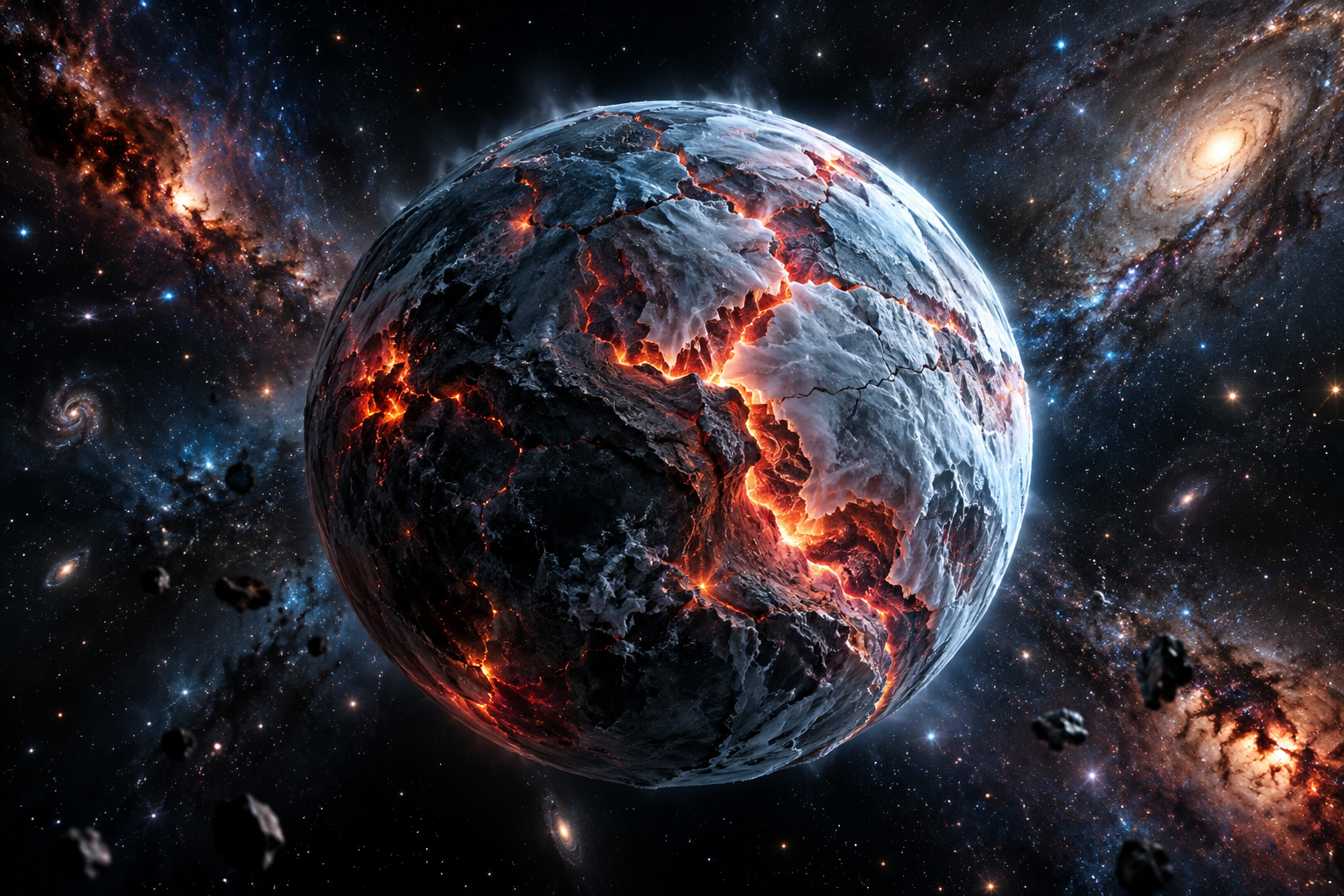
The Loneliest Worlds in the Universe
When you picture a planet, you instinctively imagine it circling a bright star. Earth basks in the golden warmth of the Sun; Mars and Jupiter trace predictable elliptical orbits around the same solar anchor. For centuries, astronomers assumed that a star was an absolute prerequisite for a planet's existence. But over the last two decades, infrared space telescopes and gravitational microlensing surveys have revealed a haunting cosmic reality: our Milky Way galaxy is teeming with trillions of dark, solitary worlds that have no parent star. These cosmic nomads are known as Rogue Planets (or free-floating planets).
Cast out from their native solar systems billions of years ago, rogue planets wander through the freezing pitch-black void of interstellar space. They experience no sunrise, no sunset, no seasons, and no daylight. Yet, astrophysicists estimate that rogue planets outnumber normal star-orbiting planets by at least two to one—meaning there could be more than 100 billion to 1 trillion rogue worlds roaming through our home galaxy alone!
The Feynman Analogy: The Crowded Pinball Machine
How does an entire planet end up alone in deep space? Think of an infant solar system as a chaotic, high-stakes game of pinball. During the earliest stages of planetary formation, dozens of planetary embryos condense out of a swirling protoplanetary disk of gas and dust. These baby planets do not glide along neat, isolated orbits; they cross paths and gravitationally tug on one another.
When a smaller terrestrial or gas planet swings too close to a colossal giant like Jupiter, the physics of a gravitational slingshot takes over. Just as a pinball bumper violently kicks a steel ball across the board, the massive gravity of the gas giant robs orbital energy from the smaller planet and flings it out of the solar system at escape velocity. Once cast out into the interstellar ocean, the displaced planet travels forever at tens of kilometers per second, unbound to any star.
How Do We Find Dark Planets in Pitch-Black Space?
Spotting a dark planet that does not emit its own starlight and sits thousands of light-years away sounds impossible. Yet astronomers use brilliant physics techniques to detect them:
- Gravitational Microlensing: Predicted by Albert Einstein's General Theory of Relativity, mass warps spacetime. When a rogue planet passes directly between Earth and a distant background star, the rogue planet's gravity acts like a natural magnifying glass. It bends and focuses the background star's light rays, causing the star to briefly brighten for several hours or days before returning to normal.
- Infrared Thermal Glow of Young Rogues: Freshly formed rogue planets (less than 100 million years old) still retain residual heat from their gravitational collapse. Instruments like NASA's James Webb Space Telescope (JWST) can detect their faint infrared thermal glow in star-forming stellar nurseries like the Orion Nebula.
Comparison: Star-Bound Earth vs An Interstellar Rogue Planet
| Environmental Factor | Terrestrial Planet (Earth) | Rogue Planet (Interstellar Nomad) |
|---|---|---|
| Primary Heat Source | Solar radiation from parent star (~99.98% of surface heat) | Internal radioactive decay (uranium, thorium) & tidal heating |
| Illumination & Cycles | Regular 24-hour day/night cycles, axial seasons | Perpetual cosmic night; illuminated only by distant starlight |
| Atmospheric Fate | Maintained by balanced solar warming and planetary magnetic field | Gases (CO₂, nitrogen) often freeze solid onto the crust as thick ice |
| Orbital Trajectory | Stable closed ellipse around a host star (1 AU radius) | Galactic orbit circling the supermassive black hole at galactic core |
| Potential for Liquid Water | Surface oceans sustained in circumstellar habitable zone | Subsurface liquid oceans insulated by miles of ice and geothermal vents |
Could Life Actually Survive on a Rogue Planet?
At first glance, a sunless world sounds like the most inhospitable wasteland imaginable. Without sunlight, the surface temperature plummets to a biting -250°C (-418°F). The atmosphere condenses and snows out, blanketing the planetary crust in frozen methane, carbon dioxide, and nitrogen ice.
However, theoretical astrobiologists like David Stevenson of Caltech have demonstrated that rogue planets could harbor thriving ecosystems! Here is how life could survive in deep interstellar space:
- The Insulating Ice Blanket: Miles of frozen ice and rock act as a phenomenal thermal insulator, trapping internal planetary heat deep below ground.
- Radioactive Core Heat: Just like Earth, rocky rogue planets possess heavy radioactive isotopes (Uranium-238, Thorium-232, Potassium-40) decaying slowly over billions of years, keeping the mantle hot and molten.
- Hydrothermal Vents: On Earth, deep-ocean hydrothermal vents (black smokers) support rich food webs independent of sunlight, powered by chemosynthetic bacteria that consume sulfur and methane. Deep beneath the frozen crust of a rogue planet, volcanic vents could power warm, pitch-black subsurface oceans for billions of years.
- Thick Hydrogen Atmospheres: If an expelled planet retains a dense hydrogen envelope, hydrogen's molecular collision properties prevent infrared heat from escaping, potentially keeping surface liquid water oceans intact even without a star!
The JuMBO Discovery: Rogue Planets in Pairs!
In 2023, astronomers analyzing images from the James Webb Space Telescope made a discovery that stunned the astronomical community. Inside the Trapezium Cluster of the Orion Nebula, JWST discovered over 40 pairs of Jupiter-mass rogue worlds orbiting each other in binary systems, dubbed JuMBOs (Jupiter Mass Binary Objects).
Standard astrophysics ejection models predicted that violent gravitational slingshots would easily tear fragile planetary pairs apart. The discovery of dozens of intact binary rogue worlds suggests either an unknown mechanism of ejection, or that tiny gas clouds can collapse directly to form planetary-mass objects without ever forming a star.
Vocabulary Bank for Astronomy Students
- Rogue Planet: A planetary-mass object that orbits a galactic center directly rather than being gravitationally bound to a host star.
- Gravitational Microlensing: An astronomical phenomenon where the gravitational field of a foreground object bends and magnifies the light of a distant background star.
- Protoplanetary Disk: A rotating circumstellar disk of dense gas and dust surrounding a newly formed young star, from which planets coalesce.
- Gravitational Slingshot: The use of the relative movement and gravity of a planet or other astronomical body to alter the path and speed of a spacecraft or celestial body.
- Chemosynthesis: The biological conversion of one or more carbon-containing molecules and nutrients into organic matter using the oxidation of inorganic compounds as a source of energy, rather than sunlight.
- JuMBO: Jupiter Mass Binary Object; a pair of free-floating gas giant worlds orbiting each other without a host star.
Frequently Asked Questions (FAQ)
Q1: What is the closest known rogue planet to our Solar System?
A: The nearest known rogue planet candidate is WISE 0855−0714, located just 7.2 light-years from Earth (about twice the distance to Alpha Centauri). It is a sub-brown dwarf or rogue gas giant roughly 3 to 10 times the mass of Jupiter, with freezing atmospheric temperatures around -13°C.
Q2: Could a rogue planet ever hit Earth?
A: The chances are astronomically small. Interstellar space is vast beyond human comprehension. Even with trillions of rogue planets roaming the Milky Way, the average distance between solitary worlds is hundreds of billions of kilometers. Earth has orbited the Sun safely for over 4.5 billion years without encountering a rogue intruder.
Q3: Will our Sun ever eject any of our solar system's planets?
A: In roughly 5 billion years, the Sun will expand into a Red Giant, engulfing Mercury, Venus, and possibly Earth. As the Sun sheds mass, the outer gas giants (Jupiter, Saturn, Uranus, Neptune) will drift outward, and chaotic gravitational interactions could potentially fling Neptune or minor dwarf planets into deep interstellar space.
Q4: How do rogue planets compare to brown dwarfs?
A: Brown dwarfs are "failed stars" with masses between 13 to 80 Jupiter masses, heavy enough to temporarily fuse deuterium (heavy hydrogen) in their cores. Rogue planets have masses below 13 Jupiter masses and never ignite any nuclear fusion.