
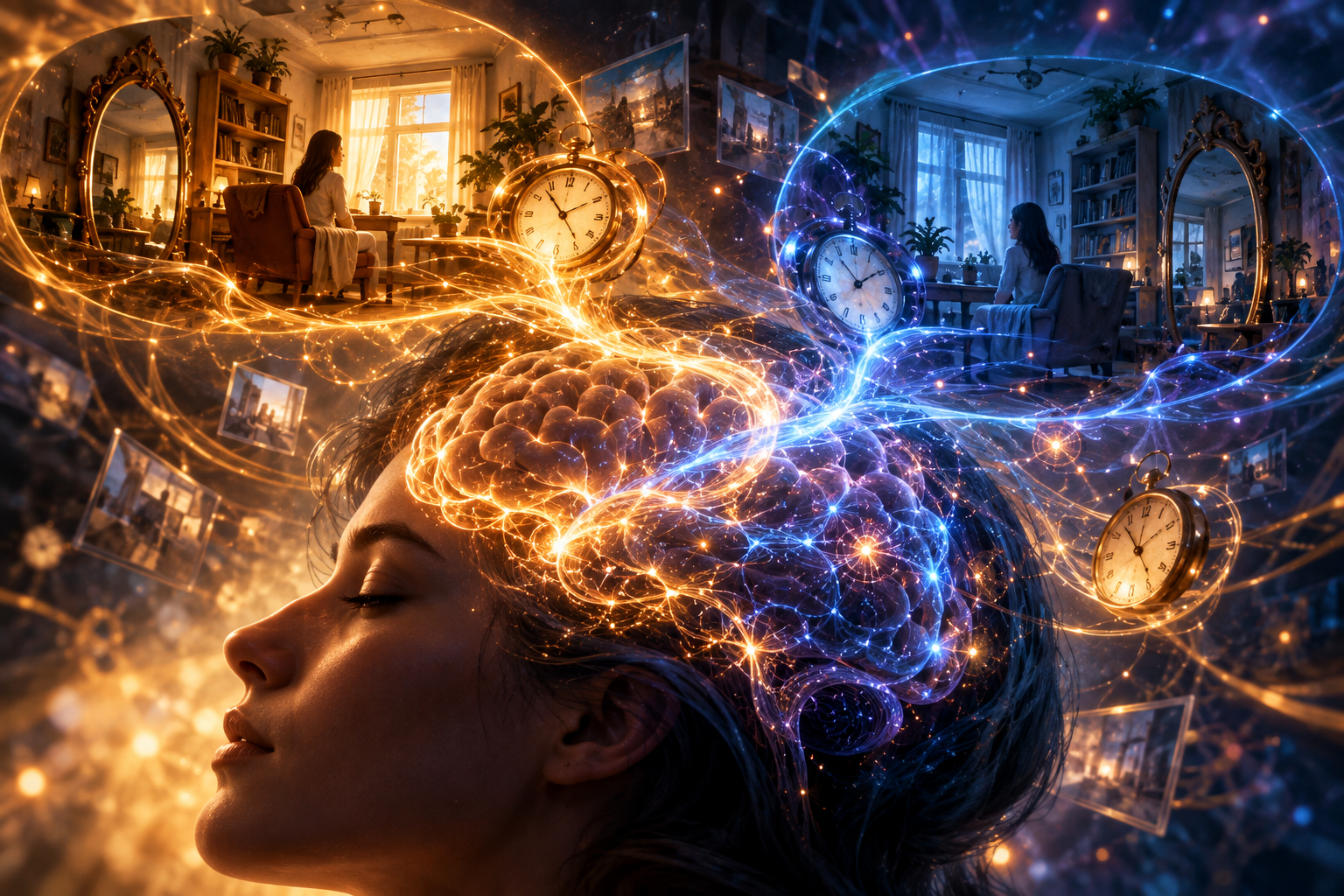
The Sensation of Living a Memory Twice
You are walking down a street in a foreign city you have never visited before, talking with a friend. Suddenly, a wave of intense familiarity washes over you. You feel certain that you have stood in this exact spot, heard these exact words, and seen this exact view before-even though you know rationally that it is completely impossible.
This uncanny psychological phenomenon is called Déjà Vu, a French phrase that translates literally to "already seen." Over 60% to 70% of healthy people experience déjà vu at least once in their lives, most frequently between the ages of 15 and 25.
What is actually happening inside your brain during these surreal moments? Is it a glimpse into a past life, a parallel universe, or simply a temporary hiccup in neural wiring?
How Memory Normally Works: The Dual-Track System
To understand déjà vu, neuroscientists first look at how the human brain processes everyday experiences. Memory formation relies heavily on two interconnected structures in the temporal lobes of your brain:
- The Hippocampus: The brain's central memory filing cabinet. It organizes, indexes, and stores factual details of events (what happened, where it happened, and who was there).
- The Parahippocampal Gyrus and Rhinal Cortex: The neural circuits responsible for generating the feeling of familiarity. When you see your best friend or your house, this area signals: "Hey, we know this!"
Under normal conditions, these two systems operate in perfect sync. You recognize a familiar friend (familiarity signal), and your hippocampus simultaneously pulls up the context of when you last saw them (recollection signal).
The Neuroscience Behind Deja Vu: The 4 Leading Theories
1. The Split Perception (Dual Processing) Theory
Imagine your brain receives sensory information through two slightly different neural pathways. Under normal circumstances, the signals arrive simultaneously (within milliseconds) and are merged into a single conscious perception.
However, if a microscopic transmission delay occurs along one pathway due to fatigue or distraction, your brain processes the first signal subliminally without your full conscious attention. When the second signal arrives a fraction of a millisecond later, your brain treats it as a brand-new experience that has already been registered in your memory-creating the illusion of a past event!
2. The Gestalt Familiarity Theory (Spatial Layout Matching)
Cognitive psychologist Dr. Anne Cleary at Colorado State University has conducted pioneering experiments on spatial memory. She discovered that déjà vu often triggers when the geometric arrangement of an environment closely matches a past scene you have forgotten.
For example, if the layout of furniture in a new doctor's waiting room, the angle of the windows, and the placement of the reception desk match the exact spatial geometry of your elementary school library, your brain's familiarity circuits fire off instantly. Because you do not consciously recall the old library, the feeling of familiarity attaches mysteriously to the present room.
3. The Temporal Lobe Neural "Glitch" (Micro-Seizure)
Just as a muscle in your eyelid can occasionally twitch involuntarily without causing harm, neurons in your temporal lobe can experience a tiny, harmless electrical misfire. When neurons in the rhinal cortex fire spontaneously during a mundane conversation, they broadcast an erroneous signal of "familiarity" to your conscious prefrontal cortex.
The rational part of your brain (the frontal lobe) quickly checks the memory archives, finds no matching past record, and realizes: "This feels familiar, but I know it cannot be!" This cognitive conflict is the exact hallmark feeling of déjà vu.
4. The Brain's "Fact-Checking" System at Work
Recent fMRI brain-scanning studies led by Dr. Akira O'Connor at the University of St Andrews revealed that during déjà vu, the memory centers of the brain (hippocampus) are not the most active regions. Instead, the prefrontal cortex-the area responsible for decision making, logic, and error detection-lights up intensely.
This suggests that déjà vu is actually a healthy sign of a young, agile brain conducting real-time quality control on its own memory circuits!
Why Does Deja Vu Happen Less as You Get Older?
Surveys show that déjà vu peaks during late adolescence and young adulthood (ages 15 to 25) and steadily declines as people age. Neuroscientists believe this occurs because young brains have highly active, rapidly firing neural connections that are constantly calibrating and checking memory errors. As we age, neural firing rates stabilize and the sensitivity of the brain's error-checking system gradually decreases.
Key Takeaways for Students
- Déjà vu is the sensation of feeling like a present event has already happened in the past.
- It is experienced by over two-thirds of healthy people, especially between ages 15 and 25.
- It is caused by minor neural timing delays, spatial geometry similarities, or temporary familiarity misfires in the temporal lobe.
- Experiencing déjà vu is a normal, healthy indicator that your brain's prefrontal cortex is actively fact-checking and resolving memory conflicts.
Frequently Asked Questions (FAQ)
Q1: What is the opposite of Déjà Vu?
A: The opposite is Jamais Vu (French for "never seen"). It is the bizarre feeling where something you know very well (like your own bedroom, or a word you have written hundreds of times) suddenly feels completely unfamiliar and alien.
Q2: Can lack of sleep or stress cause more déjà vu?
A: Yes! Fatigue, chronic stress, and sleep deprivation disrupt the precise timing of neural neurotransmitters, making temporary delays between memory and perception pathways more frequent.
Q3: Is déjà vu a sign of a medical problem?
A: For the vast majority of people, occasional déjà vu is completely harmless. However, if it happens multiple times a day accompanied by dizziness or loss of awareness, it can be associated with temporal lobe epilepsy and should be evaluated by a physician.
Classroom Memory Experiment: Can You Trigger Deja Vu in a Lab?
Can scientists artificially create the feeling of déjà vu in volunteers? In cognitive psychology experiments, researchers use virtual reality (VR) games to test the Spatial Layout Theory:
- Volunteers are asked to navigate through a virtual scene, such as a medieval castle garden with specific stone arches and pathways.
- Later, they are placed into a completely different environment-such as an ultra-modern space station-whose walls, corridors, and doorways have the exact same geometric layout as the castle garden.
- Even though the textures and objects are completely different, over 70% of volunteers report experiencing a powerful wave of déjà vu upon entering the space station!
Vocabulary Bank for Psychology & Neuroscience Students
- Hippocampus: A seahorse-shaped brain structure vital for long-term memory formation and spatial navigation.
- Rhinal Cortex: The region of the temporal lobe that evaluates familiarity without necessarily retrieving full contextual memory.
- Jamais Vu: The rare neurological sensation where a completely familiar object or word momentarily feels totally alien.
- Prefrontal Cortex: The frontal part of the brain that manages executive functions, logical reasoning, and cognitive error detection.