
The Game Show Puzzle That Broke Mathematicians' Minds
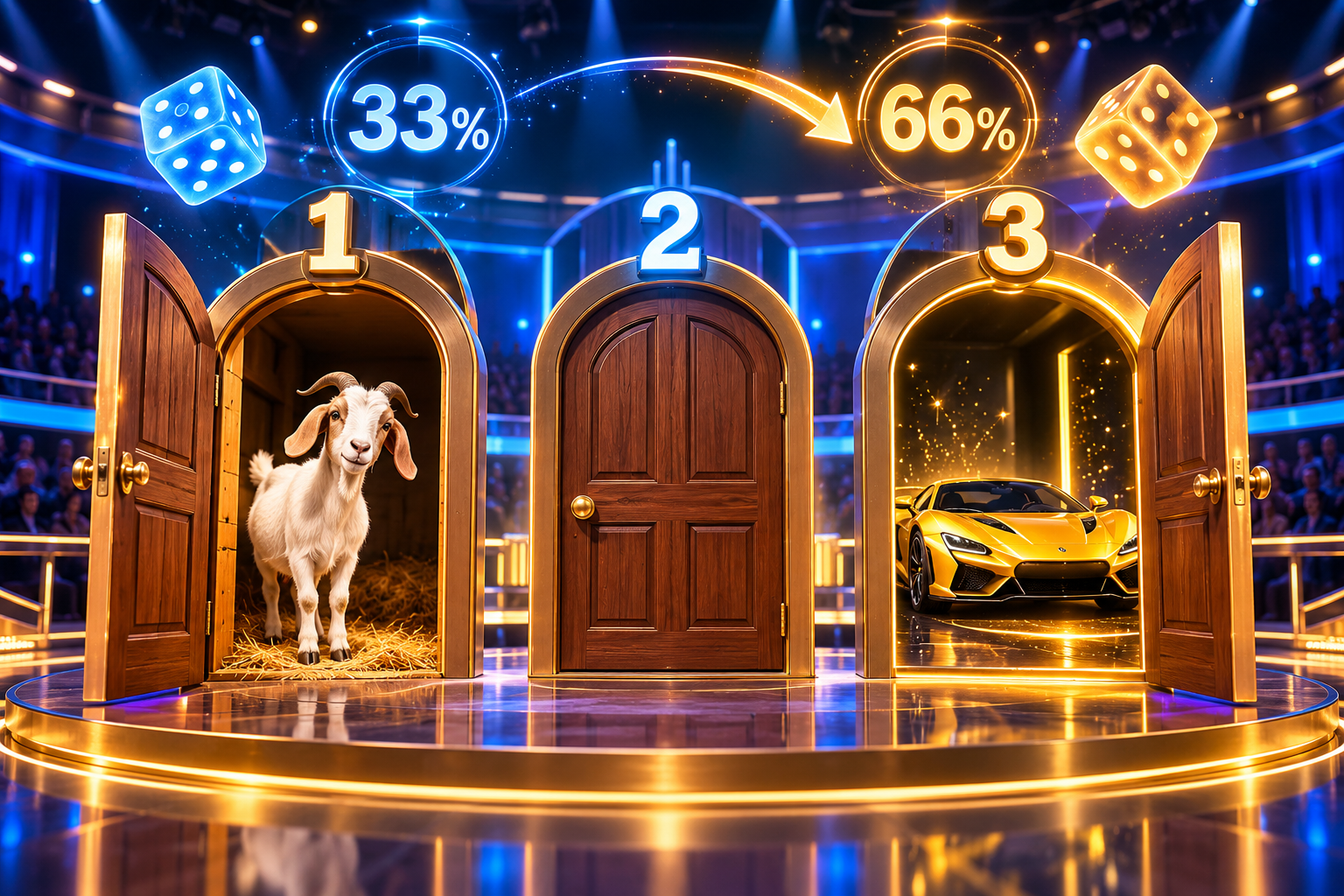
Imagine you are a contestant on a hit television game show. The host, smiling warmly, points toward three large closed doors labeled Door 1, Door 2, and Door 3. Behind one of the doors is a brand-new luxury sports car; behind the other two doors are live goats. The host asks you to pick a door. You pick Door 1.
Before opening Door 1, the host—who knows exactly what is behind every door—stops you. He walks over and opens Door 3, revealing a bleating goat. He then turns back to you with a suspenseful grin and asks: "Would you like to stick with your original choice, Door 1, or would you like to switch your choice to Door 2?"
What should you do? Does switching make any difference at all? Almost everyone's immediate gut intuition says: "There are two closed doors left, so the odds are 50/50. It doesn't matter whether I switch or stay." But your intuition is dead wrong. If you switch to Door 2, your probability of winning the sports car jumps to a staggering 66.7% (2 out of 3), while staying with Door 1 leaves you with only a 33.3% (1 out of 3) chance! Welcome to the famous Monty Hall Problem.
The 1990 Controversy: When PhDs Were Proven Wrong
In 1990, Marilyn vos Savant—listed in the Guinness Book of World Records for having one of the highest recorded IQs (228)—answered this question in her weekly column in Parade magazine. She advised contestants to always switch doors, explaining that switching gives you double the probability of winning.
Her column triggered an international uproar. The magazine received nearly 10,000 outraged letters, including approximately 1,000 letters from university professors, PhD mathematicians, and statistics experts. Many harshly ridiculed her:
- "You blew it, and you blew it big! Since you seem to have difficulty with basic math, please keep to your own field." — PhD, University of Florida
- "May I suggest that you obtain a textbook on probability before trying to answer such questions again?" — PhD, George Mason University
Yet, when computer simulations and mathematical proofs were published, Marilyn vos Savant was proven 100% correct, and the world's leading mathematicians had to publish humiliating public retractions!
The Feynman Analogy: The 1,000 Doors Game
Why does human intuition fail so miserably on three doors? Because three feels too small, making our brain collapse the remaining options into a false 50/50 symmetry. Richard Feynman always advocated scaling a problem up to extreme numbers to make the underlying physical reality obvious.
Imagine instead that Monty Hall presents you with 1,000 closed doors:
- Behind 1 door is a sports car; behind 999 doors are goats.
- You pick Door #1. Your chance of having picked the car is 1 in 1,000 (0.1%). That means there is a 999 in 1,000 (99.9%) chance the car is in the other 999 doors!
- Now Monty Hall walks onto the stage and systematically opens 998 other doors, revealing 998 goats. He leaves only your Door #1 and Door #777 closed.
- He asks: "Do you want to stick with Door #1, or switch to Door #777?"
Suddenly, the choice is crystal clear! You only had a 1-in-a-thousand lucky guess when you picked Door #1. The host actively used his secret knowledge to eliminate all 998 duds from the other pile, concentrating that entire 99.9% probability directly onto Door #777! The exact same logic applies to the 3-door game: your original pick holds 1/3 odds, and the host's deliberate goat-reveal concentrates the entire remaining 2/3 odds onto the unopened door.
The Mathematical Proof: All 3 Possible Scenarios
Because there are only three doors, we can prove the theorem beyond any doubt by mapping out every possible scenario:
| Scenario | Car Location | Your Initial Choice | Host Opens | Result if You STAY | Result if You SWITCH |
|---|---|---|---|---|---|
| Case 1 (1/3 probability) | Door 1 | Door 1 | Door 2 or Door 3 (Goat) | WIN CAR | Lose (Get Goat) |
| Case 2 (1/3 probability) | Door 2 | Door 1 | Door 3 (Forced Goat) | Lose (Get Goat) | WIN CAR |
| Case 3 (1/3 probability) | Door 3 | Door 1 | Door 2 (Forced Goat) | Lose (Get Goat) | WIN CAR |
Look at the table carefully. In 2 out of the 3 scenarios (Cases 2 and 3), you initially chose a goat. Because you chose a goat, the host is forced to reveal the only other goat. Therefore, switching guarantees you win the car in both of those cases! You only lose by switching if you were lucky enough to pick the car on your very first guess (Case 1), which only happens 1 out of 3 times.
Bayes' Theorem: The Formal Probability Proof
In formal probability theory, the Monty Hall problem is an illustration of Conditional Probability and Bayes' Theorem:
P(Car behind Door 2 | Host opens Door 3) = [P(Host opens Door 3 | Car behind Door 2) · P(Car behind Door 2)] / P(Host opens Door 3)
- The prior probability of the car behind Door 2 is P(Car behind Door 2) = 1/3.
- If the car is behind Door 2, the host has only one goat to reveal (Door 3), so P(Host opens Door 3 | Car behind Door 2) = 1.
- The total probability that the host opens Door 3 is P(Host opens Door 3) = 1/2.
- Plugging the numbers into the equation: P(Car behind Door 2 | Host opens Door 3) = [1 · (1/3)] / (1/2) = 2/3!
Why Our Brain Resists the Truth
Psychologists and cognitive scientists have studied why people stubbornly resist the Monty Hall solution. The primary cognitive biases at play include:
- The Equipartition Fallacy: When humans see two unknown options remaining, our brains instinctively assume an equal 50/50 distribution of probability, ignoring the historical process that eliminated the other options.
- Regret Aversion: People feel far worse if they switch away from Door 1 and lose, compared to staying with Door 1 and losing. We perceive switching as an active mistake and staying as passive bad luck.
- Ignoring the Host's Intent: People assume the host opened a random door. If the host opened a door at random and accidentally revealed a goat, the odds would indeed be 50/50! But Monty Hall does not act randomly; he acts with complete insider knowledge.
Vocabulary Bank for Mathematics Students
- Conditional Probability: The probability of an event occurring, given that another event has already occurred.
- Bayes' Theorem: A mathematical formula for calculating conditional probability, describing how to update the probability of a hypothesis as more evidence becomes available.
- Prior Probability: The initial probability of an event before any new information or evidence is taken into account.
- Posterior Probability: The revised or updated probability of an event occurring after taking into account new information.
- Equipartition Fallacy: The erroneous cognitive assumption that all possible outcomes in an uncertain situation are equally likely.
- Sample Space: The set of all possible outcomes or results of an experiment or random trial.
Frequently Asked Questions (FAQ)
Q1: What happens if Monty Hall doesn't know where the car is and opens Door 3 by accident?
A: This is known as the "Monty Fall" variant! If the host chooses a door completely at random and it happens to be a goat, the probability resets to a true 50/50 between Door 1 and Door 2. The host's deliberate knowledge and intent are what skew the probability to 2/3.
Q2: Has this ever been tested with real computer simulations?
A: Thousands of times! Anyone can write a 15-line Python script simulating 1,000,000 rounds of the game. In every single simulation, the "stay" strategy wins almost exactly 333,333 times (33.3%), while the "switch" strategy wins almost exactly 666,667 times (66.7%).
Q3: Can pigeons solve the Monty Hall problem?
A: Remarkably, yes! In a famous 2010 study published in the Journal of Comparative Psychology, researchers tested both human college students and pigeons on repeated trials of the Monty Hall problem with food rewards. Humans switched only about 30% of the time despite losing consistently. Pigeons, driven purely by reinforcement learning without human cognitive biases, learned to switch nearly 95% of the time, maximizing their food!
Q4: Why does Monty Hall always offer the switch?
A: In the original 1960s TV game show Let's Make a Deal, Monty Hall did not always offer contestants the option to switch. He used the offer psychologically to tempt contestants into making bad deals or to build suspense for viewers.