
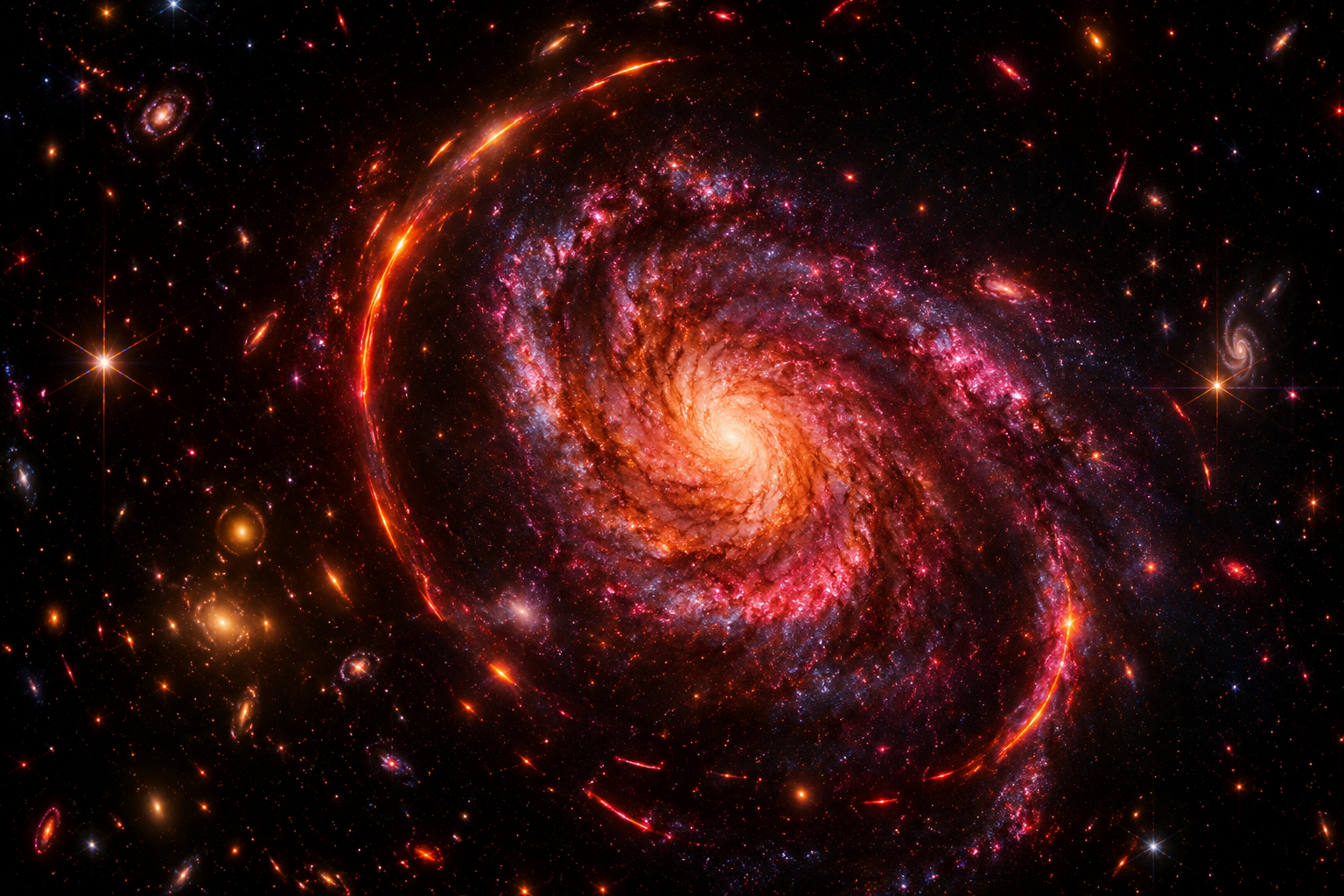
When the James Webb Space Telescope (JWST) was launched on Christmas Day 2021 and unfurled its 6.5-meter gold-coated beryllium mirror 1.5 million kilometers from Earth at the Second Lagrange Point (L2), astronomers believed they knew what they would find. Equipped with ultra-sensitive infrared instruments capable of peering back over 13.5 billion years, JWST was expected to capture images of the universe's earliest infant galaxies-small, faint, chaotic clumps of gas taking their very first tentative steps toward forming stars.
Instead, the data beaming down from JWST has delivered the biggest crisis in modern astrophysics in half a century. In the deepest, earliest epochs of cosmic history-scarcely 300 to 500 million years after the Big Bang-JWST has uncovered glowing cosmic monsters: massive, highly organized, and hyper-luminous galaxies containing almost as many stars as the modern Milky Way.
According to our standard models of physics, these galaxies simply should not exist.
The Standard Cosmological Model (Lambda-CDM) Under Siege
To understand why these observations have rattled the scientific community, one must look at the standard blueprint of the universe, known as the Lambda-CDM (Cold Dark Matter) Model.
According to Lambda-CDM:
- Following the Big Bang, the universe was a smooth, hot soup of hydrogen, helium, and invisible dark matter.
- Over hundreds of millions of years, gravity caused dark matter to slowly coalesce into dense "halos."
- Only after dark matter halos grew sufficiently massive could ordinary gas fall into them, cool down, and slowly ignite the very first stars (Population III stars).
- Galaxy growth was assumed to be a gradual, bottom-up process requiring billions of years of mergers and accretion to build massive, structured spiral or elliptical galaxies.
Yet, JWST galaxies like JADES-GS-z14-0 (observed just 290 million years after the Big Bang) are not tiny seedlings. They are sprawling, mature, and extraordinarily bright, containing billions of solar masses of stars already enriched with heavy chemical elements like oxygen and carbon.
The Three Leading Scientific Theories Explaining the Mystery
Astrophysicists and cosmologists around the globe are fiercely debating three primary hypotheses to resolve the "Impossible Early Galaxy" paradox:
1. Direct Collapse Supermassive Primordial Black Holes
In the modern universe, supermassive black holes grow slowly at the centers of galaxies over billions of years. However, if giant pockets of pristine gas in the early universe collapsed directly under their own gravity without forming intermediate stars-a process known as Direct Collapse Black Holes (DCBH)-supermassive seeds with masses 100,000 to 1,000,000 times that of the Sun could have existed almost immediately after the Big Bang.
These colossal central engines would aggressively accrete surrounding gas, releasing blinding amounts of radiation (active galactic nuclei) that makes early embryonic galaxies appear deceptively massive and luminous in JWST's infrared sensors.
2. The Top-Heavy Initial Mass Function (IMF)
In our local neighborhood of the Milky Way, star formation produces mostly small, faint stars (like red dwarfs) and relatively few giant stars. But in the ultra-pristine, metal-free environment of the early universe, physics dictates that gas clouds could not easily cool and fragment into small pieces.
Instead, early star-forming regions may have produced exclusively monster stars-hundreds or thousands of times more massive and millions of times brighter than our Sun. Under this "top-heavy" scenario, a galaxy would not need billions of stars to shine brilliantly; a smaller cluster of hyper-massive stars would emit enough infrared light to look like a giant galaxy.
3. Re-evaluating Dark Matter and Cosmic Expansion
The most radical possibility is that the fundamental equations governing dark matter clustering or cosmic expansion need revision. If dark matter interacted with itself or with radiation differently than assumed in Lambda-CDM, structural collapse in the early universe may have occurred orders of magnitude faster than conventional simulations predicted.
Heavy Elements at Cosmic Dawn: The Chemical Enigma
Perhaps the most baffling discovery from JWST's Near-Infrared Spectrograph (NIRSpec) is the detection of heavy elements (metallicity) in these primordial galaxies. In astrophysics, any element heavier than hydrogen and helium is classified as a "metal" (such as carbon, oxygen, nitrogen, and iron).
Metals are forged exclusively inside the thermonuclear hearts of massive stars and dispersed across space when those stars explode as supernovae. The fact that JWST observes high abundances of oxygen and dust just 300 million years after the Big Bang implies that multiple full generations of massive stars had already been born, lived, and died in an eye-blink of cosmic time.
A Golden Age of Cosmological Discovery
Science progresses most rapidly not when theories are confirmed, but when observations shatter established expectations. The James Webb Space Telescope is fulfilling its ultimate scientific purpose: by challenging our fundamental paradigms of cosmic dawn, it is forcing humanity to rewrite the opening chapters of our universe's 13.8-billion-year history.
Key Cosmic Dawn Galaxies Observed by JWST
| Galaxy Name | Redshift (z) | Time After Big Bang | Key Anomaly |
|---|---|---|---|
| JADES-GS-z14-0 | z = 14.32 | ~290 Million Years | Extremely luminous, large stellar radius, heavy oxygen lines |
| GLASS-z12 | z = 12.11 | ~350 Million Years | Compact disk structure far earlier than theoretical formation limits |
| GN-z11 | z = 10.60 | ~400 Million Years | Central supermassive black hole accreting at extreme Eddington rates |
Frequently Asked Questions (FAQ)
1. Does JWST disprove the Big Bang?
No. The Big Bang itself is supported by overwhelming cosmic microwave background (CMB) evidence. What JWST challenges is not the origin of the universe, but the speed and mechanics of early galaxy and star formation.
2. Why is infrared vision essential to see the early universe?
As the universe expands, light traveling from distant galaxies is stretched (cosmological redshift) from visible light into deep infrared wavelengths, making JWST's chilled infrared detectors uniquely capable of seeing them.
The Spectroscopic Fingerprints of Cosmic Dawn
The true power of the James Webb Space Telescope lies in its spectroscopy. When JWST disperses the light from galaxy JADES-GS-z14-0 through its diffraction gratings, it produces a detailed chemical fingerprint (emission spectra). The detection of strongly ionized oxygen (O III at 500.7 nanometers rest wavelength) and hydrogen Balmer lines proves that massive star clusters were actively ionizing the surrounding intergalactic medium, driving the Epoch of Reionization hundreds of millions of years earlier than theoretical astrophysical models ever anticipated.
Upcoming Observations and Gravitational Lensing Campaigns
Astronomers are now utilizing massive galaxy clusters (such as MACS J0416 and SMACS 0723) as natural cosmic magnifying glasses. Through gravitational lensing, the intense gravitational curvature of these foreground clusters magnifies background cosmic-dawn galaxies by factors of 10x to 50x, allowing JWST to resolve individual star-forming nurseries and black hole accretion disks in the newborn universe.