
The Quest for Eternal Youth in Nature
For millennia, human mythology has been captivated by the idea of an Elixir of Life or a Fountain of Youth. Ancient kings and explorers sailed across unmapped oceans searching for a secret potion that could reverse the ravages of old age. Yet, while humans wrote legends, evolution quietly engineered an organism that achieved this exact feat in the sunlit shallows of the Mediterranean Sea. Meet Turritopsis dohrnii, popularly known to marine biologists as the Immortal Jellyfish.
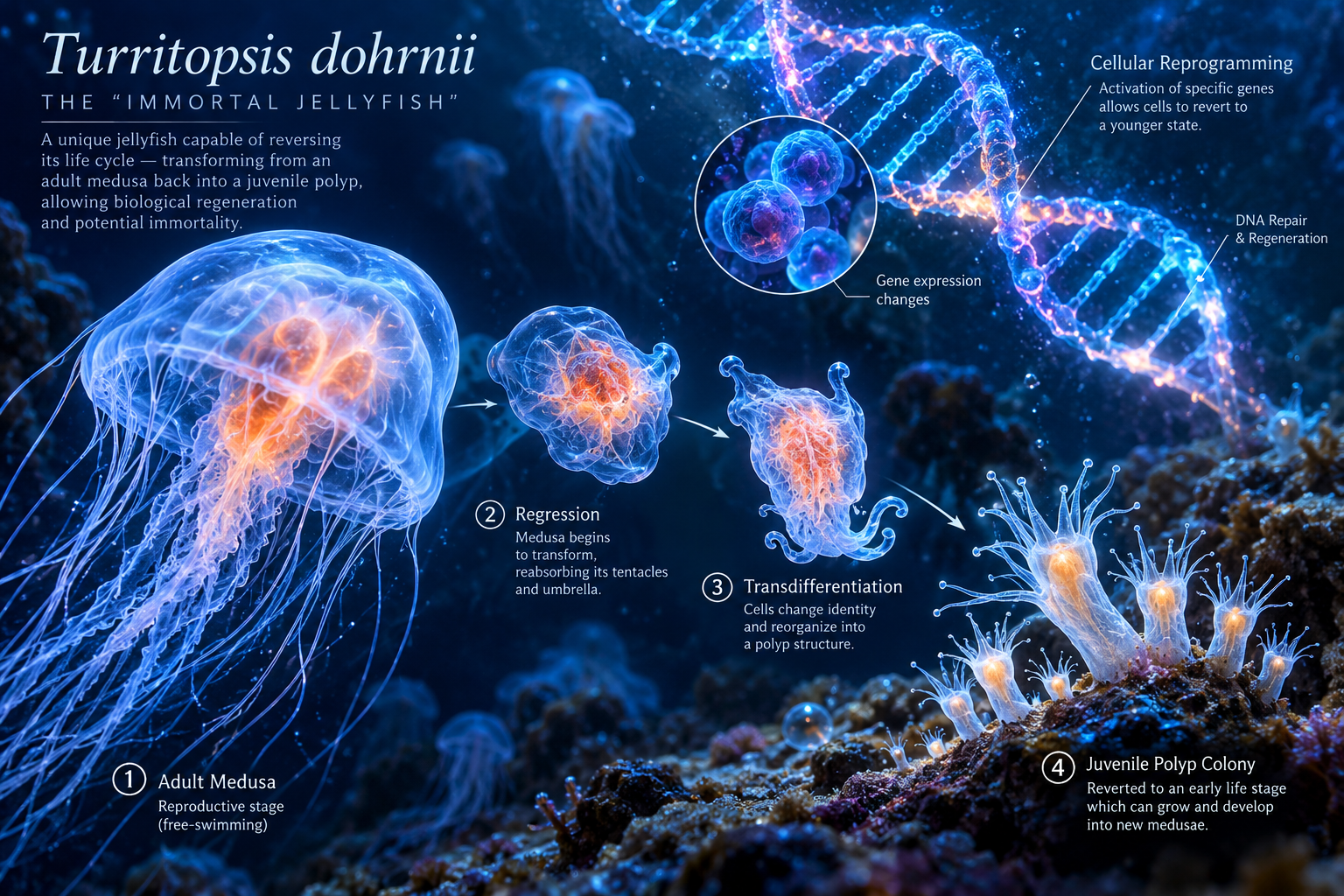
Unlike every other known complex animal on Earth that progresses through a one-way life cycle from birth to maturity to death, Turritopsis dohrnii possesses the unique biological capability to reverse its biological clock. When confronted with physical trauma, starvation, sudden temperature shifts, or the natural wear-and-tear of aging, an adult jellyfish does not die. Instead, it transforms its cells, re-absorbs its tentacles, shrinks into a blob, and regenerates into a baby colony of polyps, restarting its entire life cycle from scratch.
The Feynman Analogy: The Reversible Butterfly
To grasp just how astonishing this biological superpower is, consider an analogy from everyday biology. We all learn in elementary school about the life cycle of a butterfly: an egg hatches into a caterpillar, the caterpillar enters a chrysalis, and out emerges a winged adult butterfly. In the normal natural order, the adult butterfly mates, ages, and dies.
Now imagine if an aging adult butterfly, injured by a bird or running out of nectar, could land on a tree branch, melt its wings, dissolve its antennae, re-wrap itself into a pupa, and emerge three days later as a newborn, healthy caterpillar! That sounds like pure science fiction, yet that is the exact daily biological reality of Turritopsis dohrnii.
How the Life Cycle Reversal Works: Transdifferentiation
The secret weapon behind this jellyfish's biological immortality is an extraordinary cellular mechanism known as Transdifferentiation. To appreciate transdifferentiation, we must look at how animal cells specialize.
In human biology, an embryonic stem cell starts as a "blank slate." It differentiates into specialized cells—a heart cell, a neuron, a skin cell, or a bone cell. In almost all adult animals, this specialization is a one-way street: once a skin cell becomes a skin cell, it cannot decide to become a muscle cell or a brain cell.
Turritopsis dohrnii breaks this fundamental cellular law. During its rejuvenating metamorphosis:
- Cellular De-differentiation: Mature bell and tentacle cells shed their specialized identities, turning back into primitive stem-like cells.
- Cellular Re-differentiation: These reprogrammed cells re-specialize into entirely new cell types—such as polyp stalk cells and digestive cells.
- Cyst Formation: The jellyfish's pulsating bell contracts into a compact ball called a cyst, sinking to the seabed.
- New Polyp Colony: From this cyst, new stolons (root-like runners) sprout within 24 to 72 hours, producing an entirely new, genetically identical polyp colony. Eventually, hundreds of genetically identical baby jellyfish bud off from this colony into the sea!
Comparison: Standard Animal Aging vs Turritopsis Lifecycle
| Feature | Standard Complex Animals (Mammals, Birds, Fish) | The Immortal Jellyfish (Turritopsis dohrnii) |
|---|---|---|
| Direction of Life Cycle | Strictly linear (Zygote → Juvenile → Adult → Senescence → Death) | Cyclical and reversible (Planula → Polyp → Medusa → Polyp...) |
| Cell Fate Flexibility | Terminally differentiated; adult cells cannot swap lineages | Fully plastic via natural cellular transdifferentiation |
| Response to Starvation / Injury | Cellular necrosis, organ failure, and biological death | Triggers retro-metamorphosis back to the juvenile polyp stage |
| Telomere Shortening | Telomeres shorten with every division, causing cellular senescence | Maintains robust telomerase activity and DNA repair mechanisms |
| Maximum Theoretical Lifespan | Genetically capped by biological aging limit (Hayflick limit) | Theoretically infinite (barring predation, disease, or ocean filters) |
Does It Mean the Jellyfish Can Never Die?
It is crucial to distinguish between biological immortality and invulnerability. Turritopsis dohrnii is not Superman. It is a tiny creature measuring only 4.5 millimeters across—roughly the size of a pinky fingernail.
If a sea turtle, fish, or crab scoops up the jellyfish and eats it, the jellyfish dies. If it is caught in a ship's ballast water filter or poisoned by toxic chemical spills, it dies. What makes it "immortal" is that it does not suffer from intrinsic senescence—it does not die from old age. Barring predators and lethal disease, a single individual can theoretically cycle between adult and juvenile states indefinitely.
What Can Human Medicine Learn from the Immortal Jellyfish?
In 2022, researchers at the University of Oviedo in Spain sequenced the entire genome of Turritopsis dohrnii and compared it with closely related jellyfish species that cannot reverse aging. Their discoveries have electrified the field of regenerative medicine:
- DNA Repair Duplication: Turritopsis possesses double the copies of genes associated with DNA replication, oxidative stress defense, and chromosomal repair compared to ordinary jellyfish.
- Telomere Maintenance: Its genome produces abundant telomerase, preventing the degradation of protective chromosome caps (telomeres) that drive human aging.
- Epigenetic Reprogramming: The jellyfish can silence and re-awaken specific genetic switches without altering its underlying DNA sequence, proving that cellular identity can be reset naturally.
- Stem Cell Therapy Implications: Understanding the molecular triggers of transdifferentiation may allow medical scientists to reprogram human scar tissue after heart attacks into healthy cardiac muscle cells, or damaged neural tissue in Parkinson's disease into functional neurons.
Vocabulary Bank for Biology Students
- Transdifferentiation: A rare biological process where a non-stem cell transforms directly into a completely different type of cell without undergoing an intermediate pluripotent state.
- Medusa: The free-swimming, umbrella-shaped sexual stage in the life cycle of a cnidarian (jellyfish).
- Polyp: The sessile, stalked asexual stage in a cnidarian life cycle that anchors to underwater surfaces.
- Senescence: The condition or process of biological deterioration with age, characterized by cellular damage and loss of division potential.
- Telomere: A repetitive nucleotide sequence at the end of each chromosome that protects genetic code from degradation during cell division.
- Planula: The free-swimming, ciliated, flattened larval stage of a jellyfish that settles on rocks to form a polyp.
Frequently Asked Questions (FAQ)
Q1: How many times can a single Turritopsis dohrnii reverse its age?
A: In controlled laboratory experiments, scientists have documented individual specimens reverting from adult medusa to polyp colonies and growing back to adult medusae more than 10 to 12 consecutive times without showing any signs of genetic exhaustion.
Q2: Where does the Immortal Jellyfish live?
A: Originally native to the Mediterranean Sea, Turritopsis dohrnii has now spread to oceans worldwide, including the coasts of Japan, Panama, Florida, and Europe, hitching rides inside commercial cargo ships' ballast water tanks.
Q3: Could human beings ever become biologically immortal using jellyfish genes?
A: Humans cannot simply inject jellyfish DNA to live forever. Mammalian bodies are vastly more complex, comprising trillions of interconnected cells organized into intricate organs with rigid skeletons and delicate nervous systems. However, the genetic principles discovered in jellyfish are already inspiring therapies for organ regeneration, cancer research, and anti-aging treatments.
Q4: How long does the rejuvenation process take?
A: Once triggered by environmental distress or aging, the entire transformation from free-swimming medusa to an anchored juvenile polyp stolon typically takes between 24 to 72 hours.