
The Secret Code Hidden Across Nature
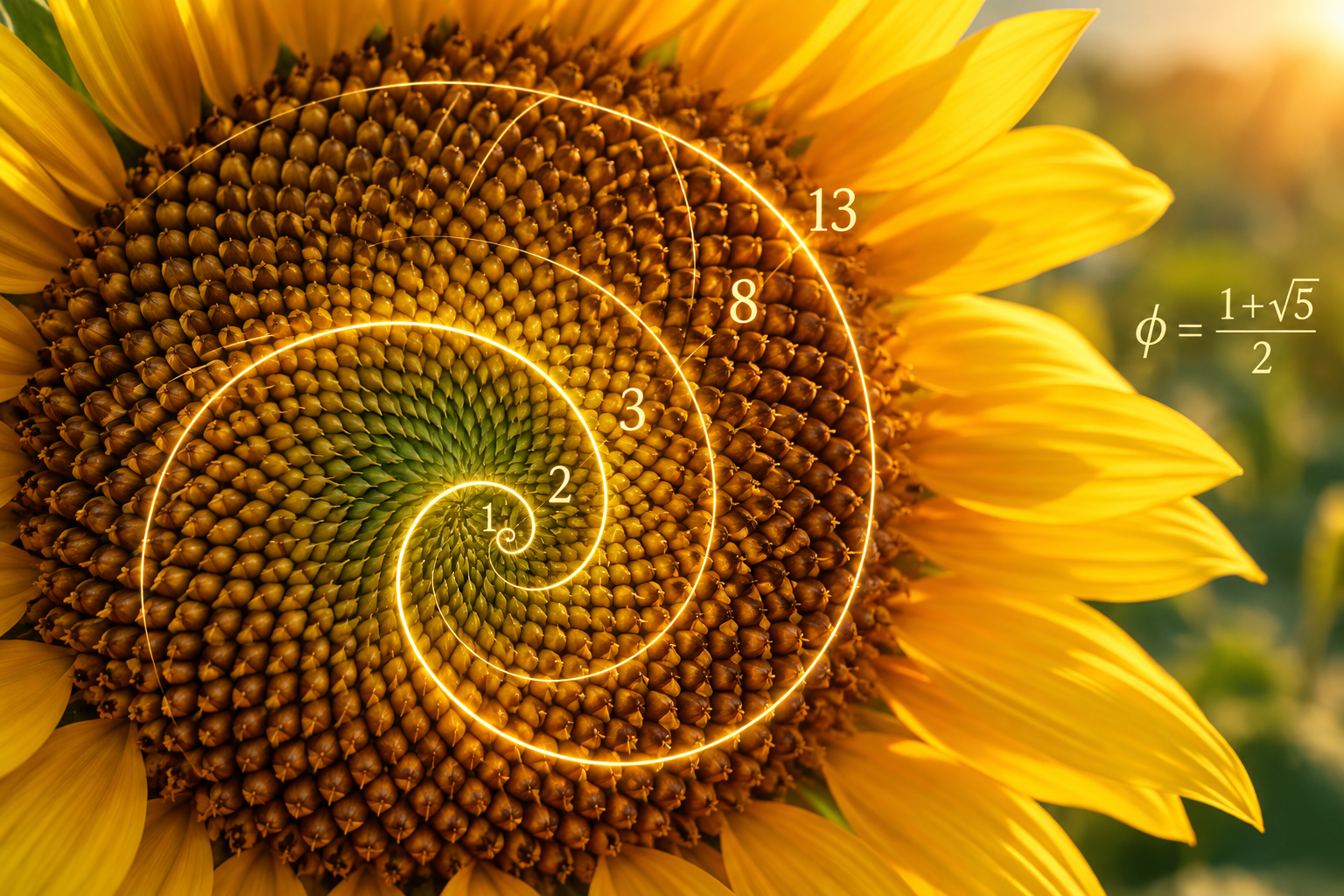
If you look closely at the spiral pattern of seeds in the center of a sunflower, count the scales on a pinecone, or examine the delicate curve of a nautilus seashell, you will find that nature is not growing randomly. Instead, living organisms build themselves using a precise, universal mathematical recipe known as the Fibonacci Sequence.
Why does nature love this specific number pattern so much? The reason is rooted in pure mathematical efficiency and the laws of optimal packing.
What Is the Fibonacci Sequence?
The Fibonacci sequence is one of the simplest yet most profound sequences in all of mathematics. It begins with the numbers 0 and 1. To find each subsequent number in the sequence, you simply add the two previous numbers together:
- 0 + 1 = 1
- 1 + 1 = 2
- 1 + 2 = 3
- 2 + 3 = 5
- 3 + 5 = 8
- 5 + 8 = 13
- 8 + 13 = 21
- 13 + 21 = 34
- 21 + 34 = 55
- 34 + 55 = 89 ... and so on to infinity!
The sequence was described in ancient Indian mathematical texts by scholars like Pingala and Hemachandra centuries before it was introduced to the Western world in 1202 by the Italian mathematician Leonardo of Pisa (known as Fibonacci) in his landmark book Liber Abaci.
The Golden Ratio: Nature's Perfect Fraction
The true magic of the Fibonacci sequence emerges when you divide any Fibonacci number by the one immediately before it:
- 5 / 3 = 1.666...
- 13 / 8 = 1.625
- 55 / 34 = 1.6176...
- 89 / 55 = 1.61818...
As the numbers grow larger, the ratio between consecutive numbers converges toward a mysterious irrational mathematical constant known as the Golden Ratio, represented by the Greek letter Phi (\Phi ~ 1.6180339887...).
Where Fibonacci Appears in Living Things
1. Sunflower Seed Heads
Look at the face of a mature sunflower. The seeds do not form straight rows; they form interlocking spirals curving clockwise and counterclockwise. If you count the spirals in both directions, you will almost always find consecutive Fibonacci numbers: 34 spirals in one direction and 55 in the other, or 55 and 89 on larger heads.
By rotating each new seed bud by the Golden Angle (approx. 137.5 degrees), the plant achieves the absolute maximum packing density. No empty gaps are left, and no seeds crush one another!
2. Pinecones and Pineapples
A pinecone exhibits spiral rows of woody scales radiating from its stem. Counting the steep spirals will reveal pairs of Fibonacci numbers like 5 and 8, or 8 and 13. Similarly, the hexagonal fruitlets on the surface of a pineapple are arranged in diagonal spirals of 8, 13, and 21.
3. Flower Petal Counts
Most wild flowers possess a petal count that is directly a Fibonacci number:
- 1 petal: White Calla Lily
- 2 petals: Euphorbia
- 3 petals: Lily and Iris
- 5 petals: Buttercup, Wild Rose, and Hibiscus
- 8 petals: Delphinium
- 13 petals: Marigold and Ragwort
- 21 petals: Black-eyed Susan
- 34 or 55 petals: Daisy species
4. Leaf Arrangement (Phyllotaxis)
As a tree branch grows upward, leaves sprout around the stem at regular angular intervals. If you start at one leaf and count the number of leaves until you find one positioned directly above the starting leaf, the number of turns around the stem and the number of leaves passed are almost always Fibonacci numbers (e.g., 3 turns and 5 leaves, or 5 turns and 8 leaves). This ensures that upper leaves never block sunlight or raindrops from reaching lower leaves!
The Golden Spiral
If you draw a series of squares whose side lengths equal the Fibonacci numbers (1, 1, 2, 3, 5, 8, 13...) and draw a smooth circular arc through the corners of each square, you produce a logarithmic spiral called the Golden Spiral. This precise logarithmic curve is mirrored in the shells of marine nautiluses, the swirl of ocean hurricanes, and the arms of spiral galaxies like the Milky Way.
Key Takeaways for Students
- The Fibonacci sequence is formed by adding the two previous numbers together (0, 1, 1, 2, 3, 5, 8...).
- Dividing consecutive Fibonacci numbers yields the Golden Ratio (\Phi ~ 1.618).
- Plants use the Golden Angle (137.5°) to pack seeds and leaves with maximum geometric efficiency without wasting sunlight or space.
- Math is not just an invention of textbooks; it is the fundamental language written into the structure of living nature.
Frequently Asked Questions (FAQ)
Q1: Why do plants grow with the Golden Angle (137.5°) instead of simple fractions like 1/2 or 1/4?
A: If a plant grew leaves at 1/4 turn (90°), leaf #5 would grow directly above leaf #1, completely blocking its sunlight. The Golden Angle is based on the most irrational number, meaning leaves will never line up directly on top of each other, ensuring maximum sunlight for every leaf.
Q2: Who discovered the Fibonacci sequence first?
A: Indian mathematicians like Pingala (around 200 BCE) and Virahanka (c. 700 CE) described the sequence in prosody poetry centuries before Leonardo Fibonacci published it in Europe in 1202.
Q3: Does every single flower have Fibonacci petals?
A: While the vast majority do, environmental variations, mutations, or damaged petals during growth can sometimes produce non-Fibonacci counts in individual specimens.
Historical Spotlight: How Ancient Indian Scholars Discovered the Pattern
While the sequence is named after the Italian mathematician Fibonacci (Leonardo of Pisa), the mathematical pattern was formulated centuries earlier in India. Around 200 BCE, the ancient scholar Pingala studied Sanskrit poetic meters (prosody), where verses are composed of short (laghu) and long (guru) syllables.
Scholars like Virahanka (c. 700 CE), Gopala (c. 1135 CE), and Hemachandra (1150 CE) explicitly wrote down the recurrence relation F_n = F_{n-1} + F_{n-2} to calculate how many poetic rhythms of a given length could be formed. Leonardo of Pisa encountered this knowledge while traveling across North Africa and introduced it to Europe in 1202 to solve his famous thought problem about rabbit breeding populations!
Vocabulary Bank for Math Students
- Recurrence Relation: An equation that defines a sequence based on a rule to find the next term from the previous terms.
- Golden Ratio (\Phi): The irrational number (1 + \sqrt{5}) / 2 ~ 1.6180339887... representing optimal divine proportion.
- Phyllotaxis: The arrangement of leaves or buds on a plant stem to maximize exposure to sunlight and rain.
- Logarithmic Spiral: A self-similar spiral curve where the distance between turns increases exponentially.