
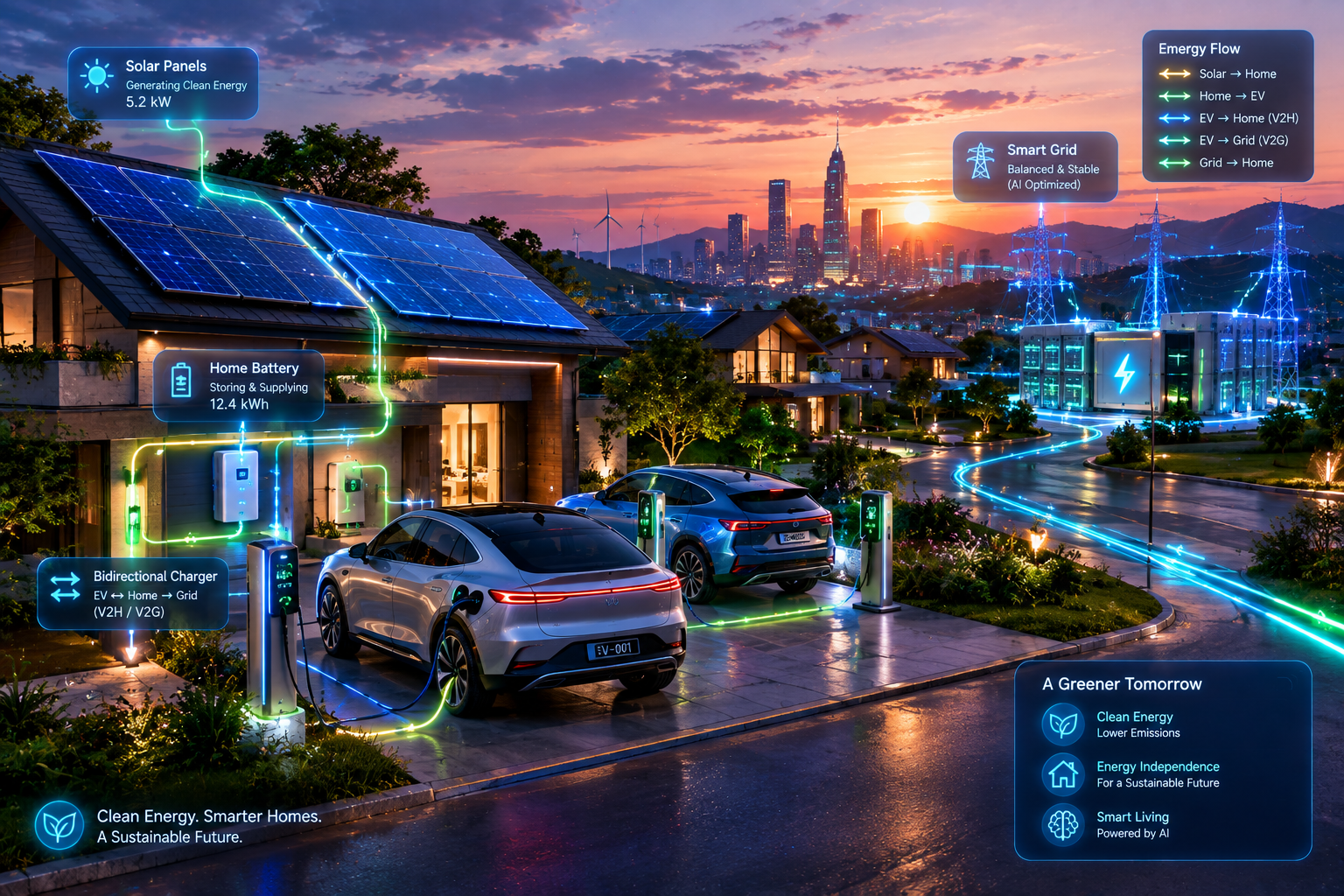
For more than a century, the global electrical grid operated under an unyielding, top-down architecture. Massive, centralized coal, gas, hydro, or nuclear power plants generated electricity in bulk, stepped up voltages through roaring transformers, and pushed electrons down thousands of miles of transmission lines into passive homes, factories, and commercial buildings. Consumers simply flipped a switch, consumed power, and paid a monthly utility bill.
However, the rapid acceleration of climate change, the electrification of transportation, and the vulnerability of aging centralized grids to extreme weather have catalyzed a profound transformation: the 'Everything-to-Grid' (E2G / V2G) Revolution. Electricity is no longer a one-way street; it has become a dynamic, bidirectional ecosystem where every home, battery, and electric vehicle acts as an active, grid-stabilizing power node.
The Anatomy of Bidirectional Energy Flow
The cornerstone of this decentralized transition is bidirectional power electronics. Traditional chargers only permit power to flow from the grid into a device's battery. Bidirectional inverters allow energy to flow in reverse-extracting stored chemical energy from batteries and converting it into AC power for immediate household consumption or feeding it back into the municipal grid.
The Key Acronyms Reshaping Energy:
- V2H (Vehicle-to-Home): Using an EV's high-capacity battery pack to power essential home appliances during peak-rate hours or emergency grid outages.
- V2G (Vehicle-to-Grid): Exporting surplus vehicle battery power back to utility operators during severe regional demand spikes, earning financial credits for the vehicle owner.
- B2G (Building-to-Grid): Commercial office parks and residential complexes equipped with integrated solar glass and stationary storage acting as localized micro-utilities.
Electric Vehicles: The World's Largest Distributed Battery Bank
Consider the staggering mathematical potential of electric vehicles. A typical residential stationary battery backup (such as a Tesla Powerwall) holds around 13.5 kilowatt-hours (kWh) of energy. In contrast, a modern electric SUV or pickup truck carries a battery pack ranging from 75 kWh to over 130 kWh-enough electricity to power an average household for 3 to 7 consecutive days.
When millions of EVs are parked overnight, they represent hundreds of gigawatt-hours of idle energy capacity. Through intelligent V2G coordination, utilities can tap into a microscopic fraction (5%-10%) of each participating car's battery during heatwaves or sudden renewable drop-offs. This eliminates the need to fire up expensive, polluting fossil-fuel "peaker plants."
Virtual Power Plants (VPPs) and AI Grid Orchestration
Managing millions of fluctuating residential solar panels, home batteries, smart thermostats, and EV chargers in real time exceeds human operational capacity. This is where AI-driven Virtual Power Plants (VPPs) come in.
A VPP is a software-defined cloud network that aggregates thousands of independent, decentralized energy assets and orchestrates them as a unified power station. Machine learning algorithms continuously ingest:
- Weather Forecasts: Predicting solar irradiance and wind velocity down to hyper-local geographic zones.
- Wholesale Energy Price Fluctuations: Automatically discharging batteries when spot prices surge and charging them when renewable energy is abundant and cheap (or even negatively priced).
- User Behavioral Patterns: Learning commuting schedules so an EV is always fully charged when its owner needs to drive to work.
Next-Generation Battery Chemistries Accelerating the Transition
Early consumer hesitancy surrounding V2G centered on concerns over battery degradation from repeated charge-discharge cycles. Breakthroughs in materials science have largely resolved this dilemma:
- Lithium Iron Phosphate (LFP) Chemistries: Offering cycle lifespans exceeding 4,000 to 6,000 full charge cycles, allowing daily grid cycling for decades with negligible capacity loss.
- Sodium-Ion Batteries: Utilizing earth-abundant, low-cost sodium rather than expensive nickel or lithium, making large stationary household and community storage accessible worldwide.
- Solid-State Electrolytes: Eliminating flammable liquid electrolytes, boosting energy density by 50%, and enabling ultra-fast charging without thermal degradation risks.
Economic Benefits: Turning Consumers into 'Prosumers'
In traditional electricity markets, consumers are purely cost-bearing entities. In the Everything-to-Grid model, homeowners and vehicle owners transition into prosumers-simultaneously producing and consuming power. In pioneer jurisdictions (such as California, Australia, and parts of Europe), households participating in automated VPPs earn hundreds to thousands of dollars annually in grid-stabilization credits simply by letting their home batteries shave peak grid loads.
The Future: Energy Democracy and Extreme Resilience
The 'Everything-to-Grid' paradigm fundamentally democratizes energy infrastructure. In place of fragile, centralized monopolies susceptible to single-point failures, humanity is constructing a distributed, resilient, and decarbonized energy web. Every building becomes a solar power station, every parking garage becomes a reserve battery bank, and every citizen becomes an active stakeholder in planetary sustainability.
Financial Blueprint: How a Typical Household Earns with V2G
In a standard residential V2G deployment, a homeowner with an 80 kWh EV battery and 6 kW rooftop solar array optimizes their energy cashflow through automated time-of-use arbitrage:
- 10:00 AM - 3:00 PM (Solar Soak): The vehicle charges from surplus rooftop solar when wholesale grid power is cheapest.
- 6:00 PM - 9:00 PM (Peak Discharge): As regional electricity demand peaks and grid prices surge, the vehicle discharges 15 kWh back into the home and grid, avoiding expensive peak rates.
- Overnight (Baseload Leveling): The car recharges to 90% capacity during off-peak overnight hours (1:00 AM - 5:00 AM) when wind energy is abundant.
Frequently Asked Questions (FAQ)
1. Does bidirectional V2G ruin my car battery warranty?
Leading automakers (including Nissan, Hyundai, Ford, and Tesla) now explicitly design and warrant battery management systems (BMS) for regulated bidirectional cycling, especially with long-lifespan LFP chemistries.
2. Can my home run off my EV during a major storm blackout?
Yes. With a certified V2H transfer switch (microgrid islanding), your vehicle can power your lights, refrigerators, and medical equipment for days even if the main grid goes completely dark.
Case Study: The South Australian Virtual Power Plant (SA VPP)
One of the world's most compelling real-world demonstrations of the Everything-to-Grid model is the South Australian Virtual Power Plant. By interconnecting over 5,000 public housing properties equipped with 5 kW solar panels and 13.5 kWh battery storage units, the network created a 25-megawatt decentralized power reserve. During unexpected coal plant trips in neighboring states, the SA VPP responded within 200 milliseconds-injecting clean power into the grid before frequency drops could trigger regional blackouts, while saving participating low-income households up to 22% on their annual electricity bills.
Global Regulatory Shifts and Grid Standards (IEEE 1547-2018)
To enable safe vehicle-to-grid integration at global scale, electrical engineering bodies have standardized interconnection protocols such as IEEE 1547-2018 and ISO 15118-20. These standards mandate automated anti-islanding protection (ensuring distributed batteries immediately halt grid export if utility lineworkers are repairing downed power lines) and encrypted bidirectional communication between vehicles and charging stations.