
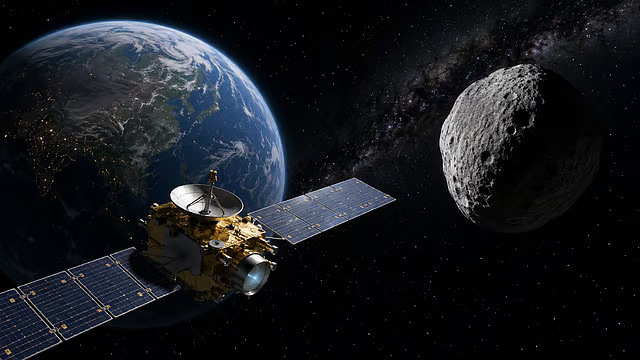
When we look up at the night sky, we are conditioned to see only one glowing orb lighting up the darkness. For centuries, humanity has written poetry, planned space missions, and tracked time based on our faithful lunar companion. However, astronomers have discovered a mind-bending cosmic plot twist: Earth actually has multiple "quasi-satellites" orbiting the Sun right alongside us.
One of the most famous of these stealthy companions is an asteroid named Kamoʻoalewa (discovered in 2016). While it doesn't orbit Earth directly the way our actual Moon does, it dances in a complex, horseshoe-shaped orbit around the Sun that keeps it locked in gravitational sync with our planet. From our perspective on Earth, it appears to loop around us like a loyal guard dog, making it our most stable quasi-satellite.
Even wilder is what scientists found when they analyzed its light spectrum: Kamoʻoalewa isn't just a random space rock. Its composition matches lunar rock samples brought back by the Apollo missions. Astronomers now strongly suspect that this tiny "second moon" is actually a giant chunk blasted off our own Moon by an ancient asteroid impact millions of years ago, which has been trapped in a cosmic game of tag with Earth ever since!
Fun Fact: Because of its unique orbital path, Kamoʻoalewa is actually closer to Earth than any other asteroid of its kind, yet it is so faint that it can only be seen with one of the world's largest telescopes (like the Large Binocular Telescope in Arizona) during a few weeks in April.