
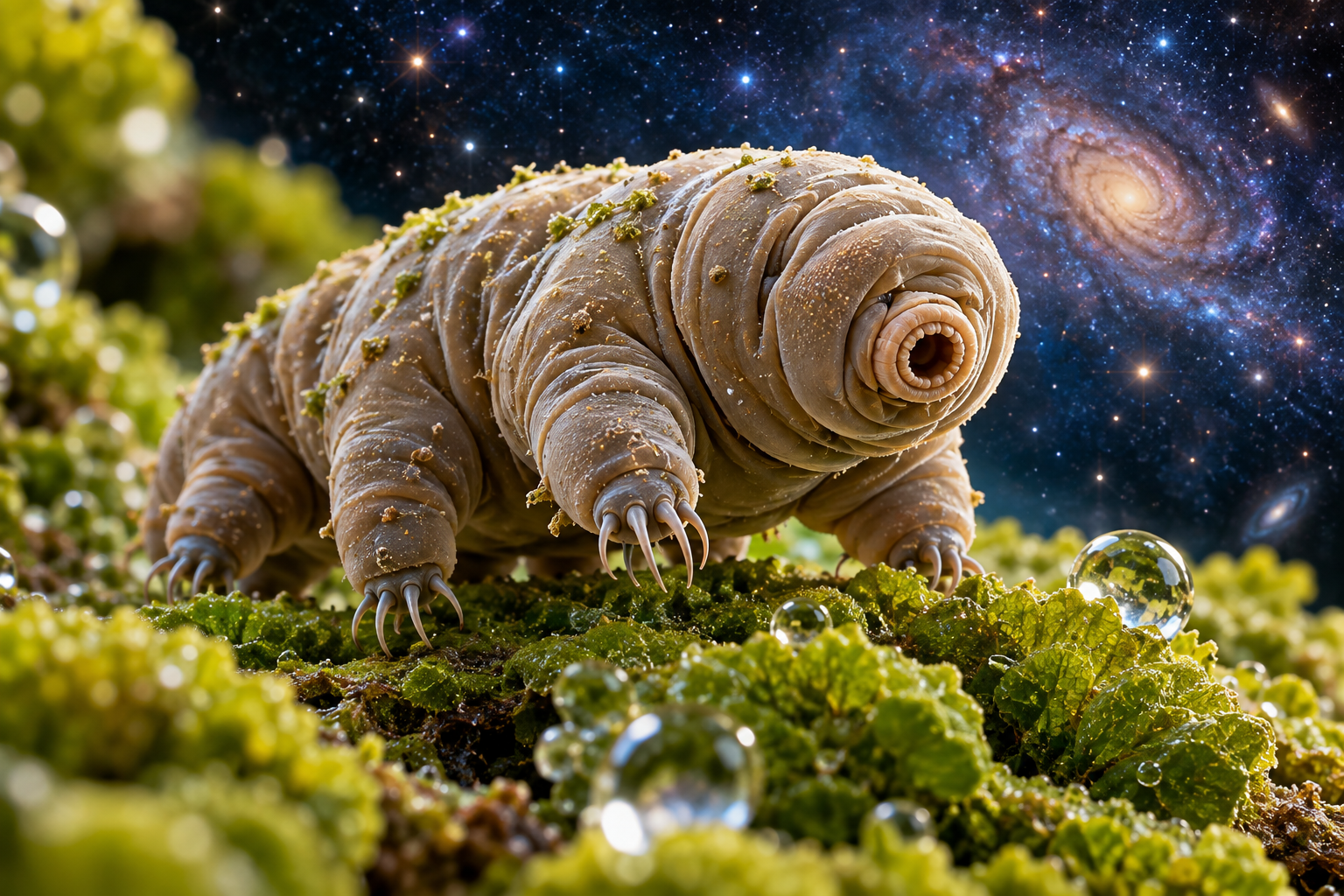
The Toughest Animal on Planet Earth
Imagine a creature smaller than a grain of sand that can survive being frozen to -272°C (just one degree above absolute zero), heated to 150°C (well above the boiling point of water), blasted with hundreds of times more radiation than would kill a human, and exposed to the harsh, airless vacuum of outer space.
This is not an alien from science fiction. It is a real creature called a tardigrade (commonly nicknamed the water bear or moss piglet), and millions of them are probably living right in your backyard moss, garden soil, and local ponds.
What Are Tardigrades?
Tardigrades were first discovered in 1773 by the German zoologist Johann August Ephraim Goeze, who called them kleiner Wasserbär ("little water bear") because of their lumbering, bear-like walking motion. In 1777, Italian biologist Lazzaro Spallanzani gave them the scientific name Tardigrada, which means "slow steppers."
Here are their basic biological characteristics:
- Size: Adults typically measure between 0.3 to 0.5 millimeters (300 to 500 micrometers) in length.
- Anatomy: They possess a barrel-shaped body with four body segments and eight short legs, each tipped with tiny claws used to grasp moss and algae.
- Diet: Most tardigrades feed on plant cells, algae, and microscopic nematodes by piercing cell walls with sharp dagger-like mouthparts called stylets.
The Secret to Immortality: Cryptobiosis and the 'Tun' State
Under normal conditions, tardigrades are delicate aquatic organisms that require a thin film of water around their bodies to breathe and move. But when their environment dries up or turns hostile, they perform an extraordinary biological trick known as anhydrobiosis (a form of cryptobiosis).
During this process:
- The tardigrade pulls its eight legs inside its body, curls up into a tiny dried pellet, and expels more than 97% of the water from its body. This dormant state is called a tun.
- Its metabolic activity drops to less than 0.01% of normal-essentially pausing all biological life processes.
- Instead of water, the tardigrade replaces its cellular fluids with special disordered proteins known as TDPs (Tardigrade Disordered Proteins). These proteins turn into a biological glass-like matrix that holds cellular membranes and organelles rigidly in place, preventing them from breaking or warping.
A tardigrade can remain in this indestructible tun state for decades. Once water is reintroduced, the glass matrix dissolves, the cells rehydrate, and the water bear wakes up and starts walking within a few hours!
Extreme Environments Tardigrades Can Survive
| Extreme Condition | Tolerance Level | Comparison with Humans |
|---|---|---|
| Extreme Cold | Survives -272°C (1 Kelvin) for days | Humans suffer fatal hypothermia below 28°C core body temp |
| Extreme Heat | Survives up to 150°C (302°F) | Human proteins permanently denature above 42°C |
| Hydrostatic Pressure | Up to 6,000 atmospheres (600 MPa) | 6x greater pressure than the deepest ocean trench (Mariana Trench) |
| Ionizing Radiation | Up to 5,000 to 6,000 Gray (Gy) | A dose of just 5 to 10 Gy is fatal to a human |
| Vacuum of Space | Survives open cosmic vacuum for 10+ days | Humans lose consciousness in under 15 seconds |
The Space Mission: Tardigrades in Orbit
In 2007, the European Space Agency launched the FOTON-M3 mission carrying dehydrated tardigrades into low Earth orbit. For 10 days, the tardigrades were exposed directly to the open vacuum of space and intense unfiltered solar UV radiation.
When the capsule returned to Earth and the tardigrades were rehydrated, over 68% of them woke up, survived, and went on to lay healthy eggs that hatched normal offspring. This made tardigrades the first multi-cellular animals proven to survive the combined vacuum and radiation of outer space!
Unique DNA Shield: The Dsup Protein
How do tardigrades protect their DNA from being shredded by extreme radiation? Scientists in Japan discovered a unique protein found only in tardigrades called Dsup (Damage Suppressor).
Dsup physically binds to DNA strands like a protective molecular blanket, absorbing the kinetic shock of hydroxyl free radicals and blocking radiation from snapping the genetic double helix. When researchers inserted the tardigrade Dsup gene into human kidney cells in a laboratory, the human cells showed a 40% increase in radiation resistance!
Key Takeaways for Students
- Tardigrades are microscopic 8-legged animals that thrive anywhere there is moisture and moss.
- When dried out, they enter a dormant state called a 'tun', reducing metabolism to near zero and turning cellular fluid into biological glass.
- They possess a unique DNA-protecting protein called Dsup that prevents radiation damage.
- Studying tardigrade biology helps scientists design better ways to preserve human vaccines without refrigeration and protect future astronauts traveling to Mars.
Frequently Asked Questions (FAQ)
Q1: Are tardigrades dangerous to humans?
A: Not at all! Tardigrades are completely harmless to humans. They do not transmit diseases and feed only on microscopic plant cells, moss, and bacteria.
Q2: Where can I find a tardigrade?
A: You can easily find them by collecting a small clump of damp green moss from a tree trunk or garden wall, soaking it in a dish of spring water for an hour, and looking at the water drops under a standard 40x-100x school microscope.
Q3: How long do tardigrades live?
A: In their active hydrated state, tardigrades live for about 3 to 30 months. However, in their dormant tun state, their lifespan is effectively paused and they can survive for decades.
How Tardigrades Are Revolutionizing Modern Medicine and Space Tech
The extraordinary biology of tardigrades is not just a curiosity-it is inspiring real breakthroughs in biotechnology:
- Dry Vaccine Preservation: Most life-saving vaccines currently require expensive "cold-chain" refrigeration to prevent proteins from degrading. By studying tardigrade TDP glass proteins, pharmaceutical scientists are developing room-temperature, dried vaccines that can be shipped worldwide without refrigerators.
- Crop Drought Resistance: Genetic engineers are exploring ways to transfer tardigrade anhydrobiosis genes into staple food crops like rice and wheat, creating drought-resistant crops that can survive harsh dry seasons.
- Deep-Space Radiation Shields: Research on the tardigrade Dsup protein may one day lead to genetic or pharmaceutical therapies that protect astronauts from cosmic radiation during multi-year crewed missions to Mars and the outer solar system.
Vocabulary Bank for Biology Students
- Cryptobiosis: A metabolic state of life entered by an organism in response to adverse environmental conditions, where metabolic activity comes to a reversible standstill.
- Anhydrobiosis: A form of cryptobiosis induced by extreme desiccation (dehydration).
- Extremophile: An organism that thrives in extreme physical or geochemical conditions that are detrimental to most life on Earth.
- Dsup Protein: Damage Suppressor protein, a unique protein found in tardigrades that physically binds to DNA to protect it from radiation damage.