
For over a century, the foundations of quantum mechanics have been explored primarily through the lens of electromagnetic radiation-the particle-like behavior of light known as photons. From Max Planck's pioneering blackbody radiation formula in 1900 to Albert Einstein's Nobel Prize-winning explanation of the photoelectric effect in 1905, light provided the undeniable empirical proof that energy at atomic scales is strictly quantized into indivisible packets.
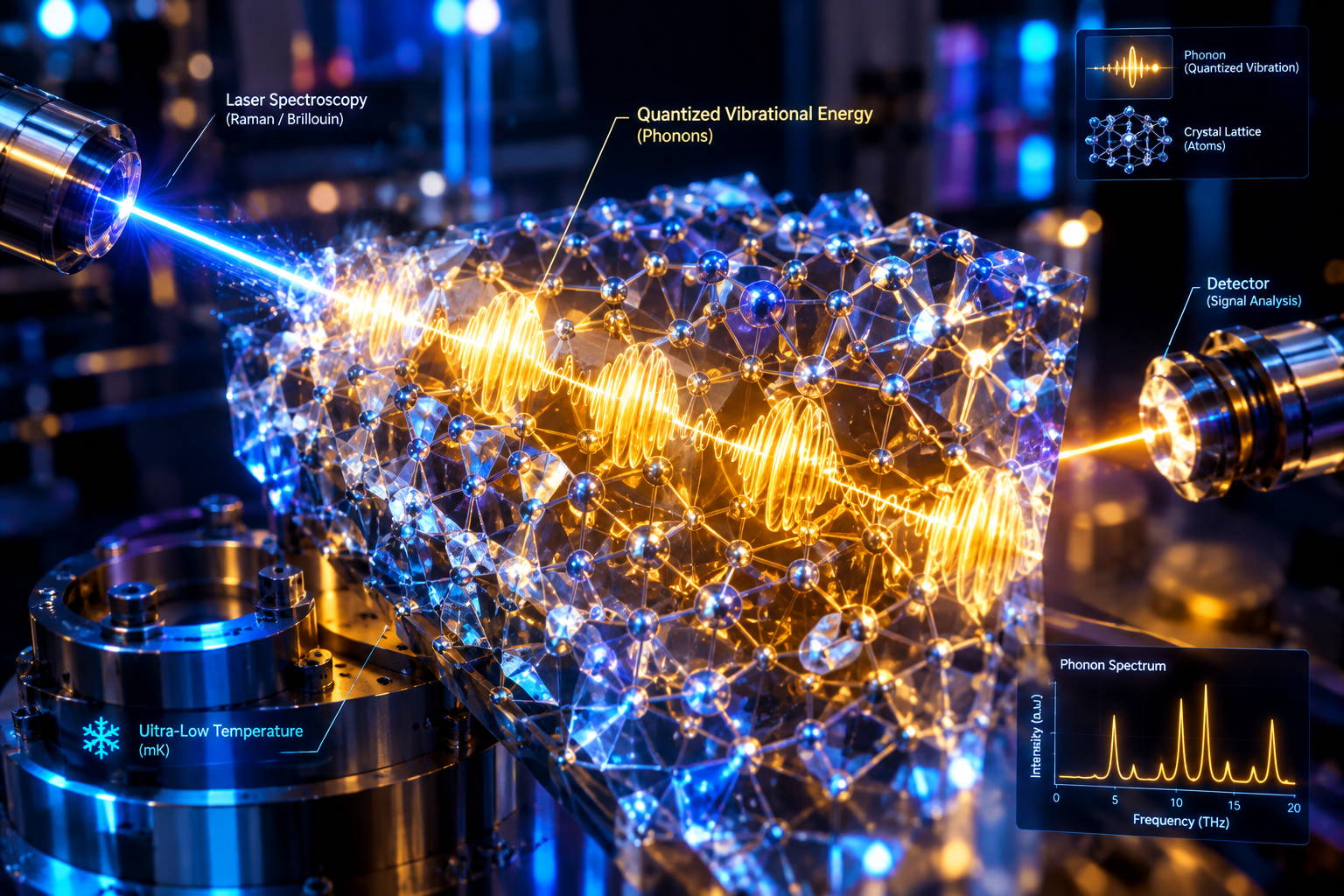
Yet, the very same quantum principles that govern light also apply to mechanical vibrations-sound waves propagating through solid matter. In quantum physics, these quantized units of vibrational energy are known as phonons. For decades, capturing, measuring, and observing a single phonon in real time without destroying its fragile quantum state was considered one of the holy grails of experimental physics. In a landmark breakthrough, quantum physicists have finally achieved this milestone, ushering in an entirely new discipline: Quantum Acoustics.
Photons vs. Phonons: The Fundamental Physics
To grasp why this discovery is so monumental, one must understand how sound differs fundamentally from light in both classical and quantum mechanics:
- Photons (Light): Fundamental gauge bosons that propagate through the vacuum of empty space at the cosmic speed limit (c ~ 300,000 km/s). Photons do not require any physical medium to exist or travel.
- Phonons (Sound): Collective excitations (quasi-particles) of billions of atoms vibrating in synchronized harmonic motion through a solid crystal lattice. Sound cannot exist in a vacuum; it requires matter. Crucially, in solid materials (such as sapphire, diamond, or quartz), acoustic waves travel approximately 100,000 times slower than light (typically 3,000 to 6,000 meters per second).
Because sound travels at a fraction of the speed of light, an acoustic wave oscillating at microwave frequencies (e.g., 5 GHz) has an acoustic wavelength of less than one micrometer-roughly the size of a bacterium. In contrast, an electromagnetic microwave of the same frequency has a wavelength of several centimeters. This microscopic spatial footprint means that sound waves can pack immense amounts of quantum information into microscopic chips that are thousands of times smaller than optical components.
The Breakthrough Experiment: Catching a Single Quanta of Sound
Observing a single phonon is extraordinarily difficult because ambient thermal energy causes atoms to jiggle uncontrollably, completely drowning out individual quantum signals in a roar of thermal noise. The research team overcame this through a multi-stage experimental apparatus:
1. Ultra-Low Dilution Refrigeration
The entire acoustic resonator-a micro-machined sapphire crystal polished to atomic smoothness-was placed inside a multi-stage dilution refrigerator and cooled to 10 millikelvin (-273.14°C), just a fraction of a degree above absolute zero. At this extreme temperature, thermal vibrations virtually cease, plunging the acoustic resonator into its pure quantum ground state (a state of zero phonons).
2. Quantum Non-Demolition (QND) Measurement
In standard quantum measurements, detecting a particle requires absorbing its energy, which instantly destroys the quantum state. To circumvent this, the researchers coupled the sapphire acoustic cavity to an ultra-sensitive superconducting transmon qubit via piezoelectric forces.
When a mechanical acoustic vibration entered the cavity, the presence of a single phonon induced a minute, non-destructive frequency shift in the superconducting qubit. By interrogating the qubit with precision microwave pulses, physicists were able to track the arrival and departure of individual phonons in real time-witnessing instantaneous quantum jumps between 0, 1, 2, and 3 phonon energy levels without absorbing the sound energy.
Why Quantum Acoustics Changes the Game for Quantum Computing
The ability to manipulate sound at the single-quantum level unlocks revolutionary engineering capabilities that solve several of quantum computing's most stubborn bottlenecks:
1. Ultra-Dense, Long-Lived Quantum Memories
Superconducting qubits (used by IBM, Google, and Rigetti) can perform logic operations in nanoseconds, but they suffer from short coherence times (fractions of a millisecond) and occupy significant surface area on physical chips. Because sound waves travel sluggishly through acoustic cavities, a sapphire crystal smaller than a grain of sand can store thousands of quantum states for extended durations, acting as an ultra-dense quantum hard drive (RAM).
2. The Universal Quantum Transducer
Modern quantum computers face a severe networking dilemma: different quantum hardware platforms operate on incompatible energy scales. Superconducting processors compute using microwave signals, while long-distance quantum communication networks require optical infrared photons that travel through fiber-optic cables without loss.
Phonons interact naturally with both microwave circuits (via piezoelectricity) and optical lasers (via Brillouin light scattering). Acoustic micro-resonators can therefore serve as the universal quantum translator, converting fragile microwave qubits into robust optical photons and enabling the creation of a global, distributed Quantum Internet.
3. Probing the Boundary Between Quantum and Classical Worlds
Unlike elementary particles like electrons or photons, a phonon is not an isolated point mass; it is a collective quantum state involving trillions of vibrating atoms. By generating quantum superposition and entanglement in macroscopic mechanical crystals, physicists can explore fundamental questions about quantum gravity and test whether there is a physical mass limit where quantum behavior collapses into classical physics.
Future Roadmap: What Comes Next in Quantum Acoustics
- All-Acoustic Quantum Processors: Developing multi-qubit logic gates where acoustic wave packets directly interact to perform algorithmic calculations on a single acoustic chip.
- Quantum Acoustic Metrology: Creating ultra-sensitive force and acceleration sensors capable of detecting gravitational waves and dark matter candidates with quantum-limited precision.
- Hybrid Superconducting-Acoustic Architectures: Merging superconducting transmon logic cores with piezoelectric acoustic delay lines to scale quantum computers from hundreds to millions of error-corrected physical qubits.
Conclusion: The Melody of the Quantum Realm
Just as the mastery of the electron birthed the digital revolution and the control of photons created laser optics and modern telecommunications, the conquest of the phonon heralds the dawn of mechanical quantum engineering. Sound is no longer merely a sensory experience; it has become a precision tool to compute, store, and communicate the deepest secrets of the universe.
Technical Comparison: Quantum Information Carriers
| Carrier | Propagation Medium | Speed (v) | Wavelength at 5 GHz | Primary Advantage |
|---|---|---|---|---|
| Photons (Light) | Vacuum / Fiber Optics | 300,000 km/s | 6.0 cm | Lossless long-distance communication |
| Phonons (Sound) | Sapphire / Diamond Lattice | ~3,000 - 6,000 m/s | ~0.6 - 1.2 um | Ultra-compact memory & non-linear coupling |
| Electrons (Charge) | Semiconductor Wires | ~100 - 1,000 km/s | N/A (Fermionic) | High-speed classical logic switching |
Frequently Asked Questions (FAQ)
1. Can humans hear quantum phonons?
No. These sound waves oscillate at microwave frequencies (gigahertz range), billions of times higher than the human hearing limit (20 kHz), and operate at infinitesimal single-quantum energy levels.
2. Why is cooling near absolute zero mandatory?
At room temperature, the thermal energy (k_B * T) is millions of times greater than the energy of a single gigahertz phonon (h * f). Without cooling to 10 millikelvin, thermal atomic chaos completely masks individual quantum jumps.