
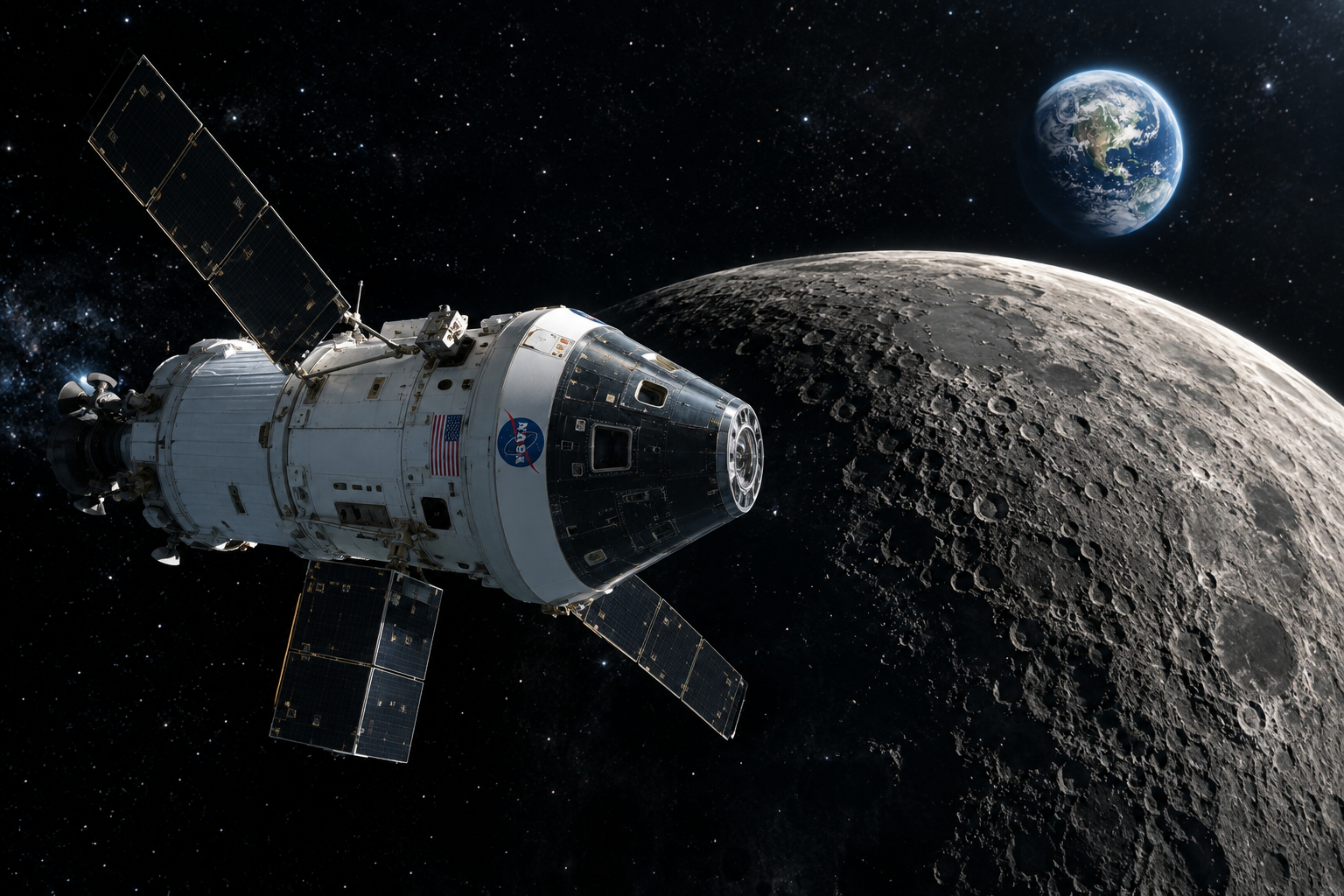
For more than half a century, the deep expanse beyond low-Earth orbit has remained untouched by human presence. Since December 1972, when Apollo 17 astronauts Gene Cernan and Harrison Schmitt climbed back into their lunar module and fired their ascent engine to leave the lunar surface, every crewed spaceflight endeavor-from the legendary Space Shuttle program to the Mir space station and the International Space Station (ISS)-has taken place inside the protective cocoon of Earth's magnetic field, rarely exceeding altitudes of 400 to 500 kilometers above the planet's surface.
That prolonged hiatus in deep-space exploration is finally coming to an end with NASA's Artemis II mission. Artemis II is an audacious, high-stakes 10-day crewed flight test that will propel four astronauts into the deep lunar wilderness, catapulting human spaceflight into an expansive new era of lunar industrialization, orbital science, and interplanetary exploration.
The Genesis of the Artemis Program: Beyond the Apollo Paradigm
To understand the profound significance of Artemis II, one must first recognize how the Artemis Program differs from its 20th-century predecessor, Apollo. The Apollo missions were born out of intense Cold War geopolitical rivalry. They were designed as a rapid, high-cost sprint to demonstrate technological supremacy over the Soviet Union. Once the goal of landing on the Moon was accomplished, public interest waned, budgets were drastically reduced, and lunar exploration ceased altogether.
In contrast, the Artemis Program is founded on three pillars: sustainability, commercial partnership, and international alliance. Named after Artemis, the Greek goddess of the Moon and the twin sister of Apollo, the program's ultimate objective is not merely to leave footprints and plant flags, but to build a permanent, enduring human presence on and around the Moon. This includes the establishment of the Artemis Base Camp at the lunar South Pole and the construction of the Lunar Gateway, a crewed orbital outpost that will serve as a staging node for future expeditions to Mars.
The uncrewed Artemis I mission successfully demonstrated that NASA's gargantuan Space Launch System (SLS) mega-rocket and the Orion spacecraft could execute deep-space translunar trajectories, withstand deep-space radiation belts, and survive the fiery inferno of high-velocity atmospheric re-entry. Artemis II represents the crucial human proof-of-concept: placing four astronauts inside Orion to validate environmental life-support systems, communication links, navigation arrays, and manual piloting controls under genuine deep-space conditions.
Meet the Historic Crew of Artemis II
The four astronauts chosen for Artemis II reflect an unprecedented level of diversity, international cooperation, and deep operational flight experience:
- Reid Wiseman (Commander, NASA): A decorated US Naval aviator and test pilot who previously spent 165 days in space as a flight engineer on Expedition 41 aboard the International Space Station. Wiseman brings veteran leadership, calm tactical execution, and extensive flight-test acumen to the commander's seat.
- Victor Glover (Pilot, NASA): A seasoned naval aviator and test pilot who served as pilot on the historic SpaceX Crew-1 mission (NASA's first operational commercial crew flight to the ISS). Glover makes history as the first person of color assigned to a lunar mission, responsible for critical proximity operations, manual maneuvering, and thruster management during flight.
- Christina Hammock Koch (Mission Specialist, NASA): An electrical engineer and veteran astronaut who holds the world record for the longest continuous spaceflight by a woman (328 days in orbit) and participated in the first all-female spacewalk. Koch makes history as the first woman to travel beyond low-Earth orbit, serving as lead mission specialist overseeing spacecraft systems, payload operations, and scientific experiments.
- Jeremy Hansen (Mission Specialist, Canadian Space Agency): A fighter pilot in the Royal Canadian Air Force and former CF-18 squadron leader. Hansen makes history as the first non-American astronaut to venture into deep lunar space, cementing Canada's vital role in lunar exploration through the development of the Canadarm3 robotic system for the Lunar Gateway.
Detailed Day-by-Day Mission Architecture
Artemis II is not configured to touch down on the lunar surface; rather, it executes a carefully calibrated hybrid free-return trajectory designed to rigorously test crew systems while ensuring a guaranteed return pathway to Earth in the event of primary propulsion failure.
Day 1: Launch and High-Apogee Orbit Insertion
The mission commences at Launch Complex 39B at NASA's Kennedy Space Center in Florida. The SLS Block 1 rocket-powered by four RS-25 cryogenic liquid engines and two massive solid rocket boosters generating 8.8 million pounds of maximum thrust-lifts Orion into initial orbit. After the solid boosters and core stage separate, the Interim Cryogenic Propulsion Stage (ICPS) ignites to place Orion into a high-Earth orbit with an apogee of approximately 2,900 kilometers.
Day 2: The Proximity Operations Demonstration
Following a second burn of the ICPS engine that raises Orion into a massive elliptical orbit extending out to 68,500 kilometers (more than five times higher than GPS satellites), the crew conducts the critical Proximity Operations Demonstration. Orion separates from the spent ICPS stage, and Pilot Victor Glover takes manual control of the spacecraft's translational and rotational hand controllers.
For several hours, the crew maneuvers Orion within close proximity of the ICPS, verifying that the spacecraft handles intuitively and that the optical rendezvous sensors, target tracking cameras, and manual guidance software perform flawlessly. This milestone ensures that future crews can reliably dock with the Lunar Gateway or lunar landers.
Day 3-5: Trans-Lunar Injection (TLI) and Deep-Space Transit
Once all primary and redundant life-support systems (ECLSS) pass exhaustive health evaluations, the European Service Module (ESM)-built by the European Space Agency (ESA) and Airbus-ignites its main orbital engine to perform the Trans-Lunar Injection (TLI) burn. This burn accelerates Orion out of Earth's gravitational grasp onto a translunar coast trajectory at velocities exceeding 36,000 km/h (22,300 mph).
During the four-day transit, the crew assesses exercise countermeasures to combat muscle atrophy, conducts optical navigation sighting tests using the stars and Earth's limb, and tests high-bandwidth laser communication systems.
Day 6: Slingshotting Around the Far Side of the Moon
On the sixth day, the Orion capsule sweeps around the far side of the Moon, reaching an altitude of approximately 10,300 kilometers (6,400 miles) above the rugged lunar surface. From this unique vantage point, the astronauts will gaze upon ancient, heavily cratered terrains that are never visible from Earth, witnessing a breathtaking view of our vibrant blue home planet rising over the desolation of the lunar horizon.
The Moon's gravitational field naturally bends Orion's trajectory, acting as a cosmic slingshot that redirects the spacecraft directly back toward Earth without requiring a large fuel burn. This free-return geometry provides an inherent safety envelope for the crew.
Day 7-9: The Return Coast and High-Altitude System Checks
As Orion falls back toward Earth under the pull of terrestrial gravity, the spacecraft steadily accelerates. The crew conducts deep-space radiation dosimeter mapping, tests emergency medical protocols, and prepares the command module for separation from the European Service Module.
Day 10: Fiery Atmospheric Re-entry and Pacific Splashdown
The finale of Artemis II is one of the most mechanically and thermally grueling phases of modern aerospace engineering. Approaching Earth at nearly 40,000 km/h (Mach 32), Orion encounters the upper layers of Earth's atmosphere. Atmospheric friction converts kinetic energy into searing thermal energy, enveloping the capsule in a superheated plasma envelope reaching 2,760°C (5,000°F)-half as hot as the surface of the Sun.
Orion's advanced ablative heat shield, fabricated from a specialized phenolic-impregnated carbon ablator (PICA), steadily vaporizes to carry extreme heat away from the cabin. After enduring deceleration forces up to 4G and passing through the ionization blackout zone, Orion deploys its sequence of drogue and three massive main parachutes, gently touching down in the Pacific Ocean off the coast of California for recovery by the United States Navy and NASA amphibious teams.
Groundbreaking Engineering Systems Tested on Artemis II
- Environmental Control and Life Support System (ECLSS): In Artemis I, mannequins equipped with sensors occupied the seats. Artemis II is the first operational test of Orion's closed-loop atmosphere revitalization system supporting four breathing, perspiring humans-scrubbing carbon dioxide using amine beds, generating oxygen, regulating cabin humidity, and recycling water.
- Optical Laser Communications (O2O): The Optical Artemis-2 Crew-to-Gateway Infrastructure (O2O) utilizes infrared laser beams to beam real-time 4K ultra-high-definition video, voice channels, and massive scientific datasets across 400,000 kilometers at speeds up to 260 Megabits per second-a monumental leap over legacy radio-frequency telemetry.
- Deep-Space Radiation Dosimetry and Active Shielding: Outside the protection of the Van Allen radiation belts, galactic cosmic rays (GCR) and solar particle events (SPE) pose severe biological risks. Artemis II monitors real-time crew radiation absorption and tests specialized ergonomic radiation protection vests (AstroRad).
The Road from Artemis II to Mars
The successful execution of Artemis II clears the path for Artemis III, which will see astronauts step foot onto the lunar South Pole, utilizing SpaceX's Starship Human Landing System (HLS) to explore permanently shadowed craters containing water ice. That water ice will eventually be mined, purified for life support, and broken down into liquid hydrogen and liquid oxygen rocket propellant.
Artemis II is far more than a routine test flight; it is the philosophical and operational bridge between humanity's pioneering past and its multi-planetary future. When Reid Wiseman, Victor Glover, Christina Koch, and Jeremy Hansen look out of Orion's panoramic windows back toward the distant cradle of humanity, their journey will inspire millions of students, scientists, and engineers to pursue the next frontier of discovery.