
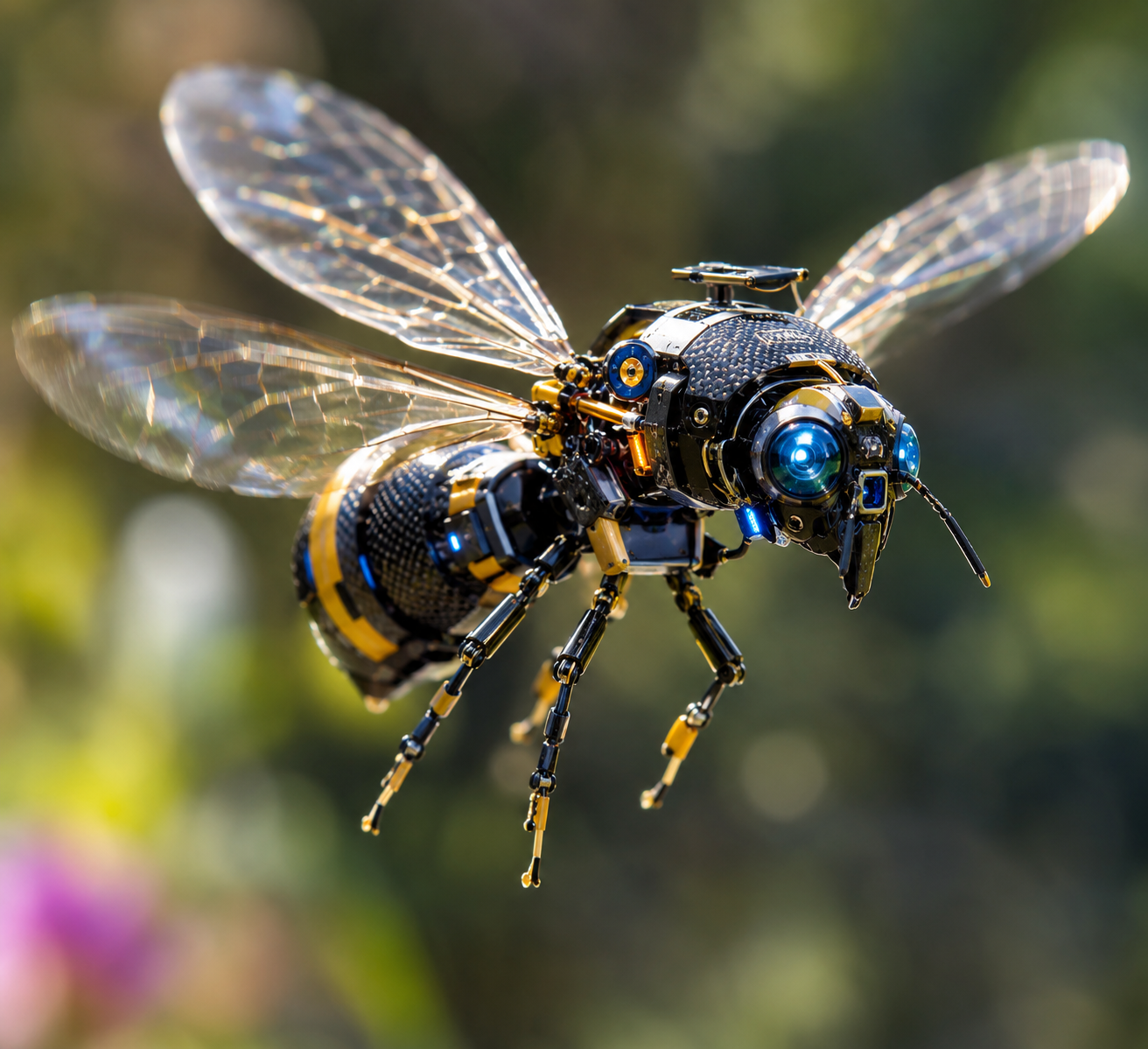
For hundreds of millions of years, evolutionary biology has perfected the biomechanics of flying insects. A common housefly or bumblebee can perform breathtaking aerial acrobatics-executing 360-degree somersaults in milliseconds, navigating turbulence, bouncing off solid glass windows undamaged, and landing upside down on a ceiling with effortless grace.
For decades, human aerospace engineering struggled to replicate this agility at micro scales. Miniature quadcopters built with rigid motors broke upon the slightest impact and lacked the power-to-weight ratio necessary to carry onboard sensors. Now, researchers at the Massachusetts Institute of Technology (MIT) have broken through the physical barrier, creating a revolutionary class of insect-scale micro-aerial robots powered by soft artificial muscles and adaptive artificial intelligence.
The Physics of Flight at Centimeter Scales
Flying at the scale of an insect is fundamentally different from flying a passenger airliner or even a standard commercial drone. At microscopic scales, aerodynamic laws change dramatically:
- Viscous Air Resistance: To a creature measuring just a few centimeters across, air does not behave like a light, invisible gas; it feels thick, sticky, and viscous-almost like swimming through molasses.
- Inertial Limits: Micro-drones cannot rely on traditional electric motors and gearboxes because electromagnetic motors become hopelessly inefficient and heavy when scaled down to sub-gram weights.
The Core Innovation: Soft Dielectric Elastomer Actuators (DEAs)
Instead of rigid motors, the MIT engineering team developed soft artificial muscles known as Dielectric Elastomer Actuators (DEAs). These actuators are constructed from ultra-thin elastomer layers sandwiched between carbon nanotube electrodes.
When high voltage is applied across the electrodes, electrostatic forces compress the elastomer, causing it to rapidly expand and contract. This mechanical pulsing flaps the drone's carbon-fiber wings at blistering frequencies exceeding 400 to 500 beats per second (Hz)-faster than a hummingbird.
Why Soft Actuators Change Everything:
- Indestructible Collision Resilience: Unlike brittle silicon rotors that shatter when hitting a wall, soft elastomer muscles absorb physical impact forces effortlessly. The micro-robot can smash into walls, endure mid-air collisions with other drones, and tumble to the ground before righting itself and resuming flight within milliseconds.
- Superhuman Power Density: DEAs offer one of the highest power-to-weight ratios in modern robotics, allowing a drone weighing less than 0.6 grams (the weight of a single paperclip) to generate enough lift to carry onboard payload electronics.
AI-Powered Neuromorphic Flight Control
At insect scale, a sudden gust of wind or an air vortex acts like a catastrophic hurricane. Traditional flight computers take too long to compute stability equations. MIT roboticists solved this by coupling micro-sensors with reinforcement learning (RL) neural network controllers.
Trained over millions of simulated flight scenarios across chaotic airflow environments, the AI controller modulates wing-stroke angles independently in real time. The micro-drone can:
- Execute instantaneous 360-degree somersaults and aggressive bank turns with 450% higher angular acceleration than previous micro-robots.
- Hover stably inside turbulent wind tunnels by predicting micro-vortices before they destabilize the frame.
- Perform coordinated swarm formations without colliding, communicating spatial vectors through optical beacon tracking.
Transformative Real-World Applications
1. Search-and-Rescue in Collapsed Rubble
Following catastrophic earthquakes, explosions, or building collapses, human rescuers and search dogs cannot penetrate deep into unstable, narrow rubble crevices. Insect-scale drones equipped with micro-gas sensors and thermal cameras can fly through millimeter-wide air gaps, navigating treacherous voids to locate trapped survivors and detect hazardous gas leaks.
2. Industrial Pipeline & Turbine Inspection
Inspecting the interior of jet engines, nuclear reactor cooling conduits, and underground chemical pipelines currently requires expensive, multi-day system shutdowns. Micro-drones can swarm inside complex industrial machinery, mapping micro-fractures and thermal wear without disassembly.
3. Artificial Agricultural Pollination
With global pollinator bee populations threatened by colony collapse disorder and habitat loss, autonomous robotic pollinators capable of precision flower-to-flower pollen transfer offer an essential technological safety net for global food security.
The Road Ahead: Untethered Autonomous Swarms
Current research frontiers focus on integrating micro-scale solid-state batteries and solar energy harvesting circuits directly into the drone's exoskeleton to achieve fully untethered, long-duration autonomous flight.
MIT's insect-scale drones represent a milestone convergence of biomimicry, materials science, and edge AI. By mastering the physics of the microscopic world, roboticists are unlocking a future where swarms of resilient, intelligent micro-machines work alongside humanity to explore, inspect, and protect our world.
Engineering Specifications: MIT Insect-Scale Drone vs. Natural Bee
| Metric | Honeybee (Apis mellifera) | MIT Soft-Actuator Micro-Drone |
|---|---|---|
| Mass | ~0.1 grams | ~0.6 grams |
| Wingbeat Frequency | ~230 Hz | ~400 - 500 Hz |
| Actuator Type | Biological flight muscles | Dielectric Elastomer Actuators (DEAs) |
| Collision Survival | High (Flexible exoskeleton) | Indestructible (Soft polymer resilience) |
| Control System | Insect nervous system (1M neurons) | Edge AI Reinforcement Learning Controller |
Frequently Asked Questions (FAQ)
1. How do micro-drones navigate without GPS?
Under rubble or inside industrial pipes, GPS signals cannot penetrate. MIT insect-scale drones utilize onboard optical flow micro-sensors and neuromorphic event-based cameras that track visual motion relative to surfaces in real time.
2. Can these tiny drones fly outdoors in high winds?
Due to ultra-high wingbeat frequencies (500 Hz) and rapid AI attitude adjustment (500 updates per second), micro-drones can resist wind gusts several times their body weight by dynamically angling their lift vectors.
Swarm Intelligence and Decentralized Micro-Flocking
While an individual insect-scale micro-drone is a formidable technological marvel, their true transformative potential emerges when operating as an autonomous collaborative swarm. Utilizing decentralized bio-inspired flocking algorithms (modeled after starling murmurations and honeybee foraging), hundreds of micro-drones can disperse across disaster zones, dynamically partitioning search areas, establishing self-healing mesh radio networks, and triangulating thermal signatures without relying on a centralized base station.
Extreme Environmental Resilience and Aerodynamic Ingress
Because soft dielectric elastomer actuators have no rotating shafts or delicate gear teeth, they are completely immune to particulate fouling. Micro-drones can fly through dense smoke plumes, chemical fumes, volcanic ash, and dusty collapsed concrete rubble that would instantly seize up conventional ball-bearing electric motors, making them the ultimate robotic scouts for hazardous environments.
Comparative Energy Efficiency and Aerodynamic Scaling
At insect scale, dielectric elastomer artificial muscles demonstrate over 80% electromechanical efficiency, drastically outperforming miniature electromagnetic motors that lose over 60% of their energy as waste heat. This thermodynamic efficiency allows micro-drones to maximize battery life during critical surveillance and inspection sorties.