
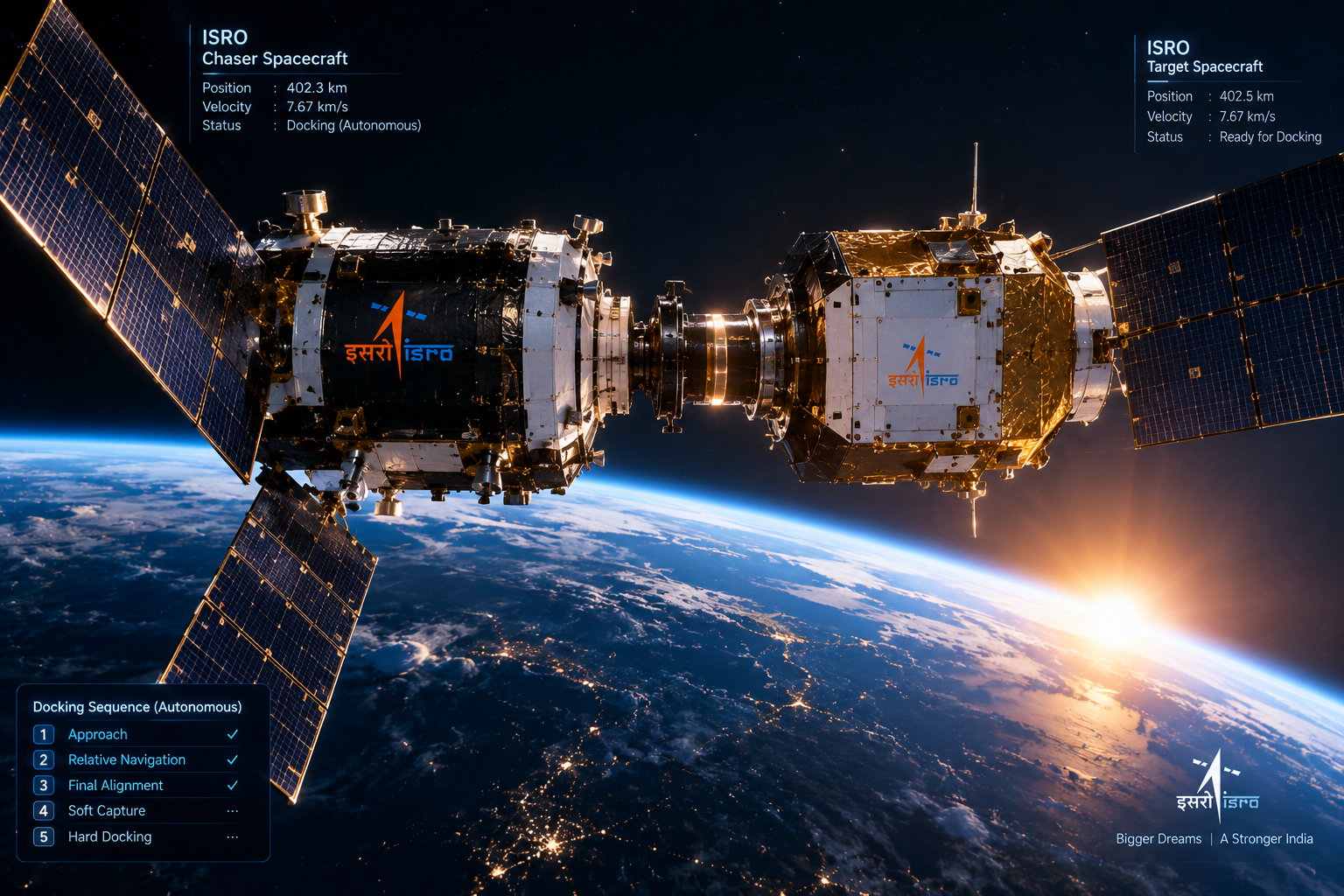
In the high-stakes arena of space exploration, few capabilities separate regional space agencies from true global space superpowers quite like autonomous orbital rendezvous and docking. Maneuvering two separate spacecraft traveling at blistering velocities of 28,000 kilometers per hour (17,500 mph) in the unforgiving vacuum of low-Earth orbit, bringing them to a relative standstill within millimeters, and locking them into a rigid, airtight structural union is an immense aerospace challenge.
With the historic success of the Space Docking Experiment (SPADEX), the Indian Space Research Organisation (ISRO) has officially mastered this vital capability. India now joins an exclusive, elite club consisting of only the United States, Russia, and China who possess independent mastery over autonomous space docking.
What Was the SPADEX Mission?
Launched aboard ISRO's reliable Polar Satellite Launch Vehicle (PSLV) from the Satish Dhawan Space Centre in Sriharikota, the SPADEX mission deployed two purpose-built spacecraft into slightly offset low-Earth orbits at an altitude of approximately 700 kilometers:
- The Target Satellite (SDX01): A stabilized orbital platform equipped with passive docking rings, laser retroreflectors, visual target markers, and telemetry transponders.
- The Chaser Satellite (SDX02): An active, highly agile spacecraft outfitted with autonomous navigation computers, cold-gas micro-thrusters, laser rangefinders (LiDAR), optical rendezvous sensors, and an active mechanical docking mechanism.
Over a sequence of complex orbital maneuvers spanning several days, the Chaser autonomously calculated relative orbital mechanics vectors, closed a separation distance of thousands of kilometers, transitioned through a series of safe intermediate hold points (500 meters, 100 meters, 15 meters), and gently engaged its docking probe into the Target satellite with zero real-time human intervention from mission controllers in Bengaluru.
Why Space Docking Is the Indispensable Key to Deep Space
A single rocket launch, no matter how powerful, is strictly constrained by payload mass, fuel capacity, and fairing volume. To construct large space stations, send humans on long-duration interplanetary journeys, or return extraterrestrial geological samples, space architectures must be launched in modular pieces and assembled in orbit. Docking is the foundational prerequisite for:
1. Bharatiya Antariksh Station (BAS)
India's ambitious roadmap to construct its own permanently crewed space station by 2035 relies entirely on SPADEX architecture. The station's foundational core module (BAS-1) will be launched first, followed by specialized laboratory modules, solar power trusses, and environmental life-support nodes that will autonomously dock and integrate into a modular orbital research complex.
2. Chandrayaan-4 Lunar Sample Return Mission
Bringing pristine soil and rock core samples back from the Moon's South Pole requires a complex multi-stage architecture that cannot be accomplished in a single vehicle descent. A lunar lander collects samples and launches an ascent module back into lunar orbit. This ascent stage must rendezvous and dock with an awaiting Earth-return orbiter circling the Moon-a flight sequence identical to the SPADEX autonomous algorithms.
3. Gaganyaan Human Spaceflight & Orbital Safety
For long-term human spaceflight, docking capability ensures that emergency rescue spacecraft can rendezvous and dock with a disabled crew module to evacuate astronauts safely. It also enables in-orbit refueling and logistics resupply flights using automated cargo freighters.
4. Satellite Servicing and Orbital Debris Removal
With thousands of defunct satellites cluttering low-Earth orbit, docking technology enables robotic servicing spacecraft to latch onto aging satellites to refuel them, upgrade their electronics, or de-orbit dangerous space debris safely into the atmosphere.
Core Indigenous Technologies Tested on SPADEX
- Autonomous Rendezvous and Guidance Algorithms: Real-time relative pose estimation software capable of calculating relative velocity, distance, and attitude angles under varying lighting conditions-from blinding direct solar glare to pitch-black orbital night.
- Precision Cold-Gas Micro-Thrusters: Propulsion thrusters that deliver ultra-fine velocity increments of millimeters per second, ensuring soft contact and preventing structural rebound upon latching.
- Hermetic Mechanical Latching & Interface Conduits: The docking collar features magnetic alignment pins and mechanical capture latches that establish high-integrity electrical power, data transfer, and fluid conduits between the two joined spacecraft.
Step-by-Step Flight Phasing of the SPADEX Docking Sequence
The execution of SPADEX followed an intricately choreographed multi-phase sequence:
- Phase 1: Far-Field Orbit Phasing (10,000 km to 50 km): Utilizing onboard GPS receivers and ground telemetry to synchronize orbital planes and altitude differentials.
- Phase 2: Mid-Field Rendezvous (50 km to 5 km): Activating onboard optical cameras and LiDAR to lock onto the Target satellite's retroreflectors.
- Phase 3: Close-Range Proximity & Stationkeeping (5 km to 15 m): The Chaser matches orbital velocity down to 0.05 meters per second, pausing at designated safety waypoints to confirm sensor accuracy.
- Phase 4: Final Approach & Capture (15 m to 0 m): The docking probe penetrates the capture cone, triggering mechanical latches and locking the two spacecraft into a unified rigid body.
The Geopolitical and Economic Impact for India
ISRO's mastery of autonomous docking dramatically lowers the financial barrier for complex space exploration. While Western and Chinese space architectures have historically required multi-billion-dollar budgets, ISRO has once again demonstrated world-class engineering frugality and technical elegance.
SPADEX is not just a technological milestone; it is the definitive launchpad for India's 21st-century space leadership. From orbiting laboratories and lunar base camps to deep-space asteroid missions, India has cemented its place at the forefront of the global space economy.
Mission Comparison: Global Autonomous Docking Capabilities
| Country / Agency | Key Docking Platforms | First Mastery | Primary Application |
|---|---|---|---|
| USA (NASA / Commercial) | Apollo, Space Shuttle, Dragon, Orion | 1966 (Gemini 8) | ISS Resupply, Lunar Artemis, Gateway |
| Russia (Roscosmos) | Soyuz, Progress, Mir, ISS Modules | 1967 (Kosmos 186/188) | Automated Kurs docking system |
| China (CNSA) | Shenzhou, Tianzhou, Tiangong | 2011 (Shenzhou 8 / Tiangong 1) | Modular Tiangong Space Station & Lunar Sample Return |
| India (ISRO) | SPADEX, BAS Modules, Gaganyaan | 2025/2026 (SPADEX) | Bharatiya Antariksh Station & Chandrayaan-4 |
Frequently Asked Questions (FAQ)
1. What happens if docking sensors fail during rendezvous?
SPADEX algorithms include autonomous 'Abort to Safe Orbit' triggers. If alignment deviates by more than 2 degrees or closing velocity exceeds tolerance, the Chaser fires retrograde thrusters to retreat to a safe stationkeeping orbit.
2. How does SPADEX differ from manual docking?
Manual docking requires human astronauts looking through periscopes. SPADEX is 100% autonomous, allowing uncrewed robotic freighters to dock without human ground control delays.