
The Hidden Nervous System of Planet Earth
When you click a link on your computer to watch a video hosted in London, send a chat message to a friend in Tokyo, or trade stocks on a New York exchange, it feels like your data travels magically through the air. Many people assume that satellites orbiting high in outer space handle global internet communication. But that is a popular modern myth. In reality, satellites handle less than 1% of international telecommunications.
More than 99% of all transoceanic internet traffic—trillions of dollars in daily bank transactions, social media feeds, and high-definition video streams—is carried through a fragile network of steel-armored cables resting directly on the pitch-black floor of the world's oceans. These Subsea Fiber-Optic Cables span over 1.4 million kilometers (nearly 900,000 miles), weaving an underwater web across the Atlantic, Pacific, and Indian oceans. At their core lies one of the most elegant applications of optical physics: transmitting petabits of information as laser light through glass strands no thicker than a single strand of human hair.
The Feynman Analogy: The Mirrored Water Pipe
How do you trap light inside a bendable tube and force it to travel 8,000 kilometers across an ocean without escaping? Richard Feynman frequently illustrated optical principles with water and mirrors.
Imagine a long tunnel lined entirely with polished, perfect mirrors. If you stand at one end and shine a flashlight into the tunnel, the light beam bounces off the floor, hits the ceiling, bounces to the wall, and zigzags all the way to the other end without leaking outside. In fiber optics, we achieve this without physical silver mirrors by exploiting a fundamental law of physics called Total Internal Reflection. The glass core is surrounded by an outer glass cladding with a lower refractive index. Whenever light strikes the boundary at a shallow angle, the boundary acts as an impenetrable 100% reflective mirror, keeping the light trapped forever inside the core!
The Anatomy of an Undersea Cable
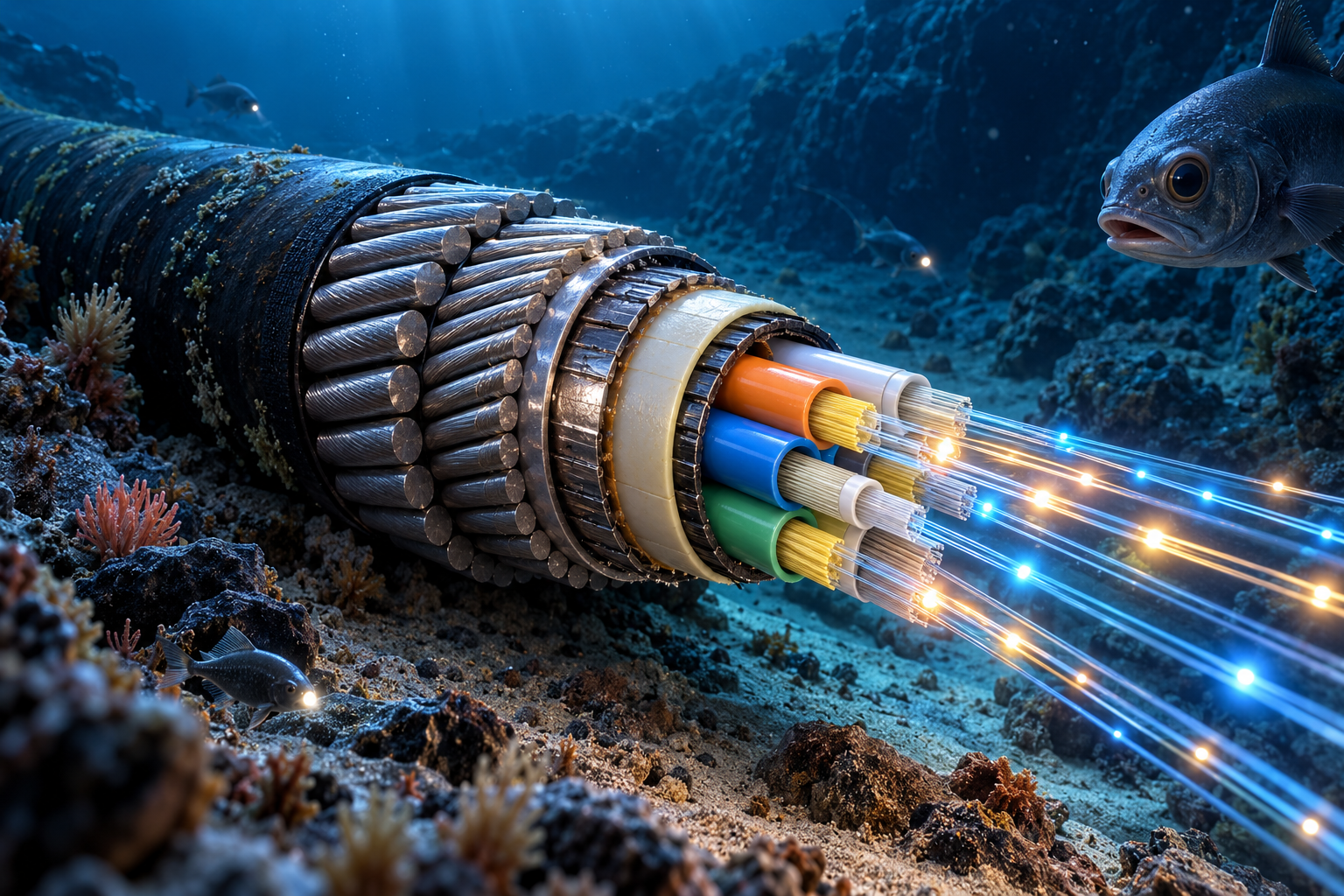
An undersea cable resting on the abyssal plain has to survive 8,000 meters of water depth, crushing pressures of over 800 atmospheres, underwater landslides, and shark bites. Yet, the cable is surprisingly slim—typically no thicker than a garden hose (about 25 to 30 millimeters in diameter).
Here is what you see if you slice through a modern transoceanic cable from outside in:
- Polyethylene Jacket: Outer waterproof and wear-resistant polymer shielding.
- Mylar Tape Layer: Moisture barrier and electrical insulation.
- Stranded Steel Wire Armor: High-tensile steel cables providing mechanical strength to prevent snapping when stretched under immense oceanic tension.
- Aluminum / Copper Conductor: A conductive tube carrying several thousand volts of direct current (DC) to power laser amplifiers situated every 70 kilometers along the ocean floor.
- Petroleum Jelly Compound: Water-blocking thixotropic gel that cushions fibers and seals leaks if the outer jacket is punctured.
- Stainless Steel Tube: Welded central pressure housing protecting the delicate fibers.
- Optical Fiber Glass Hair: Up to 16 to 24 pairs of ultra-pure silica glass fibers carrying modulated infrared laser beams.
Comparison: Subsea Cables vs Satellite Internet (Starlink / Geostationary)
| Feature / Metric | Subsea Fiber-Optic Cables | Satellite Internet Networks |
|---|---|---|
| Global Traffic Share | Carries >99% of all international data | Carries <1% (serves rural, maritime, aviation niches) |
| Transmission Speed / Latency | Ultra-low (Transatlantic round-trip ~60 ms) | Higher latency (Geostationary ~600 ms, LEO ~40–80 ms) |
| Data Bandwidth Capacity | Enormous (Up to 250–400 Terabits per second per cable) | Limited; shared satellite transponder bandwidth bottlenecks |
| Weather Sensitivity | Immune to rain, clouds, snow, and solar flares | Vulnerable to rain fade, atmospheric moisture, and solar storms |
| Vulnerability to Damage | Fishing trawlers, ship anchors, deep underwater seismic quakes | Space debris, orbital decay, rocket launch failures |
Overcoming Light Attenuation: The Erbium-Doped Laser Booster
The silica glass used in optical fibers is the purest substance manufactured by humanity. If you had an ocean filled with 5 kilometers of optical-grade glass, you could look straight down through it and see pebbles resting clearly on the bottom! However, even in the purest glass, light rays inevitably scatter (Rayleigh scattering) and dim over hundreds of kilometers.
To prevent transatlantic signals from fading into silence, engineers install Optical Repeaters (EDFAs - Erbium-Doped Fiber Amplifiers) every 60 to 80 kilometers along the seafloor. Inside each repeater, an optical fiber is infused with atoms of the rare-earth element Erbium. A 980-nanometer pump laser excites the erbium electrons. When the dimming incoming data light passes through, it triggers stimulated emission, instantly amplifying the data signal back to full intensity without ever converting the light into electricity!
Wavelength Division Multiplexing: Hundreds of Colors in One Glass Thread
How does a single glass strand carry over 20 Terabits per second simultaneously? Through an optical technique called Dense Wavelength Division Multiplexing (DWDM).
Just as a prism splits white sunlight into a spectrum of red, orange, yellow, green, and violet colors, engineers transmit dozens of slightly different infrared laser wavelengths (around 1550 nanometers) through the exact same glass core. Each wavelength acts as an independent communication channel, carrying 100 to 400 Gigabits per second without interfering with adjacent colors.
Vocabulary Bank for Telecommunications Students
- Total Internal Reflection: The complete reflection of a light ray at the boundary of two media when the angle of incidence in the denser medium exceeds the critical angle.
- Refractive Index: A dimensionless number that describes how fast light travels through a material relative to the speed of light in a vacuum.
- EDFA (Erbium-Doped Fiber Amplifier): An optical amplifier that uses an erbium-doped optical fiber to amplify light signals directly without optical-electrical conversion.
- DWDM (Dense Wavelength Division Multiplexing): An optical technology used to increase bandwidth over existing fiber networks by combining multiple optical signals at different wavelengths onto a single fiber.
- Latency: The time delay required for data to travel from its source to its destination across a network.
- Rayleigh Scattering: The elastic scattering of light or other electromagnetic radiation by particles much smaller than the wavelength of the light, causing signal attenuation in fibers.
Frequently Asked Questions (FAQ)
Q1: Do sharks really bite undersea internet cables?
A: In the 1980s and 1990s, when experimental deep-sea optical cables were first deployed, unshielded electromagnetic fields from high-voltage copper power lines attracted curious sharks, causing tooth-mark punctures. Modern cables feature comprehensive multi-layered steel armoring and electromagnetic shielding, virtually eliminating shark-induced damage today.
Q2: What is the primary cause of internet cable outages today?
A: Over 70% of cable cuts are caused by commercial fishing trawlers dragging heavy nets along the seabed, or commercial shipping vessels improperly dragging ship anchors in shallow coastal waters. Earthquakes and submarine mudslides account for most of the remainder.
Q3: How do engineers repair a broken cable miles below the sea?
A: Specialized Cable Repair Ships are dispatched to the coordinate of the fault (determined by laser pulse reflection time). A robotic underwater rover (ROV) or grapnel hook retrieves the broken cable ends from the seabed, hoists them onto the ship's sterile cleanroom deck, where technicians meticulously fuse individual glass fibers with precision fusion splicers before lowering the repaired joint back to the seafloor.
Q4: Why don't cables use visible light instead of infrared?
A: Silica glass exhibits its absolute minimum optical absorption and scattering at infrared wavelengths around 1550 nanometers. Transmitting visible red or green light would result in much higher light loss, requiring amplifiers every 5 kilometers instead of every 70 kilometers.