
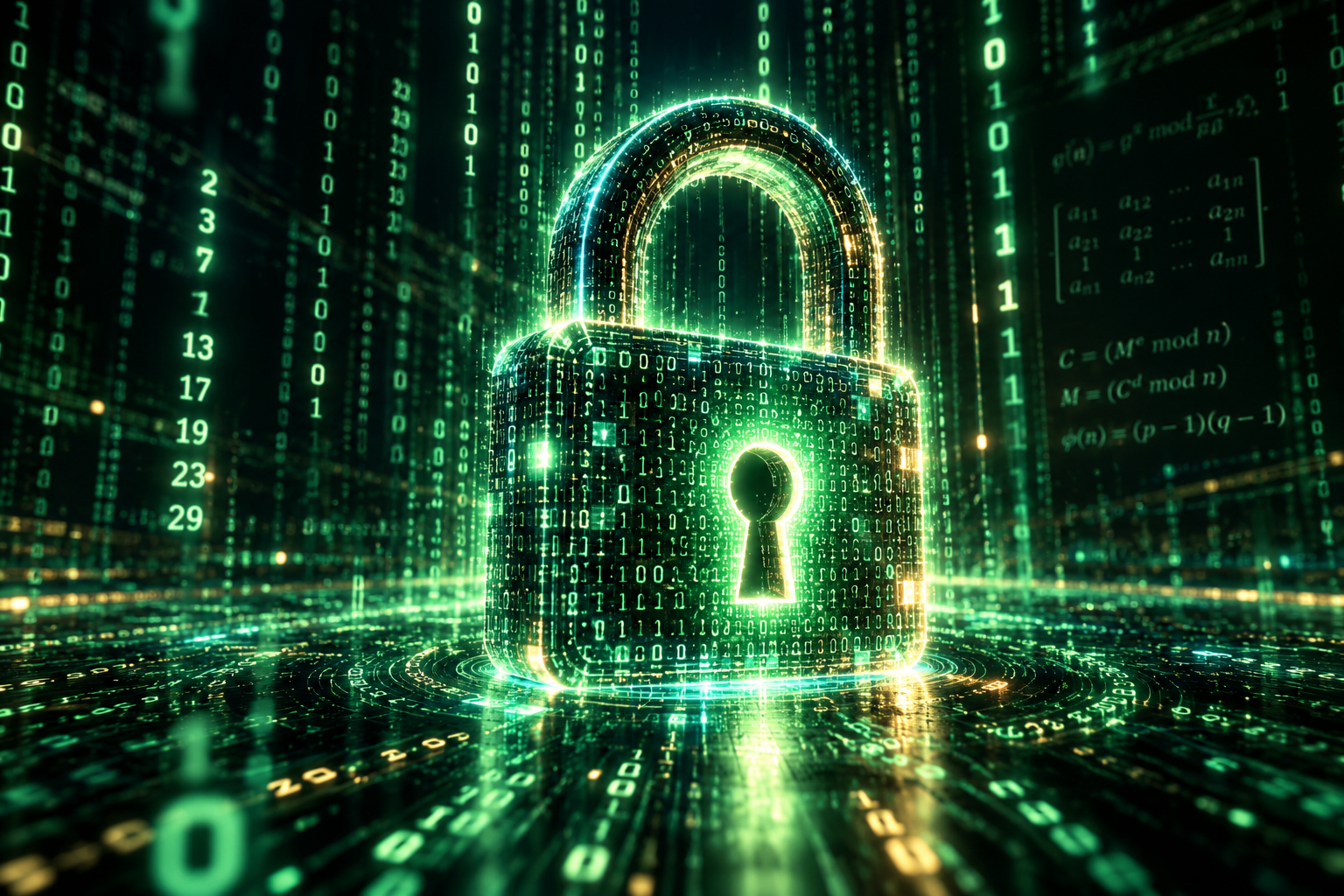
The World Runs on Secret Math
Every time you send a private WhatsApp message, log into your email, or buy something online, your personal information travels across thousands of miles of public copper cables, fiber-optic wires, and wireless radio waves.
Anyone with basic network tools could eavesdrop on that data stream. Yet, your passwords and bank details remain secure. How? Through the science of cryptography-the art of using mathematical locks and keys to scramble readable messages into unbreakable secret codes.
1. The Ancient Era: The Caesar Cipher
One of the earliest recorded ciphers in human history was used by Roman general Julius Caesar around 58 BCE to send confidential military orders across the Roman Empire.
The Caesar Cipher is a simple substitution cipher. To encrypt a message, you take each letter of the alphabet and shift it forward by a fixed number of positions (called the key k):
If we use a shift key of k = +3:
- A becomes D
- B becomes E
- C becomes F ... and Z wraps around to C.
If Caesar wanted to send the message ATTACK AT DAWN, the encrypted ciphertext became DWWDFN DW GDZQ. To decrypt it, the Roman general simply subtracted 3 from each letter.
Why Caesar Ciphers Are Easy to Crack
In English, there are only 25 possible shift keys, so a modern computer (or even a bored student) can test every single key in seconds through a brute-force attack. Furthermore, codebreakers use Frequency Analysis: in the English language, the letter E is the most common letter (appearing ~12.7% of the time), followed by T and A. By counting which letters appear most often in a scrambled text, the cipher key can be decoded effortlessly.
2. Symmetric Key Encryption: The Shared Secret
As computers emerged in the 20th century, ciphers evolved from shifting letters to performing complex binary bit-permutations. The gold standard today is AES (Advanced Encryption Standard), created in 2001 and used by governments, militaries, and banks worldwide.
AES uses Symmetric Encryption, which means the exact same secret key is used both to lock (encrypt) and unlock (decrypt) the file:
- AES-256: Uses a 256-bit key length. That means there are 2^{256} possible key combinations (a number greater than the total number of atoms in the entire observable universe!).
- Even if you combined all the supercomputers on Earth to guess the key, it would take billions of years to crack by brute force.
The Fatal Flaw of Symmetric Keys: The Key Exchange Problem
Symmetric encryption works great if you and your friend already share the secret key. But what if you want to send encrypted data to an Amazon or Google web server that you have never visited before? If you send the secret password over the open internet, a hacker listening in can steal the password and unlock everything!
3. The Public-Key Revolution: Asymmetric Cryptography (RSA)
In 1977, three computer scientists-Ron Rivest, Adi Shamir, and Leonard Adleman-solved this dilemma with Asymmetric Public-Key Cryptography (RSA).
Instead of one shared key, every user has a Key Pair:
- The Public Key: Published openly for anyone in the world to see (like a public padlock or a post office mailbox slot).
- The Private Key: Kept 100% secret on your own personal device (like the physical key that opens the padlock).
The Real-World Padlock Analogy
- You want to receive a secret letter from a friend across the world. You send them an open, unlocked padlock (your Public Key), but you keep the physical key (your Private Key) in your pocket.
- Your friend puts their letter in a box, snaps your open padlock shut, and mails the box. Once snapped shut, even your friend cannot reopen it!
- When the locked box arrives at your house, you use your secret Private Key to unlock the padlock and read the letter.
The One-Way Math of Prime Numbers
How does the computer make a padlock that can only be unlocked with a specific private key? By using one-way mathematical trapdoor functions based on prime numbers:
- Multiplying is easy: If I ask you to multiply two prime numbers: 61 \times 53 = 3,233. A computer can do this in nanoseconds.
- Factoring is brutally hard: If I give you the number 8,616,460,799 and ask you to find the two prime factors (89,681 \times 96,079), it takes massive computational effort.
RSA uses giant prime numbers hundreds of digits long. Creating the public key from the two primes is instantaneous, but calculating the private key from the public number without knowing the prime factors is mathematically impossible for modern supercomputers.
Key Takeaways for Students
- The Caesar Cipher shifts letters along the alphabet, but is vulnerable to frequency analysis and brute force.
- Symmetric encryption (AES-256) uses one key to lock and unlock, making it lightning fast and unbreakable.
- Asymmetric encryption (RSA) uses a Public Key to lock data and a Private Key to unlock it, solving the internet key-sharing problem.
- Modern digital security relies on the mathematical difficulty of factoring giant prime numbers.
Frequently Asked Questions (FAQ)
Q1: What does HTTPS and the padlock icon on a website mean?
A: It means your web browser and the server have negotiated an encrypted TLS/SSL session using public-key cryptography to generate a temporary secure AES session key.
Q2: Can quantum computers break RSA encryption?
A: Yes! A theoretical algorithm called Shor's Algorithm running on a large-scale quantum computer could factor prime numbers in minutes. This is why mathematicians are actively deploying new Post-Quantum Cryptography (PQC) based on lattice mathematics.
Q3: How are passwords stored securely by websites?
A: Websites never store your actual password. They run your password through a one-way mathematical function called a cryptographic hash (such as SHA-256 or bcrypt) and only store the resulting hash output.
The Next Frontier: Quantum Cryptography & QKD
To defend against future quantum computers, physicists have developed Quantum Key Distribution (QKD). QKD uses the fundamental laws of quantum mechanics rather than mathematical difficulty:
- Keys are transmitted using single photons whose quantum spin states represent 0s and 1s.
- According to the Heisenberg Uncertainty Principle, the very act of a hacker observing or measuring a quantum particle alters its state instantly.
- If an eavesdropper intercepts the key, the sender and receiver immediately detect the quantum error and abort the transmission before any secret data is sent!
Vocabulary Bank for Cryptography Students
- Ciphertext: Encrypted text that has been converted from plaintext into unreadable code using an algorithm.
- Brute-Force Attack: A cryptographic attack method that involves systematically trying every possible key combination until the correct one is found.
- Frequency Analysis: The study of the frequency of letters or groups of letters in ciphertext to decipher substitution ciphers.
- Trapdoor Function: A mathematical function that is easy to compute in one direction, but extremely difficult to invert without special secret information.