
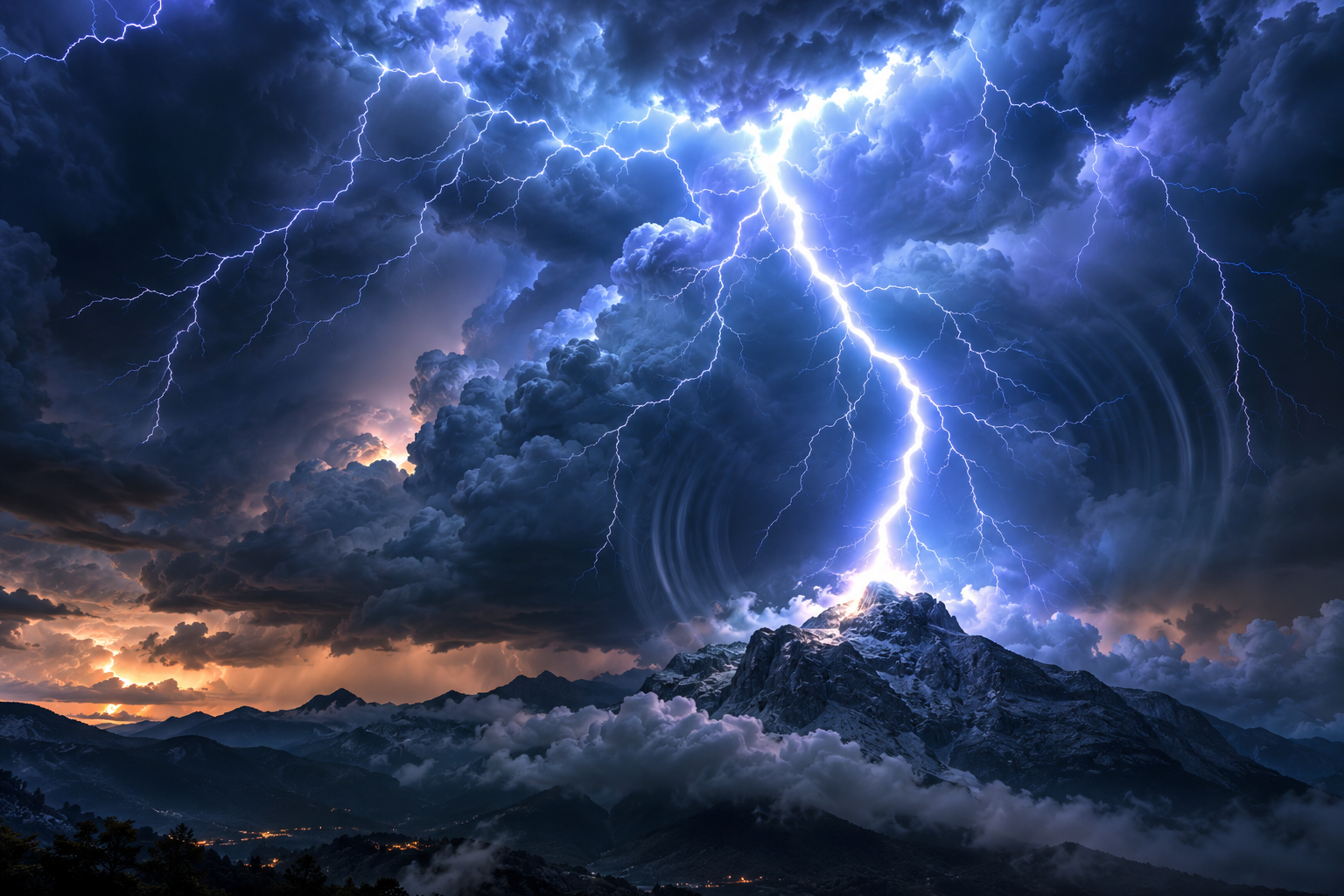
Nature's Most Spectacular Light Show
During a summer storm, a blinding flash of white-blue light tears through the dark sky, illuminating the entire landscape for a fraction of a millisecond. Five seconds later, a deep, rattling roar of thunder shakes the windows of your house.
At any given moment, there are roughly 2,000 active thunderstorms occurring worldwide, producing about 100 lightning strikes every single second (over 8 million strikes per day). What forces turn a fluffy rain cloud into a colossal electrical generator?
Inside the Thundercloud: Building a Massive Static Charge
Lightning begins inside a towering storm cloud known as a cumulonimbus cloud, which can stretch over 12 to 15 kilometers into the atmosphere. The upper part of the cloud is well below freezing (-40°C), while the lower portion contains warm updrafts.
The charging mechanism works through a process called triboelectric charging:
- Updrafts and Downdrafts: Powerful vertical winds blast light ice crystals upward while pulling heavier, soft hail pellets (called graupel) downward.
- Billions of Collisions: As these millions of ice particles collide, electrons are stripped from the rising ice crystals and transferred to the falling graupel.
- Charge Separation:
- The top of the storm cloud becomes heavily positively charged (+).
- The bottom base of the cloud becomes concentrated with massive negative charge (-).
- Ground Induction: Because opposite charges attract and like charges repel, the strong negative charge at the base of the cloud repels electrons on Earth's surface below, creating a powerful shadow of positive charge (+) on trees, buildings, and the ground.
The Anatomy of a Lightning Strike: Step by Step
Air is normally an excellent electrical insulator. But when the electric potential difference between the cloud and the ground exceeds 3 million volts per meter, the air breaks down through dielectric breakdown:
- The Stepped Leader: An invisible stream of negative electrons branches downward from the cloud in discrete 50-meter jumps, traveling at roughly 300,000 km/h.
- The Upward Streamer: As the negative stepped leader approaches the ground (about 50 to 100 meters away), tall objects on the ground (lightning rods, trees, church steeples) shoot an upward channel of positive charge called a streamer.
- The Return Stroke: The instant the downward stepped leader connects with an upward streamer, a complete conductive plasma channel opens. A massive surge of electric current (tens of thousands of amperes) shoots upward to the cloud at nearly one-third the speed of light (100,000 km/s). This brilliant return stroke is the blinding flash our eyes see!
Why Lightning Is 5x Hotter Than the Sun
In less than a thousandth of a second, the electrical current superheats the surrounding air channel to an astonishing 30,000 Kelvin (approx. 53,500°F or 29,700°C).
By comparison, the surface of the Sun sits at about 5,500°C (9,900°F). A lightning bolt is literally five times hotter than the surface of our solar system's star!
Why Does Thunder Make a Loud Boom?
Thunder is not electrical-it is purely acoustic physics. Because the air inside the lightning channel is instantly heated from 20°C to nearly 30,000°C in microseconds, the air molecules expand explosively at supersonic speeds.
This violent, instantaneous expansion creates a high-pressure shockwave that travels outward like an explosion. As the shockwave slows down below the speed of sound, it transforms into the acoustic rumble we hear as thunder.
The 5-Second Rule: How Far Away Is the Storm?
Why do you see the flash of lightning before you hear the boom of thunder?
- Speed of Light: Light travels at approximately 300,000 km/s (186,000 miles/s). You see the lightning flash almost instantaneously.
- Speed of Sound: Sound travels through air at only about 343 m/s (approx. 1 km every 3 seconds or 1 mile every 5 seconds).
How to Calculate: When you see a lightning flash, start counting seconds (1, 2, 3...) until you hear the thunder:
- Every 3 seconds of delay means the lightning struck 1 kilometer away.
- Every 5 seconds of delay means the lightning struck 1 mile away.
- If you hear thunder immediately after the flash, the strike was right on top of you!
Key Takeaways for Students
- Lightning is caused by static electricity generated by billions of colliding ice crystals in storm clouds.
- A lightning channel reaches temperatures near 30,000°C-five times hotter than the Sun's surface.
- Thunder is the supersonic shockwave produced when superheated air violently expands.
- You can calculate the storm's distance in kilometers by dividing the number of seconds between the flash and boom by 3.
Frequently Asked Questions (FAQ)
Q1: Does lightning ever strike the same place twice?
A: Absolutely! The Empire State Building in New York City is struck by lightning an average of 25 times every single year. Tall conductive metal structures provide the easiest path for upward streamers.
Q2: Why are cars safe places to be during a lightning storm?
A: Contrary to popular belief, it is not the rubber tires that protect you! A metal car acts as a Faraday cage, routing the electrical charge harmlessly around the exterior metal shell and into the ground without penetrating the interior cabin.
Q3: What is 'Ball Lightning'?
A: Ball lightning is a rare atmospheric phenomenon where a glowing, floating orb of electrical plasma (ranging from pea-sized to several meters wide) hovers for several seconds during a storm before silently vanishing or popping.
Lightning Safety: The 30-30 Rule Everyone Should Memorize
Meteorologists and emergency responders teach a simple safety protocol known as the 30-30 Rule:
- First 30: When you see lightning, count the seconds until you hear thunder. If the count is 30 seconds or less (meaning the lightning is within 10 km / 6 miles), immediately seek shelter indoors or inside a hard-topped metal vehicle.
- Second 30: After the last clap of thunder is heard, wait at least 30 full minutes before resuming outdoor activities, as trailing storm clouds can still produce deadly "bolts from the blue."
Vocabulary Bank for Meteorology Students
- Cumulonimbus: A dense, towering vertical cloud associated with thunderstorms and heavy atmospheric instability.
- Triboelectric Effect: A type of contact electrification in which certain materials become electrically charged after coming into contact and separating.
- Dielectric Breakdown: The process whereby an insulating material (like air) becomes electrically conductive when exposed to a strong electric field.
- Faraday Cage: An enclosure used to block electromagnetic fields, routing electric currents along the exterior surface.