
The Magic of Unlocking with Your Face
Pick up a modern smartphone, glance at the front screen for a fraction of a second, and the device instantly unlocks. The camera does not just see a random assortment of colors-it instantly knows that it is you, even if you are wearing glasses, standing in low light, or smiling.
How does a computer chip made of silicon and metal understand human faces? The process is a masterpiece of applied mathematics, linear algebra, geometry, and Deep Learning.
The 4 Steps of Facial Recognition
Every facial recognition system-from smartphone Face ID to airport security scanners-processes your face through a streamlined four-step pipeline:
Step 1: Face Detection (Finding Where the Face Is)
Before an algorithm can identify who you are, it first needs to locate where a human face exists within a complex photographic background. Older systems used the Haar Cascade method developed by Viola and Jones, which searches for universal light/dark contrast patterns (for instance, the eye region is usually darker than the upper cheeks, and the bridge of the nose is brighter than its sides).
Modern AI systems use Convolutional Neural Networks (CNNs). The camera slides small mathematical filters across the image pixels to detect edges, curves, contours, and skin textures, isolating the exact bounding box containing a face.
Step 2: Landmark Alignment and Pose Normalization
People rarely look directly into a camera like a flat passport photo; you might be tilting your head, looking down, or turning slightly to the side.
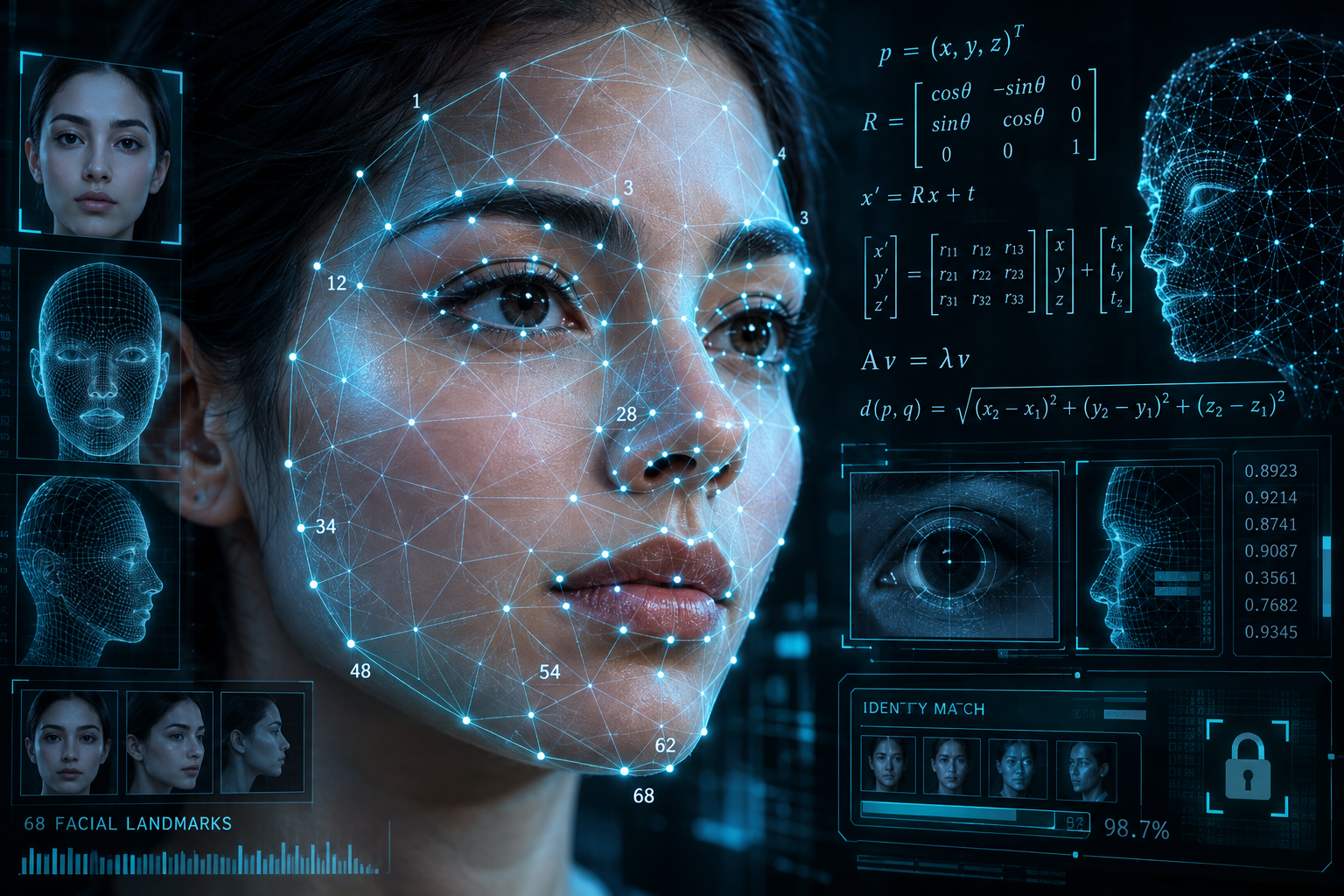
To standardize the face, the algorithm maps out between 68 to 468 precise geometric facial landmarks. These include:
- The exact corners of your left and right eyes.
- The tip and nostrils of your nose.
- The contours of your lips and jawline.
- The outer and inner arches of your eyebrows.
Using affine transformations (matrix rotations, scaling, and shears), the software rotates and stretches the face digitally into a normalized, frontal-facing 2D or 3D coordinate model.
Step 3: Feature Extraction (Generating the Face Vector / Embedding)
This is where the true mathematical magic happens. A computer cannot understand concepts like "curly hair" or "high cheekbones." Instead, it converts your entire facial structure into a long list of numbers called a Facial Embedding (or Feature Vector).
A deep neural network (such as FaceNet or ResNet) compresses the unique geometry, depth ratios, and texture distances of your face into an array of typically 128, 512, or 1024 decimal numbers:
Face Vector = [0.142, -0.891, 0.450, 0.012, ..., -0.638]
These numbers capture abstract spatial relationships: the ratio of the distance between your pupils to the width of your mouth, the angle of your jawline, and the depth of your eye sockets.
Step 4: Vector Comparison (Calculating Distance)
To verify if the face currently looking at the phone is the registered owner, the AI compares the new face vector with the stored master vector using Euclidean Distance or Cosine Similarity in high-dimensional vector space:
- Euclidean Distance Formula: d = \sqrt{\sum_{i=1}^n (x_i - y_i)^2}
- If the calculated mathematical distance d is below a strict threshold (e.g., d < 0.6), the AI concludes with 99.999% mathematical confidence that both vectors represent the exact same human being, and unlocks the device.
2D vs 3D Facial Recognition: Why You Cannot Fool Modern Phones with a Photo
| Technology | How It Works | Vulnerability to Photo Spoofing |
|---|---|---|
| Standard 2D RGB Camera | Analyzes flat color pixel values from standard photo | High; can often be fooled by a high-resolution printed photo or tablet screen |
| 3D Structured Light (e.g. Apple Face ID) | Projects 30,000 invisible infrared dots onto the face to build a 3D depth mesh | Immune to flat photos; requires true physical 3D contour and open eyes |
| Time-of-Flight (ToF) Sensors | Measures the nanosecond time it takes for light pulses to bounce off facial curves | High security; builds millimeter-accurate topographical 3D depth maps |
Key Takeaways for Students
- Facial recognition works in 4 clean steps: Detection \rightarrow Landmark Alignment \rightarrow Vector Extraction \rightarrow Vector Matching.
- AI does not store photos of you; it stores an encrypted mathematical array of 128-512 coordinates (a vector embedding).
- Distances between vectors in multi-dimensional space are calculated using basic Euclidean geometry and linear algebra.
- 3D infrared dot projectors make modern facial recognition immune to simple photographic spoofing.
Frequently Asked Questions (FAQ)
Q1: What happens if I grow a beard or wear heavy makeup?
A: Deep neural networks prioritize skeletal and bone-structure ratios (inter-pupillary distance, nose bridge bone, eye socket depth) which do not change with makeup, facial hair, or natural aging.
Q2: Can identical twins unlock each other's phones?
A: Because identical twins share near-identical facial bone geometry, standard biometric error rates increase for twins, though subtle difference in iris patterns or micro-depth variations can still distinguish them.
Q3: Is your face image sent to cloud servers when unlocking a phone?
A: On modern devices (iOS and Android), facial biometrics are processed 100% locally inside an isolated, encrypted hardware enclave (Secure Enclave or Titan chip) and never leave your phone.
Ethical Considerations & The Future of Biometrics
As facial recognition technology becomes ubiquitous in daily life, computer scientists and ethicists are tackling critical challenges:
- Dataset Bias and Fairness: Early AI training models were trained predominantly on lighter skin tones, leading to higher error rates for diverse populations. Modern computer vision researchers now use mathematically balanced datasets and synthetic generation to ensure equal accuracy across all demographics.
- Privacy and Digital Rights: Unlike passwords, you cannot change your face if a biometric database is compromised. This is why local on-device processing (Edge AI) without cloud transmission is now considered the global privacy gold standard.
Vocabulary Bank for Computer Science Students
- Convolutional Neural Network (CNN): A class of deep neural networks commonly applied to analyzing visual imagery through sliding matrix convolutions.
- Feature Vector / Embedding: A low-dimensional numerical representation of complex high-dimensional data like images or audio.
- Euclidean Distance: The straight-line distance between two points in multidimensional geometric space.
- Biometrics: The measurement and statistical analysis of unique physical and behavioral human characteristics.
Hands-On Computer Vision Experiment: Visualizing Pixels as Numbers
If you want to understand how a computer perceives images, you can try this simple mental or coding exercise:
- Take any small 8x8 black-and-white icon on a computer screen.
- To your eye, it is a recognizable shape like a smiley face or an arrow.
- To the computer's CPU, it is nothing more than a 2D mathematical matrix containing 64 numbers ranging from 0 (pure black) to 255 (pure white).
- When an AI system performs edge detection, it simply subtracts adjacent numbers in the matrix. If two adjacent pixels have values of 10 and 240, the large difference (230) signals the presence of a sharp physical edge!