
For nearly a decade, the progression of modern artificial intelligence followed an ironclad empirical rule known as the Scaling Laws (formulated by researchers at OpenAI and Anthropic). The formula was straightforward: if you want a smarter model, make it larger (increase parameter count), feed it more internet text data (increase token volume), and train it on larger supercomputing clusters for longer periods.
However, by 2024, the tech industry began colliding with the boundaries of traditional pre-training. High-quality human text on the public internet was rapidly being exhausted, compute costs were soaring into hundreds of millions of dollars per training run, and models still suffered from hallucinations and catastrophic failures on complex, multi-step mathematical problems.
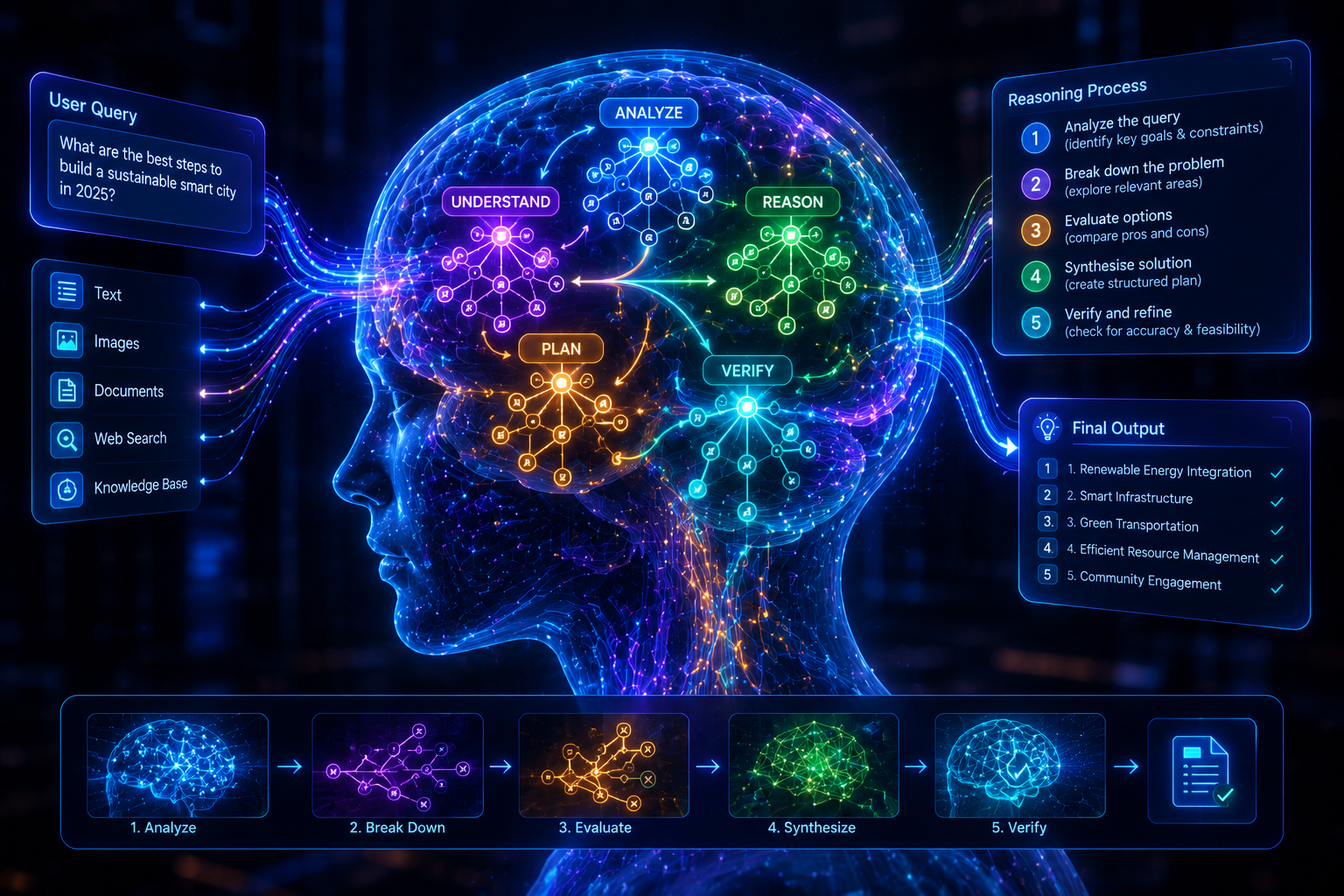
Then came the breakthrough: Inference-Time Reasoning (Thinking Models). Pioneered by architectures like OpenAI's o1/o3 and popularized globally by open-weights innovators like DeepSeek-R1, artificial intelligence has entered a new dimension: giving models the capacity to "think," reflect, and verify their logic before outputting a single word.
The Core Breakthrough: What Is Test-Time Compute?
To understand why reasoning models represent a tectonic leap, consider how traditional large language models (like GPT-4 or standard Llama 3) operate. Traditional LLMs are auto-regressive token predictors: given an input prompt, they immediately generate the statistically most probable next token in milliseconds. They cannot "pause," draft intermediate working steps, or backtrack if they make a false assumption in the middle of a mathematical proof.
Reasoning models flip this paradigm through Test-Time Compute (Inference Scaling):
- Chain-of-Thought (CoT) Hidden Tokens: When presented with a complex prompt, the model generates thousands of internal, non-visible reasoning tokens.
- Hypothesis Exploration: It tests multiple problem-solving approaches in parallel, identifying mathematical contradictions or logical flaws in its own reasoning.
- Self-Correction & Backtracking: If a particular derivation leads to an impossible result, the model recognizes the dead end, backtracks to the point of divergence, and pursues an alternative calculation path.
- Final Synthesis: Only after verifying its internal chain of logic does the model synthesize a clean, precise, and hallucination-free final response to the user.
The Reinforcement Learning Revolution: Moving Beyond Human Demonstrations
Historically, teaching AI models to follow instructions relied heavily on Supervised Fine-Tuning (SFT), where human experts wrote out thousands of ideal answers for the model to mimic. However, human mimicry hits a ceiling: an AI trained purely to imitate human outputs can never significantly surpass the best human tutor.
Reasoning architectures utilize Large-Scale Reinforcement Learning (RL) directly on verifiable domains (such as pure mathematics, algorithmic coding, and formal logic):
- The model is given thousands of complex Olympiad-level problems without human answers.
- It generates diverse reasoning paths through trial and error.
- An automated compiler or mathematical verifier rewards the model only when the final answer is provably correct.
- Over millions of training iterations, the model independently discovers novel heuristics, problem-solving strategies, and cognitive shortcuts that human teachers never explicitly taught it.
The DeepSeek-R1 Moment: Democratizing Frontier Reasoning
The release of DeepSeek-R1 sent shockwaves through the global technology sector not merely because its reasoning benchmark performance rivaled proprietary closed-source models, but because of its radical architectural efficiency:
- Pure RL Bootstrapping (R1-Zero): Proving that complex reasoning behaviors emerge naturally through reinforcement learning without requiring expensive human-annotated datasets.
- Mixture-of-Experts (MoE) Architecture: Activating only a small subset of parameters (e.g., ~37 billion active out of 671 billion total) per token, slashing computational inference costs by up to 90%.
- Distillation to Smaller Models: Distilling the reasoning traces of large models into compact 1.5B, 7B, 8B, and 14B models, allowing high-level reasoning to execute locally on everyday consumer laptops and smartphones.
Real-World Impact: What Reasoning Models Unlock for Society
1. Competitive Mathematics & Scientific Proofs
Reasoning models regularly score in the 99th percentile on the American Invitational Mathematics Examination (AIME) and achieve gold-medal equivalent scores in the International Mathematical Olympiad (IMO), assisting researchers in verifying complex theoretical conjectures.
2. Zero-Defect Software Development
Software development is inherently brittle; a single logic bug or missing semicolon breaks an entire system. Reasoning models evaluate edge cases, memory leaks, and concurrency race conditions before generating complete software modules.
3. Accelerated Scientific Research
From analyzing genomic sequences to designing chemical synthesis routes, reasoning models can evaluate multi-variable scientific hypotheses, cross-referencing published literature to eliminate dead ends before physical laboratory trials begin.
The Next Horizon: Where Does AI Go From Here?
The emergence of test-time compute proves that artificial intelligence scaling is far from dead-it has simply shifted from the pre-training axis to the inference and reasoning axis. As models learn to allocate seconds, minutes, or even days of computational reflection to grand scientific questions, we are witnessing the emergence of true cognitive problem-solving partners for humanity.
Architectural Comparison: Standard LLMs vs. Reasoning Models
| Dimension | Standard Auto-Regressive LLMs | Test-Time Reasoning Models |
|---|---|---|
| Primary Scaling Axis | Pre-training compute & token volume | Inference-time / Test-time reflection tokens |
| Cognitive Approach | Instantaneous next-token prediction | Branching exploration, self-critique & backtracking |
| Math & Coding Performance | High error rate on novel multi-step proofs | Olympiad gold-medal level accuracy |
| Training Paradigm | Supervised Fine-Tuning (human imitation) | Large-scale Reinforcement Learning on verifiable tasks |
Frequently Asked Questions (FAQ)
1. Does 'thinking time' make AI slower for everyday tasks?
For simple conversational queries (e.g., writing an email), reasoning tokens add unnecessary latency. Modern hybrid systems dynamically route easy tasks to fast token generators and reserve test-time compute for complex math, science, and coding.
2. Why is Reinforcement Learning better than Human Feedback (RLHF)?
Human raters can be fooled by eloquent-sounding, incorrect answers. Pure RL with programmatic rule verifiers (compilers and math kernels) rewards only objectively true proofs, unlocking superhuman problem-solving ability.
The Economics of Inference Compute: Why Reasoning Slashing Total AI Costs
While allocating 30 seconds of test-time thinking compute to a single query costs slightly more than a standard 1-second auto-regressive response, the total economic value is substantially higher. In high-stakes enterprise applications-such as legal compliance auditing, medical triage, and mission-critical software debugging-a single undetected hallucination can cost hundreds of thousands of dollars in damages. By spending pennies on test-time reflection to guarantee logical correctness, enterprises eliminate downstream human verification costs and achieve orders-of-magnitude higher return on investment (ROI).
Future Paradigm: Asynchronous Deep Thinking Models
AI research labs are now developing asynchronous reasoning engines capable of spending hours or days exploring open scientific questions-such as finding new superconductor materials or proving long-standing open mathematical conjectures-operating like dedicated, round-the-clock digital research scientists.