
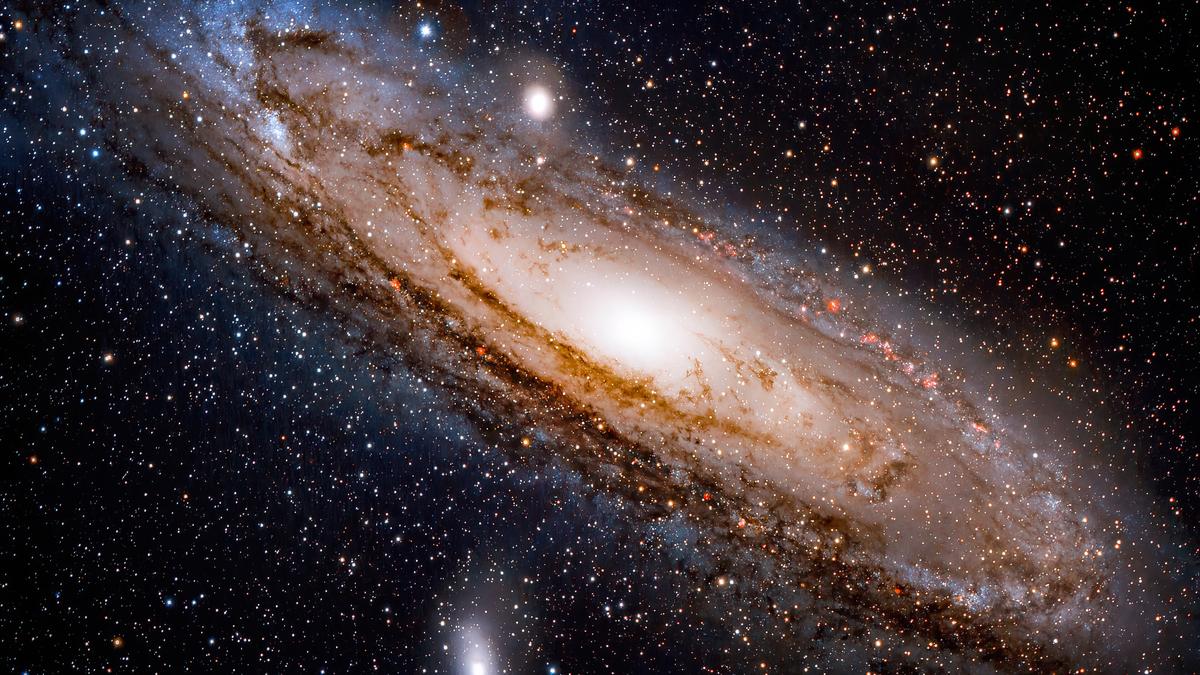
Andromeda Galaxy Entering ‘Middle Age’: A New Chapter in Cosmic Evolution
The Andromeda Galaxy, the closest large galaxy to our own Milky Way, appears to have entered what astronomers describe as its "middle age." This fascinating development provides scientists with valuable insights into how galaxies evolve over billions of years.
Located approximately 2.5 million light-years from Earth, Andromeda has long been one of the most studied galaxies in the universe. With advanced space telescopes and detailed observations, researchers have found evidence that its intense period of star formation has slowed compared to its younger years.
What Does "Middle Age" Mean for a Galaxy?
Unlike humans, galaxies do not age over decades—they evolve over billions of years.
When astronomers say Andromeda is entering middle age, they mean:
- The galaxy is producing fewer new stars than during its youthful phase.
- Much of its available gas has already been converted into stars.
- Its structure has become more stable and well-defined.
- Stellar populations are gradually becoming older.
This stage is a natural part of a galaxy's life cycle and does not indicate that Andromeda is nearing the end of its existence.
A Future Collision with the Milky Way
One of the most fascinating facts about Andromeda is its future encounter with our own galaxy.
Scientists estimate that the Milky Way and Andromeda will begin interacting in roughly 4 to 5 billion years. Rather than a catastrophic crash, the event will be a slow gravitational merger lasting billions of years.
Because the distances between individual stars are so vast, direct star-to-star collisions are expected to be extremely rare. Instead, the two galaxies will gradually merge into one much larger galaxy.
Why This Discovery Matters
Understanding Andromeda's current stage helps astronomers answer important questions about:
- How galaxies form and evolve.
- Why star formation slows over time.
- The role of dark matter in shaping galaxies.
- The long-term future of the Milky Way.
Since Andromeda is our nearest large galactic neighbour, it serves as an ideal laboratory for studying processes that are difficult to observe in more distant galaxies.
Looking Ahead
Future observations from next-generation telescopes are expected to reveal even more about Andromeda's history, including its past mergers with smaller galaxies and the evolution of its central black hole.
Each new discovery brings scientists one step closer to understanding the life cycle of galaxies across the universe.
Final Thoughts
The idea that the Andromeda Galaxy is entering its middle age reminds us that the universe is constantly changing—even on timescales far beyond human imagination. While humanity will never witness the eventual merger between Andromeda and the Milky Way, studying our galactic neighbour today offers an extraordinary glimpse into the future of our own cosmic home.
Frequently Asked Questions
Q: How far away is the Andromeda Galaxy?
Approximately 2.5 million light-years from Earth.
Q: Will the Milky Way collide with Andromeda?
Yes. Scientists predict the two galaxies will merge in about 4–5 billion years.
Q: What does "middle age" mean for a galaxy?
It refers to a stage where star formation slows and the galaxy becomes more mature and stable.
Q: Is Earth in danger?
No. The merger is billions of years away, and direct collisions between stars are considered highly unlikely.