
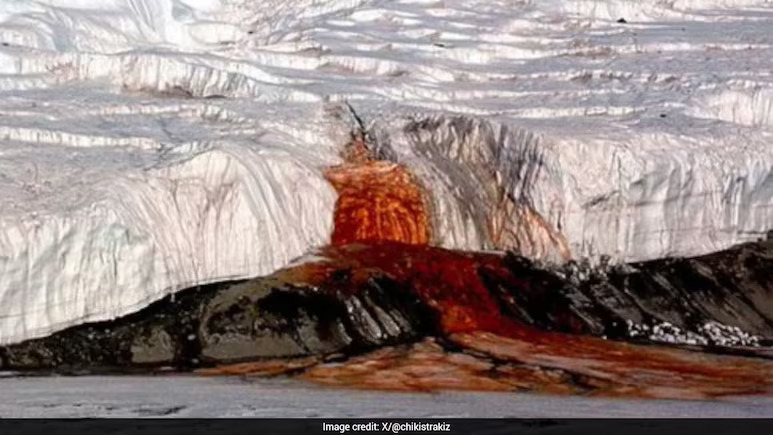
Scientists have made an exciting discovery at Antarctica's famous Blood Falls, a natural red-colored waterfall that flows from Taylor Glacier into a frozen lake in the McMurdo Dry Valleys. A new study, published in Nature Geoscience on August 3, has revealed that the unusual red water is home to tiny marine microorganisms that have survived in one of Earth's harshest environments.
Millions of years ago, rising glaciers trapped a body of seawater beneath Taylor Glacier. Over time, the water became extremely salty, rich in iron, and completely cut off from sunlight, oxygen, and fresh water. The high iron content gives Blood Falls its striking crimson-red color.
Researchers found that the trapped brine contains a unique group of microscopic marine organisms, including algae and other single-celled life forms. These microbes have adapted to survive in complete darkness and freezing temperatures for thousands of years, showing an incredible ability to live in extreme conditions.
Marine biologist Andrew Allen from the Scripps Institution of Oceanography said the Antarctic landscape appears almost lifeless at first glance, with no plants or large animals. However, the discovery proves that hidden microbial ecosystems can exist even in places that seem completely barren.
Scientists believe these ancient microbes likely originated when seawater was trapped beneath the glacier millions of years ago, rather than being carried there by wind. Periodic flows of salty water from beneath the glacier have helped these microorganisms continue to survive.
The researchers say the findings preserve evidence of Antarctica's ancient marine environment and provide valuable clues about past climate changes. The discovery also strengthens the possibility that life could exist in similar extreme environments beyond Earth.
Astrobiologists believe Blood Falls is an important natural model for studying the potential for life beneath the icy surfaces of moons such as Europa, which orbits Jupiter, and Enceladus, one of Saturn's moons. If microorganisms can survive beneath Antarctica's glaciers, similar life could also exist in hidden oceans elsewhere in our Solar System.