
Between 2022 and 2024, generative artificial intelligence captivated the global consciousness through conversational chatbots. We marvelled at large language models (LLMs) that could draft poems, summarize dense PDFs, and generate workable snippets of software code in response to single text prompts. Yet, for all their fluency, early chatbots possessed a fundamental limitation: they were completely passive, stateless, and reactive. They could only generate text when directly prompted, possessed no memory of past execution failures, and had no native ability to interact directly with the software tools that run our digital economy.
Today, the computing landscape is witnessing a monumental paradigm shift from simple conversational assistants to Agentic AI-autonomous, goal-driven computational entities capable of reasoning over complex problems, breaking down objectives into logical milestones, executing actions across external software environments, and self-correcting mistakes in real time.
What Exactly Is Agentic AI?
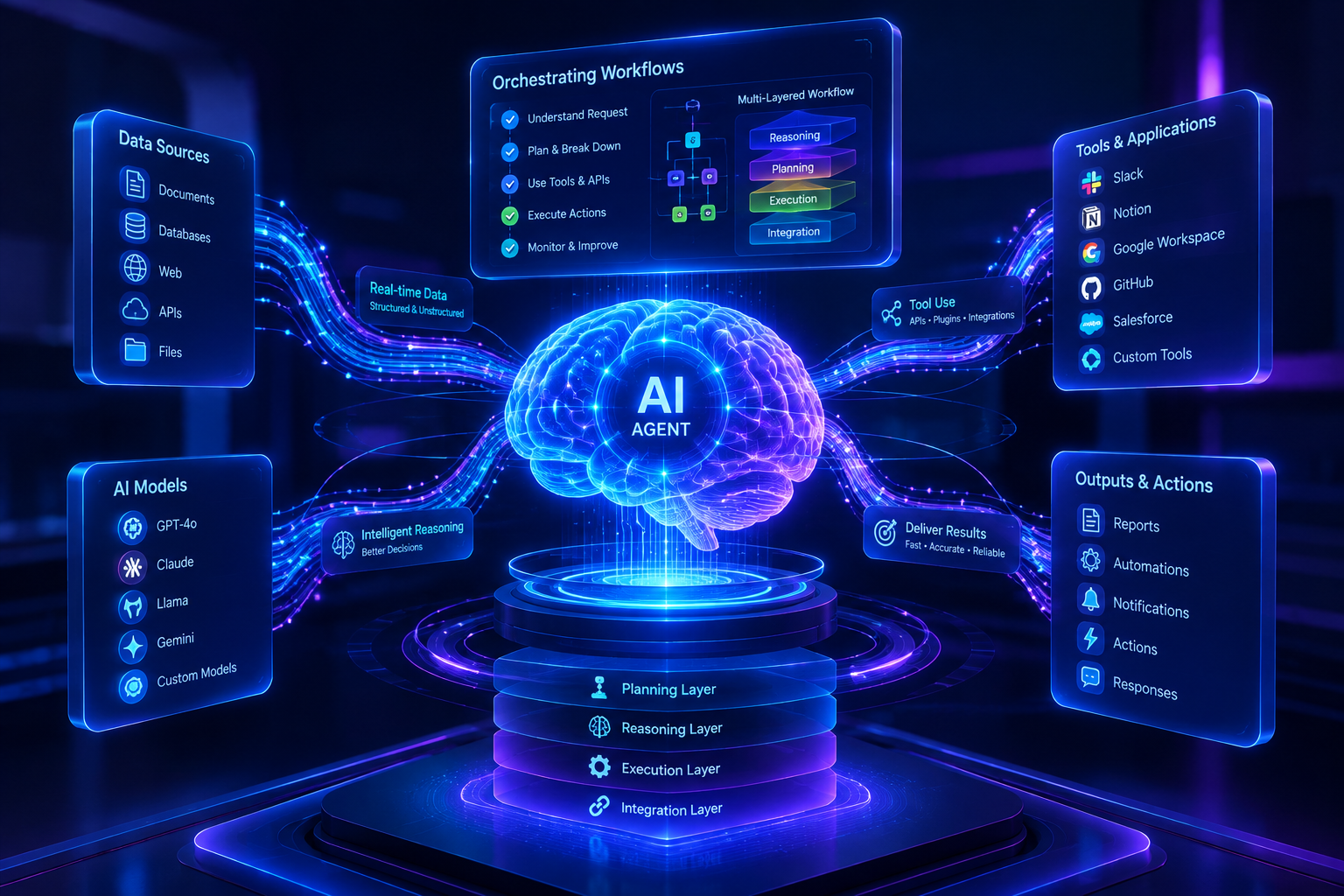
At its core, an AI Agent is not merely an LLM; it is an autonomous software system that uses a large reasoning model as its central decision-making engine ('the brain') surrounded by specialized auxiliary modules that grant it perception, memory, tool access, and environmental agency.
While a conventional chatbot requires continuous human guidance at every step (prompting, evaluating the output, correcting mistakes, and copying code into an editor), an agent is given an overarching, high-level outcome (for example: "Audit our quarterly financial balance sheet, identify risk factors, generate comparison graphs against industry competitors, and email a synthesized PDF report to the board") and independently plans, executes, and verifies the entire workflow from start to finish.
The Four Architectural Pillars of an AI Agent
Modern autonomous agent frameworks-such as LangGraph, AutoGen, and CrewAI-rely on four interconnected architectural components:
1. Goal Decomposition & Strategic Planning
When confronted with an open-ended objective, an agent does not rush into immediate execution. Instead, it employs advanced cognitive frameworks such as Tree-of-Thoughts (ToT), ReAct (Reason + Act), or Plan-and-Solve. It decomposes the overarching goal into a structured dependency tree of smaller, verifiable subtasks, forecasting potential roadblocks and dependencies before taking its first action.
2. Dual Memory Architecture (Short-Term & Long-Term)
- Short-Term Memory (In-Context Working Memory): Tracks active task parameters, recent tool execution logs, intermediate calculation results, and current execution states within the model's active attention window.
- Long-Term Memory (Vector Databases & Knowledge Graphs): Stores and retrieves historical domain knowledge, user preferences, past execution trajectories, and organizational policies using semantic vector embeddings (RAG) and graph databases. This allows an agent to "remember" how it solved similar problems weeks or months earlier.
3. Tool Invocation & Environmental Grounding
Unlike isolated text models, agents possess digital "hands." Through standardized API schemas and Function Calling protocols, agents can:
- Browse live web pages, click interactive buttons, submit web forms, and parse dynamic DOM elements using headless browser engines.
- Write and execute sandboxed Python, JavaScript, and SQL code in isolated container environments to perform mathematical computations and statistical modeling.
- Interact directly with local operating systems, manipulating file systems, creating directories, and running terminal commands.
4. Self-Reflection and Error Correction
When an agent runs a script that produces a runtime error or queries an API endpoint that yields empty results, it does not freeze or ask the user for help. Instead, it reads the error stack trace, diagnoses the root cause, revises its hypothesis, and executes an alternative approach-mirroring the tenacity and iterative debugging of human problem solvers.
Real-World Industry Case Studies
1. Autonomous Software Engineering (SWE Agents)
Modern software engineering agents (such as Devin and GitHub Copilot Workspace) do not just autocomplete single lines of code. They ingest entire multi-gigabyte GitHub repositories, reproduce bug tickets in local unit test environments, locate faulty functions across dozens of disparate files, write and verify patches, ensure all unit tests pass, and submit clean Pull Requests complete with documentation.
2. Automated Scientific Research and Drug Discovery
In biochemistry and materials science, autonomous multi-agent networks collaborate to accelerate research. One agent generates molecular hypotheses, another queries biochemical databases (like AlphaFold and ChEMBL), a third runs molecular dynamics simulations, and a fourth directs robotic liquid-handling lab equipment to synthesize physical compounds in wet labs without human intervention.
3. Financial Auditing and High-Frequency Market Research
Financial firms deploy agent swarms to monitor real-time SEC filings, earnings calls, news feeds, and supply chain trade databases. When an anomaly or investment opportunity is detected, the agent autonomously aggregates data, models discount cash flows, evaluates risk exposure, and generates executive briefings in seconds.
Comparison: Traditional LLM vs. Agentic AI
| Feature | Traditional Chatbot / LLM | Agentic AI System |
|---|---|---|
| Operating Mode | Passive & Reactive (Wait for prompt) | Proactive & Autonomous (Goal-driven) |
| Execution Scope | Single-turn text generation | Multi-step planning and tool execution |
| Tool Access | None (Generates text only) | Browsers, APIs, Shells, Compilers, DBs |
| Error Handling | Hallucinates or outputs broken code | Self-debugs, reflects, and retries |
| State / Memory | Transient session context | Persistent vector & episodic memory |
Ethical Challenges, Security Risks, and Safety Guardrails
The transition to autonomous agents introduces critical technological and societal challenges:
- Prompt Injection & Privilege Escalation: Malicious actors can embed hidden instructions in web pages or documents designed to hijack an agent's tool access-tricking an agent into leaking private database keys or deleting critical server files.
- The Recursive Cost Spiral: An agent caught in an infinite self-correction loop can execute thousands of high-cost API calls in minutes, leading to unexpected cloud computing bills.
- Human-in-the-Loop (HITL) Governance: High-stakes actions-such as initiating wire transfers, deploying code to production servers, or modifying database schemas-must require explicit human verification and cryptographic sign-off.
The Future: From Multi-Agent Swarms to Organizational Intelligence
The next frontier of Agentic AI is the emergence of Multi-Agent Swarms, where specialized agents (e.g., Project Manager, Coder, QA Tester, Legal Auditor) collaborate dynamically, negotiating tasks, critiquing each other's work, and achieving complex milestones that exceed the capability of any single model.
Agentic AI does not represent the obsolescence of human talent; rather, it elevates human workers from repetitive manual execution to strategic orchestration. By delegating complex procedural burdens to autonomous digital agents, humanity unlocks unprecedented velocity across science, engineering, and enterprise innovation.