
The Ultimate Cold: What Is Absolute Zero?
Imagine standing outside on a freezing winter day. The air bites your cheeks, water freezes into solid ice, and your breath condenses into billowing clouds. But no matter how cold winter gets on Earth, it is nowhere close to the physical limits of temperature. In physics, there is an absolute basement to coldness—a precise point where thermal energy reaches its theoretical minimum. That point is known as Absolute Zero, defined as 0 Kelvin, -273.15° Celsius, or -459.67° Fahrenheit.
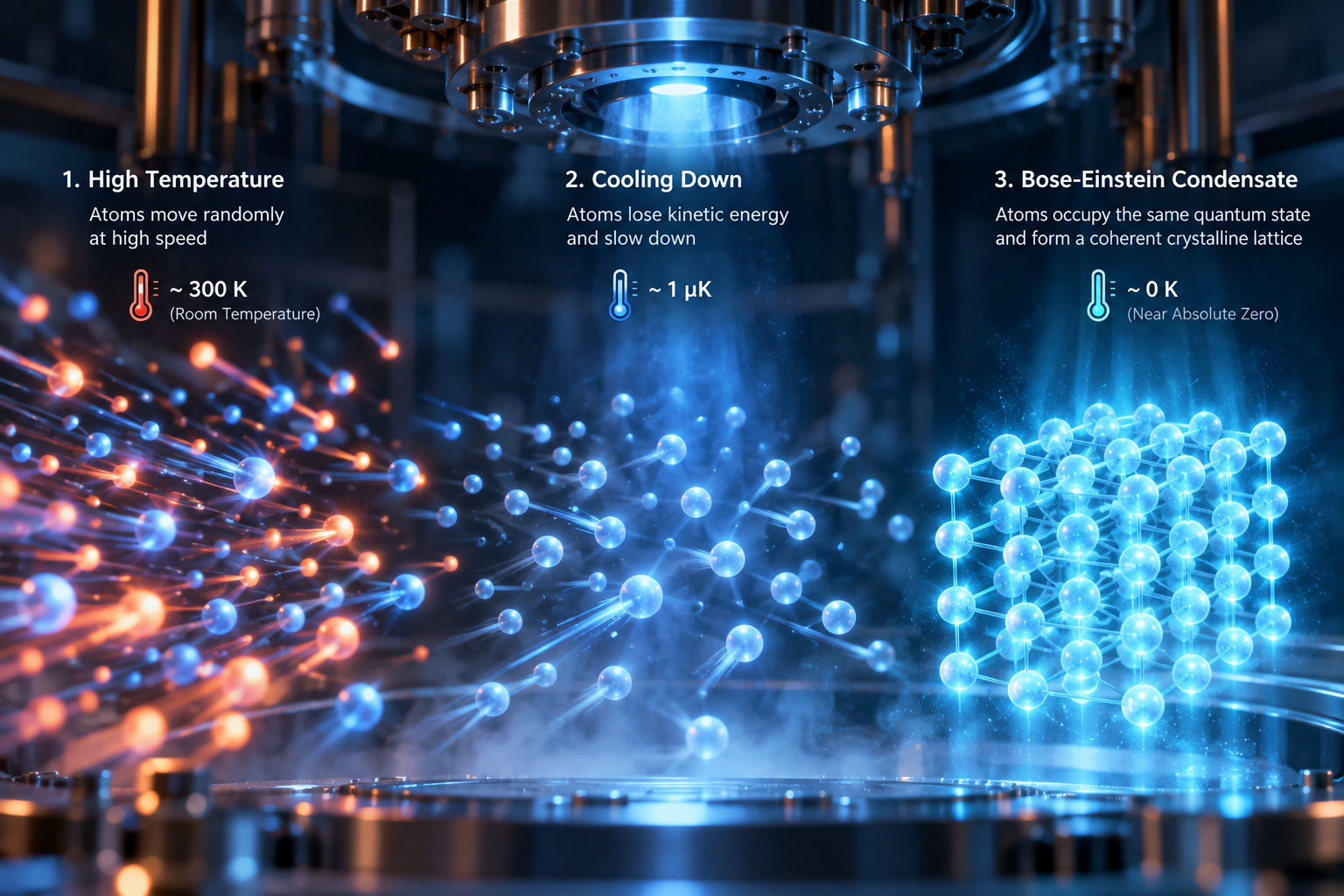
To truly understand why absolute zero exists, we must first change how we think about heat. When you touch a hot mug of cocoa, what your skin actually detects is microscopic movement. Temperature is not an invisible liquid or mystical force; it is simply a direct measurement of the average kinetic energy of atoms and molecules. In hot air, molecules zip around at over 1,800 kilometers per hour, violently bouncing off walls and colliding with one another. As a substance cools down, its atoms lose kinetic energy and slow down. Following this logic to its ultimate conclusion: what happens if you cool matter so much that all atomic motion stops entirely? That theoretical stopping point is absolute zero.
The Feynman Analogy: The Restless Classroom
The legendary physicist Richard Feynman loved to explain complex thermal dynamics using everyday human behavior. Imagine a classroom packed with thirty energetic kindergarten children during recess. When the children are hyperactive, running around in all directions, shouting, and bouncing off desks, the room has high "temperature." As the teacher asks them to calm down, they slow from running to walking, then to sitting in their chairs, merely wiggling their feet and hands.
Absolute zero is like asking every single child to freeze into a statue, holding their breath, with zero eye movement, zero heartbeat, and zero fidgeting. But in nature, just like in that classroom, achieving 100% total stillness is physically impossible because of the fundamental rules of quantum mechanics!
The Third Law of Thermodynamics: The Unreachable Horizon
One of the foundational principles of physics is the Third Law of Thermodynamics, formulated by German chemist Walther Nernst. It states that as the temperature of a system approaches absolute zero, the entropy (disorder) of the system approaches a constant minimum, but absolute zero cannot be achieved in a finite number of thermodynamic steps.
Why can you never actually reach 0 Kelvin? Consider how refrigeration works. To make something colder, you must transfer its heat to an even colder substance. To cool an object to 1 Kelvin, you need an environment colder than 1 Kelvin. But what could you possibly use to cool something from 0.000001 Kelvin to 0 Kelvin? There is nothing in the universe colder than absolute zero! Every time you pump out heat, the remaining heat becomes exponentially harder to extract. Trying to reach absolute zero is like trying to reach the physical horizon: no matter how far you walk, the horizon recedes into the distance.
Quantum Mechanics Says: Total Rest Is Forbidden!
Even if you could somehow isolate an atom completely from all outside heat, quantum physics introduces an inescapable speed bump: Werner Heisenberg's famous Uncertainty Principle (Δx · Δp ≥ ℏ / 2).
The Uncertainty Principle dictates that you cannot simultaneously know both the exact position and the exact momentum of a subatomic particle. If an atom were to come to a completely dead stop at absolute zero, its momentum would be exactly zero (Δp = 0). But that would mean you could measure its momentum with 100% precision, which quantum mechanics strictly forbids! Therefore, even at the lowest conceivable energy state, subatomic particles must maintain a residual tremor known as Zero-Point Energy. Matter never truly stands still; it hums with quantum vacuum fluctuations.
Comparison: Extreme Temperatures Across the Universe
| Location / Phenomenon | Temperature (°C) | Temperature (Kelvin) | Physical State & Significance |
|---|---|---|---|
| Core of the Sun | +15,000,000°C | ~15,000,273 K | Thermonuclear fusion plasma converting hydrogen to helium |
| Surface of the Earth (Average) | +15°C | 288.15 K | Liquid water oceans, active biology and weather |
| Coldest Temperature Recorded on Earth (Antarctica) | -89.2°C | 183.95 K | Vostok Station in 1983; ambient atmospheric chill |
| Surface of Pluto (Average) | -230°C | 43.15 K | Nitrogen and methane ice glaciers |
| Cosmic Microwave Background (Deep Space) | -270.42°C | 2.73 K | Residual thermal radiation left over from the Big Bang |
| Boomerang Nebula (Coldest Natural Place Known) | -272.15°C | 1.0 K | Rapidly expanding gas cloud cooling via adiabatic expansion |
| Cold Atom Lab aboard the ISS (Human-Made) | -273.1499999999°C | ~100 picoKelvin | Bose-Einstein condensates created using magnetic traps and lasers |
| Absolute Zero (Theoretical Limit) | -273.15°C | 0.00 K | Zero thermal kinetic energy; quantum zero-point ground state |
The Fifth State of Matter: Bose-Einstein Condensates (BEC)
When you cool matter within billionths of a degree above absolute zero, something extraordinary happens. In the 1920s, Indian physicist Satyendra Nath Bose and Albert Einstein predicted that at near-zero temperatures, individual atoms would lose their distinct identities and merge into a single macroscopic quantum object. In 1995, physicists Eric Cornell and Carl Wieman finally proved this in the laboratory using rubidium atoms, winning the Nobel Prize in Physics.
Normally, atoms act like tiny billiard balls bouncing around independently. But in a Bose-Einstein Condensate (BEC), their quantum wavelengths stretch out until they overlap completely. Millions of individual atoms synchronize their wavefunctions and behave like one giant "super-atom." Light shining through a Bose-Einstein condensate can be slowed from its cosmic speed of 300,000 km/s down to a human bicycle speed of just 17 meters per second—or even frozen completely in place!
Real-World Technologies Powered by Ultra-Cold Physics
- Superconducting MRI Machines: Hospital magnetic resonance imaging scanners use liquid helium cooled to 4 Kelvin (-269°C) to keep superconducting electromagnet coils at zero electrical resistance, generating intense magnetic fields for medical imaging.
- Superconducting Quantum Computers: Processors built by IBM and Google use dilution refrigerators operating at 15 milliKelvin (colder than deep interstellar space) to maintain fragile quantum superposition states in qubits.
- Ultra-Precise Atomic Clocks: Optical lattice clocks use laser-cooled strontium atoms near absolute zero to measure time so precisely that they will not gain or lose a single second over 30 billion years.
- Superfluidity: Liquid helium cooled below 2.17 Kelvin loses all viscosity entirely. It climbs up container walls, flows through micro-pores without resistance, and creates perpetual friction-free whirlpools.
Vocabulary Bank for Physics Students
- Absolute Zero: The lowest possible temperature, where a thermodynamic system has the lowest conceivable thermal energy, equivalent to 0 K or -273.15°C.
- Kinetic Energy: The energy an object or particle possesses by virtue of its motion. In thermodynamics, thermal energy is the sum of microscopic kinetic energies.
- Entropy: A quantitative measure of the randomness, disorder, or multiplicity of microstates in a closed thermodynamic system.
- Bose-Einstein Condensate (BEC): A state of matter of a dilute gas of bosons cooled to temperatures very close to absolute zero, causing microscopic quantum phenomena to manifest macroscopically.
- Zero-Point Energy: The lowest possible quantum mechanical physical energy that a quantum system may have; the energy of its ground state.
- Superconductivity: A phenomenon occurring in certain materials below a critical temperature, characterized by zero electrical resistance and the expulsion of magnetic fields.
Frequently Asked Questions (FAQ)
Q1: Why is absolute zero exactly -273.15°C and not some other round number?
A: The Celsius scale was originally defined around water: 0°C was set as water's freezing point, and 100°C as its boiling point. When 18th-century scientists like Jacques Charles observed that gases shrink linearly by 1/273.15th of their volume for every 1°C drop in temperature, extending that straight line to zero volume naturally pointed to -273.15°C.
Q2: Is deep space at absolute zero?
A: No! Even the emptiest interstellar void between galaxies is warmed to approximately 2.73 Kelvin (-270.42°C) by the Cosmic Microwave Background radiation, the lingering thermal echo of the Big Bang.
Q3: Can we have negative temperatures below absolute zero?
A: In very specific laboratory setups with restricted atomic energy levels (called population inversions in quantum lasers), physicists have created mathematical "negative Kelvin" states. However, these systems are actually hotter than infinite positive temperature because they readily dump energy into any normal system they touch!
Q4: Why can't human bodies be cryogenically frozen at absolute zero and revived?
A: Human bodies are 60% water. When water freezes slowly, it forms jagged, razor-sharp ice crystals that shred cell membranes and rupture blood vessels like microscopic daggers. Advanced cryoprotectant chemicals can vitrify cells into glass-like states, but rewarming biological tissue without cellular damage remains an unsolved bioengineering challenge.